
If your question is “are paper towels recyclable,” the answer is usually no. Most curbside recycling programs exclude paper towels, whether the sheets are used or unused. Used sheets normally belong in the trash unless your compost program specifically accepts them.
Paper towels often have short fibers, wet-strength treatments, moisture, food residue, grease, cleaning products, or other contamination. A clean cardboard paper towel tube may be recyclable separately, while plastic wrapping depends on local film-recycling rules. Because collection systems differ, confirm the accepted-material list published by your city, county, hauler, workplace, or compost facility before choosing a bin.
Key takeaways
- Most household recycling programs exclude paper towels, whether the sheets are used or unused.
- Food, grease, chemicals, and moisture make used paper towels unsuitable for paper recycling.
- Plain paper towels may be compostable when the local program accepts them and the absorbed material is compost-safe.
- Clean cardboard tubes are commonly handled separately from the paper towels and may be recyclable.
- Your local accepted-material list is the final authority because recycling and composting systems vary.
Why Paper Towels Are Not Recyclable
Paper towels are usually not recyclable because a recycling facility evaluates how the material behaves in a pulping and cleaning system, not how it looks in your hand. Office paper, newspaper, and many cardboard products contain fibers that can be separated, screened, and formed into another paper product. Paper towels are designed for a different job. They must absorb liquid quickly and remain usable long enough for wiping, drying, or cleaning. Many paper towels also contain a high proportion of already-recycled fibers, which become shorter each time paper is processed.
Short fibers have less value for another recycling cycle because they do not bond as effectively in a new sheet. Wet-strength performance can further complicate repulping, while embossing, lotions, printing, fragrances, and other product features may change how a particular sheet behaves. These factors do not mean that every paper towel has the same formula. They explain why collection programs usually manage paper towels as a category rather than asking households to identify fiber length, additives, or production method at the bin.
When you are deciding whether a paper product belongs in recycling, check the material in this order:
- Identify the product: Separate paper towels, napkins, tissues, office paper, cardboard, and paperboard instead of treating them as one category.
- Check the condition: Look for water, food, grease, chemicals, ink, bodily fluids, or other contamination that can affect the collection route.
- Read the local list: Confirm that the exact product is accepted by the service that collects your bin, not merely by a recycling facility in another area.
The most practical rule is to follow the local program list. The U.S. Environmental Protection Agency advises residents to confirm which materials their community accepts because recycling systems and markets differ. Its guidance on recycling common household materials also emphasizes keeping recyclables clean and dry. Paper towels conflict with that requirement as soon as they are used to absorb a spill or wipe a surface.
| Factor | Paper towels | Common recyclable paper | Recycling effect |
|---|---|---|---|
| Fiber condition | Often short or previously recycled fibers | May contain longer fibers with further recycling value | Very short fibers may not form a useful new sheet. |
| Performance design | Absorbency and strength during wet use | Printing, writing, packaging, or structural use | Wet-strength behavior can make repulping less suitable. |
| Condition at disposal | Frequently wet, soiled, or chemically contaminated | Expected to be empty, clean, and dry | Contamination can reduce the quality of an entire paper load. |
| Collection category | Usually excluded | Accepted when listed by the local program | The local list determines the correct bin. |
Clean and Unused Paper Towels
Clean and unused paper towels are still usually not recyclable, even when they are white, unprinted, and free from food or cleaning chemicals. A recycling program must have a process and market for the fiber category it collects. Many programs exclude tissues, napkins, and paper towels because of their short fibers and product construction, even before contamination becomes an issue. Placing an unaccepted clean sheet in the recycling bin is still wish-cycling.
If a roll becomes damaged in storage, first consider whether the clean sheets can still serve a lower-risk use. You might use them for wiping water, protecting a work surface, packing a fragile item, or absorbing moisture in a non-food setting. Reuse is reasonable only when the paper towels remain sanitary for that purpose. Sheets exposed to pests, flooding, sewage, mold, unknown chemicals, or a product recall should not be redirected to household use merely to avoid disposal.
Color does not settle the question. Brown paper towels may contain recycled fiber, while white paper towels may use virgin fiber, recycled fiber, or a blend. Neither appearance proves that your curbside system accepts the finished product. Recycled content describes what went into the paper towels; recyclability describes whether a particular collection and processing system can turn the discarded product into another useful material. Those are related but different claims.
Used Paper Towels
Used paper towels should not go in paper recycling. A sheet used for cooking oil, meat juices, paint, disinfectant, glass cleaner, bathroom cleaning, personal hygiene, or pet waste carries material that a paper mill does not want mixed with clean recovered fiber. Moisture can also encourage odor and microbial growth during collection. Even a paper towel used only with water is normally excluded if the program does not accept the product category.
These common uses should send the sheet away from paper recycling immediately:
- Kitchen cleanup: Oil, sauces, meat juices, and heavy food residue can contaminate recovered fiber.
- Bathroom cleaning: Disinfectant, bleach, soap residue, and bodily fluids require a different disposal decision.
- Workshop tasks: Paint, solvents, lubricants, and automotive fluids should follow product-specific waste instructions.
- Pet and hygiene use: Odor, pathogens, and contamination make recycling unsuitable even when the sheet looks mostly dry.
Washing consumes water, does not restore fiber length, may spread the absorbed material, and does not change the accepted-material list. Drying a contaminated sheet also does not make it clean.
| What the sheet absorbed | Recycle | Compost possibility | Likely route |
|---|---|---|---|
| Water | Usually no | Possible for plain sheets where accepted | Approved compost or trash |
| Fruit or vegetable residue | No | May be accepted by some compost systems | Follow the compost provider list |
| Grease, meat juice, or dairy residue | No | Depends on the managed compost program | Approved organics collection or trash |
| Cleaning chemicals, paint, solvents, or automotive fluid | No | No | Follow product and local disposal instructions |
| Bodily fluids, pet waste, or hygiene use | No | Generally unsuitable | Secure trash or applicable regulated route |
You should also keep paper towels out of the toilet. A recycling question and a plumbing question have different systems behind them, but the disposal result is similar: paper towels do not belong in either route unless a program expressly says otherwise. Wet strength, plumbing restrictions, and the response to an accidental flush are separate disposal concerns.
Paper Towel Tubes and Packaging
A finished roll contains more than one material, and each component needs a separate decision. The cardboard tube is often recyclable separately, but it is not the same product as the paper towels wrapped around it. A clean, dry tube is commonly accepted with paperboard or cardboard, although you should flatten it only if your local instructions request that step. Remove any remaining paper towels before placing the tube in recycling.
Plastic film around multi-roll packs creates a different issue. Some communities accept selected plastic films at store drop-off locations, while many curbside systems reject flexible film because it can wrap around sorting equipment. Packaging printed with a recycling symbol may still require a specific collection route. Check the label and the current local program rather than assuming all plastic marked with a resin code belongs in the household recycling cart.
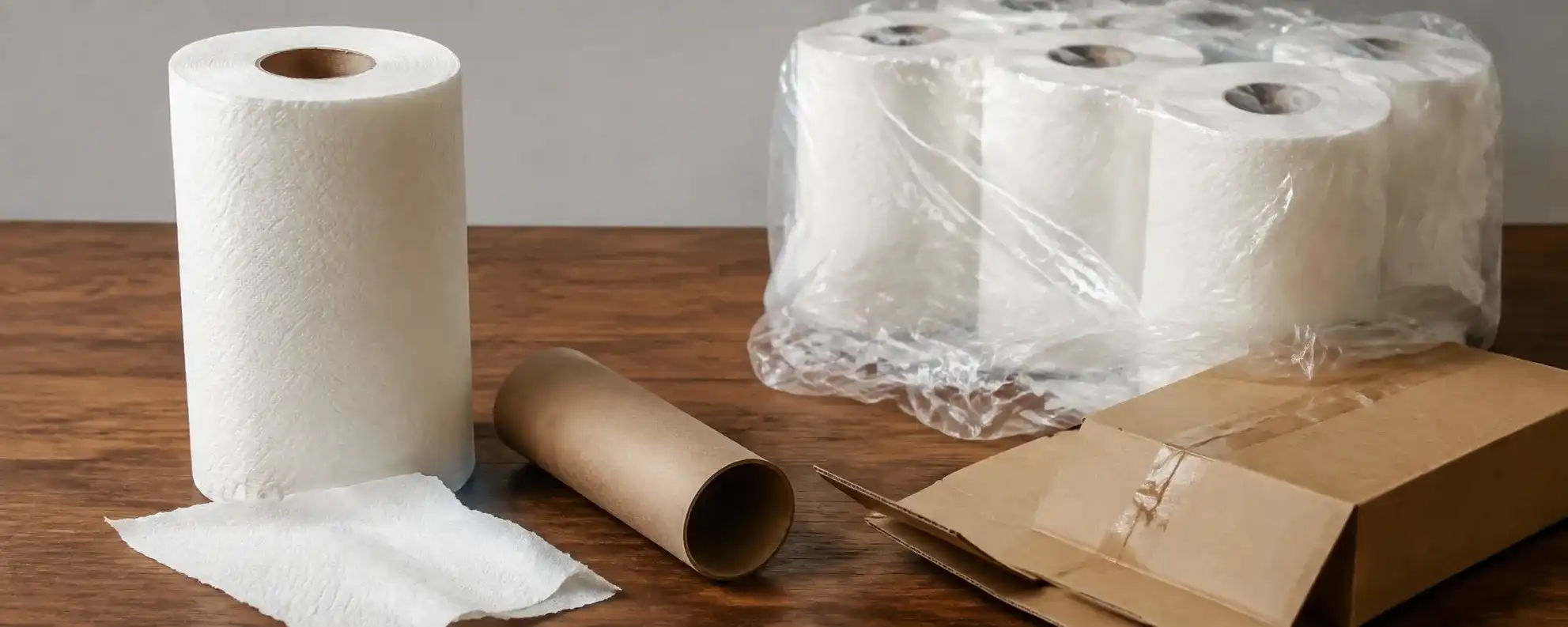
Paper labels, cardboard cartons, and shipping cases may be recyclable when they are clean, dry, and accepted locally. Adhesive tape, laminated coatings, heavy food contamination, or mixed-material construction can change the answer. Separate components when they come apart easily, but do not spend excessive water or energy trying to convert a contaminated package into a recyclable one.
| Component | Typical handling | Preparation | Local question |
|---|---|---|---|
| Used paper towels | Trash or approved compost | Keep out of paper recycling | Does organics collection accept plain paper towels? |
| Clean cardboard tube | Often paperboard recycling | Remove remaining sheets; keep dry | Are small paperboard tubes accepted? |
| Flexible plastic wrapping | Store drop-off or trash in many areas | Clean and dry if a film program accepts it | Is this exact film type accepted? |
| Cardboard shipping case | Commonly cardboard recycling | Empty, flatten if required, keep dry | What are the size and preparation rules? |
Compost or Trash
Some plain paper towels may be compostable, but composting is not a universal substitute for recycling. The sheet, printing, additives, and absorbed material all matter. A plain paper towel used to wipe water or plant-based food residue may be acceptable to a home compost pile or commercial organics program. A sheet containing disinfectant, degreaser, paint, motor oil, synthetic polishing compound, or another harmful substance should not be added to compost.
Home composting and commercial composting are not identical. A managed commercial facility may control temperature, moisture, aeration, and processing time differently and may accept materials that are difficult to handle in a backyard pile. Conversely, some facilities exclude all paper towels because of contamination risk or certification requirements. The EPA overview of composting at home explains the role of carbon-rich brown materials and the need to avoid unsuitable inputs.
If you are unsure about a particular sheet, use the trash rather than contaminating a compost stream. Check the product ingredients, the absorbed material, and the rules of the home or commercial compost system before making an exception.
Home Compost Conditions
Tear acceptable paper towels into smaller pieces so they mix with other materials instead of forming a wet mat. Add them as part of the carbon-rich portion of the pile, then balance moisture and nitrogen-rich inputs. A compost pile that becomes compacted, waterlogged, or dominated by paper may break down slowly and develop odors. Paper towels are a minor input, not a complete compost recipe.
Do not rely only on claims such as natural, recycled, biodegradable, or plant-based. Those words do not tell you what the paper towel absorbed or whether every additive suits your compost system. When product information is unavailable, keep the decision conservative. Your garden does not benefit from importing uncertain cleaning chemicals or contamination simply because the carrier sheet is made from cellulose fiber.
Local Recycling Rules
Recycling labels work only when they match the collection system available where you discard the item. A city may accept cardboard tubes but reject flexible plastic film. A workplace may collect compostable hand towels through a contracted service even though employees cannot put the same material in their household organics bin. An airport, school, restaurant, factory, hospital, and apartment building may each use different waste contracts within the same region.
Search the accepted-material list for paper towels, napkins, tissues, paperboard tubes, cardboard, compostable paper, and plastic film. If the wording is unclear, contact the provider and describe the exact item and condition. A statement that a program accepts paper does not necessarily include every paper-based product.
Place the sign at the point of disposal and use clear item names. If paper towels belong in compost, show which paper towels and which contaminants are allowed. If only the cardboard tubes are recyclable, separate the tube collection from the used-sheet bin. Staff training should follow the same terms used on the bins.
Before you change a bin sign or collection routine, use this short verification sequence:
- Name the item: Write the exact product, such as used paper towels, cardboard tubes, or plastic film.
- Describe the condition: State whether the material must be clean, dry, empty, uncoated, or free from chemicals.
- Confirm the route: Check the current recycling, compost, trash, or special drop-off contract.
Recycling Symbols and Claims
A recycling symbol does not by itself make paper towels recyclable. Packaging language can make disposal decisions look simpler than they are. Recycled content means that recovered material was used to make part or all of a product. It does not promise that the finished paper towels can enter another recycling cycle.
Recyclable means that a suitable collection, sorting, processing, and end market may exist, but the claim still has to match the system available to the person discarding the item. A material can be technically processable in one facility and excluded from your curbside program because that facility, collection route, or market is not locally available.
Biodegradable and compostable are also different from recyclable. Cellulose fiber can break down under suitable biological conditions, but time, temperature, moisture, oxygen, additives, and contamination influence the result. A compostable claim may apply only under commercial conditions or under a named certification standard. It does not mean the paper towels belong in paper recycling, and it does not override the rules of a compost provider. Read the full qualifier rather than relying on one environmental word printed in large type.
The recycling symbol on plastic wrapping may identify the resin or provide a disposal instruction for the packaging, not for the paper towels inside. Similarly, a recycling statement on the cardboard tube applies to the tube when it is clean and accepted locally. Treat each component as a separate material. If the label directs you to a store drop-off, special collection point, or commercial compost facility, do not place the item in a curbside bin that excludes it.
State which component is recyclable, where it is accepted, and what condition it must be in. Avoid a broad sign saying that the entire product is recyclable when only the cardboard core qualifies. Clear wording reduces contamination and makes the disposal instruction easier to audit when the waste contract changes.
Reduce Paper Towel Waste
You reduce paper towel waste by matching the product and dispenser to the task. In a kitchen, one sufficiently absorbent sheet may replace several weak sheets. In a washroom, a controlled dispenser can reduce accidental over-dispensing. Liquid uptake, wet strength, embossing, and sheet structure all affect how many sheets a task requires.
For repeated low-risk cleaning, a washable cloth may reduce disposable use when you have an appropriate laundry process. Cloth is not automatically better in every situation. Water, energy, detergent, cross-contamination controls, drying, replacement frequency, and staff time all matter. Compare the complete use scenario rather than making the decision from one material label.
Keep unopened rolls dry, protected from pests, and away from chemicals or strong odors. Use older stock first when packaging and product condition remain acceptable. Choose pack sizes that match consumption so opened rolls do not sit in unsuitable storage. In a facility, monitor sheets used per visit, refill frequency, bin volume, and contamination. Those observations can identify a dispenser problem or an unclear waste station more accurately than a broad instruction to use less.
You can reduce avoidable paper towel waste by focusing on three practical controls:
- Right-size the sheet: Select a format that handles the task without encouraging multiple sheets for one spill or hand-drying cycle.
- Control dispensing: Check portion size, sensor settings, and refill behavior so the dispenser does not release unnecessary material.
- Place bins correctly: Keep the disposal point close to the use point and label each route with the exact accepted material.
Conclusion
Most curbside programs exclude the sheets because of short fibers, wet-strength performance, moisture, and contamination. Keep used paper towels out of paper recycling. Compost only plain sheets that meet the rules of your home system or organics provider, and send uncertain or contaminated sheets to the appropriate trash route. Separate the clean cardboard tube and packaging so each component can follow its own local instructions.
Liansheng Sempo is a tissue factory. To discuss paper towel fiber options, absorbency, sheet structure, packaging, or product requirements, contact Liansheng Sempo with the intended use and target market.
FAQ
Can paper towels be recycled with paper?
Usually not. Most programs exclude paper towels because the fibers have limited recycling value and used sheets are commonly wet or contaminated. Follow your local accepted-material list.
Are unused paper towels recyclable?
Most curbside programs still reject them. Clean condition removes contamination, but it does not change the product category, fiber length, or local processing rules.
Are brown paper towels recyclable?
Brown color or recycled content does not prove recyclability. The finished paper towels must still be accepted by the collection and processing system available in your area.
Are paper towel rolls recyclable?
The clean cardboard tube is often recyclable as paperboard, but the paper towels are normally excluded. Remove the sheets and check local preparation rules for the tube.
Can you compost paper towels?
Sometimes. Plain sheets used with water or accepted food residue may be compostable, but chemicals, hygiene contamination, coatings, and local program restrictions can make composting unsuitable.
Why can cardboard be recycled but not paper towels?
Clean cardboard generally provides useful recoverable fiber. Paper towels often contain shorter fibers and arrive wet or contaminated, so many paper-recycling systems exclude them.
Should wet paper towels go in recycling?
No. Keep wet paper towels out of paper recycling. Use an approved compost route when the sheet and contamination qualify; otherwise use the trash.


