
kitchen paper towels are better for fast, hygienic, one-time cleanup, while cloth towels are better for repeat use, lower long-term cost, and less waste. In most kitchens, the best choice is not one or the other. It is a mix of both, used for different jobs.
If you clean food spills often, handle raw meat, or want the easiest option with no washing, Kitchen Paper Towels are usually the better fit.
If you care more about reducing waste and saving money over time, Cloth is the better everyday tool.
The right choice depends on how you cook, how often you clean, and what matters most in your kitchen.
Key takeaways:
- ✓
Kitchen Paper Towels are best for quick cleanup, greasy messes, and hygiene-sensitive tasks.
- ✓
Cloth towels are better for repeated cleaning, drying, and long-term savings.
- ✓
For most households, a hybrid system works best.
- ✓
If you want fewer germs and less cross-contamination, paper towels are the safer choice for certain jobs.
- ✓
If you want lower waste and lower long-term cost, cloth towels win.
- ✓
The best kitchen setup depends on the task, not just the product.
Paper Towels Vs. Cloth
When you compare Kitchen Paper Towels vs. Cloth, the main differences come down to hygiene, convenience, cost, absorbency, and sustainability.
Paper towels are disposable, which makes them practical for messy or sensitive cleanup. Cloth towels are reusable, which makes them better for routine use and long-term value.
For most kitchens, paper towels solve problems faster. Cloth towels, however, often perform better once you factor in repeated use and washing. That is why the better option depends on the specific kitchen task.
| Feature | Kitchen Paper Towels | Cloth Towels |
|---|---|---|
| Hygiene | Better for one-time use | Good if washed properly |
| Convenience | Very high | Lower, because washing is required |
| Cost | Lower upfront, higher over time | Higher upfront, lower over time |
| Absorbency | Good for small spills | Better for larger or repeated cleaning |
| Durability | Single-use | Reusable |
| Waste | More disposable waste | Less solid waste, but uses water and energy to wash |
| Best for | Raw meat spills, grease, quick cleanup | Drying dishes, wiping counters, daily maintenance |
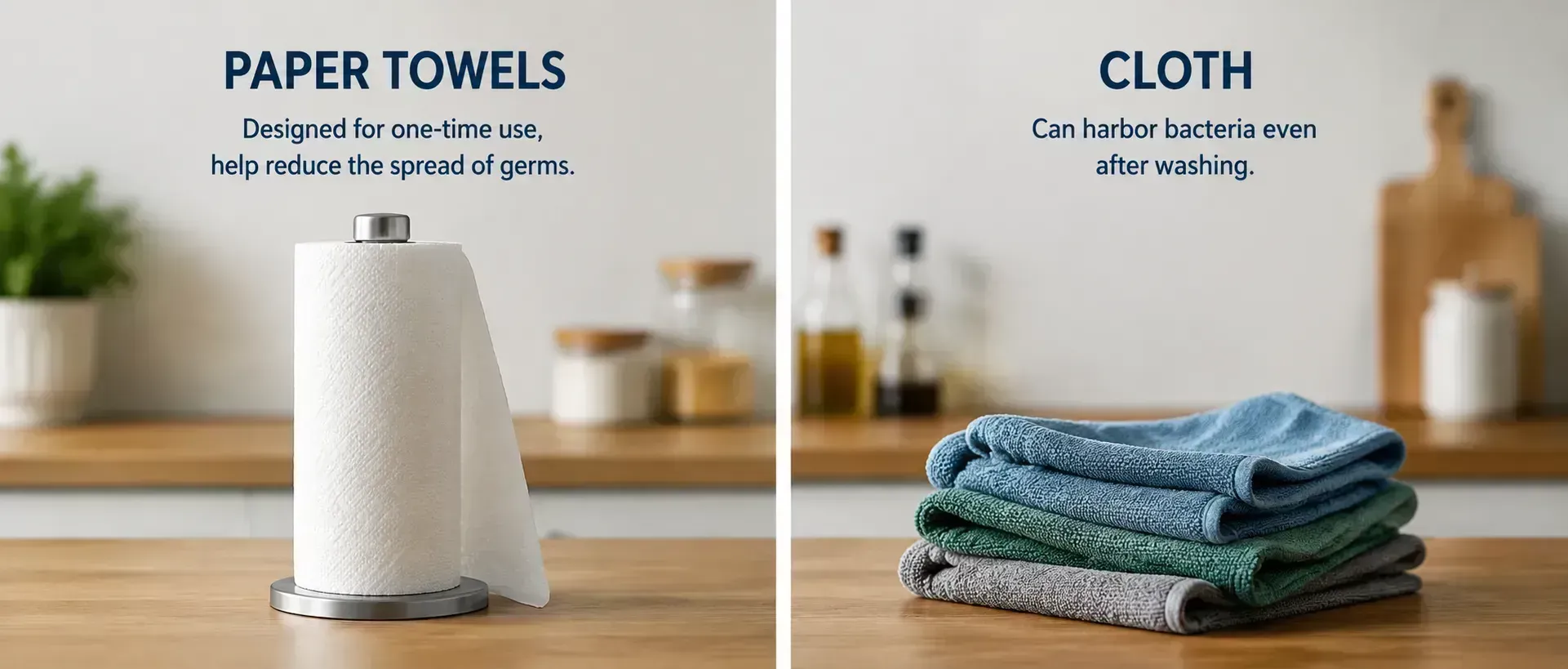
Why Kitchen Paper Towels Often Win On Hygiene
For hygiene, Kitchen Paper Towels are usually the safer choice because they are used once and thrown away. That reduces the risk of spreading bacteria from one surface to another. In a kitchen, that matters most when you are cleaning raw meat juice, egg residue, or sticky food spills.
Cloth towels can still be hygienic, but only if you wash them often and correctly. If you reuse the same towel too long, it can hold moisture, food particles, and bacteria. That makes cloth less suitable for high-risk messes unless you change and wash them regularly.
Use Cases For Paper Towels
- •Wiping raw meat spills
- •Cleaning up egg yolk or dairy spills
- •Handling pet-related kitchen messes
- •Cleaning surfaces when you want to avoid cross-contamination
- •Drying hands after handling food
Which Is More Absorbent?
The answer depends on what you are cleaning.
For small spills and quick blotting, Kitchen Paper Towels are often enough. For larger messes, cloth towels usually perform better because they can keep absorbing without falling apart.
Paper towels absorb quickly, but they have limits. If you are wiping a large puddle or repeated moisture from a countertop, a cloth towel often handles the job more efficiently. Microfiber cloths, in particular, can pick up liquid and residue well.
| Task | Better Choice | Why |
|---|---|---|
| Small water spill | Paper towels | Fast and easy |
| Grease cleanup | Paper towels | Disposable and cleaner to discard |
| Large liquid spill | Cloth | More durable and absorbent |
| Drying dishes | Cloth | Better for repeated drying |
| Polishing surfaces | Cloth | Leaves less waste |
Note
If your kitchen sees frequent spills, cloth towels can reduce how many sheets you use. If the issue is quick cleanup near the sink or stove, Kitchen Paper Towels are more efficient.
Which Is More Cost-Effective?
If you look only at the checkout price, paper towels seem cheaper. But over time, cloth towels usually cost less because you can reuse them many times. That is the key difference: paper towels are a recurring expense, while cloth towels are a reusable asset.
For households that clean often, paper towel usage can add up quickly. If you use them every day for counters, spills, hands, and dishes, the monthly cost is often higher than people expect. Cloth towels require washing, but the same towel can last through many uses if you care for it properly.
| Household Type | More Cost-Effective Option | Reason |
|---|---|---|
| Light use | Paper towels | Lower hassle, lower total volume |
| Heavy use | Cloth towels | Reusable and lower long-term cost |
| Large family | Cloth towels | More daily cleaning, more savings over time |
| Occasional cooking | Paper towels | Convenience may matter more |
If you buy Kitchen Paper Towels in bulk, the unit cost may look small. But in a kitchen that cleans several times a day, the total use can be substantial. Cloth is more economical when you are disciplined about washing and reuse.
Which Is Better For The Environment?
If your main priority is reducing landfill waste, cloth towels are usually better because they are reusable. That said, the environmental question is not simple. Cloth towels need water, detergent, and energy for washing. Paper towels use more raw material and create more disposable waste.
So the better choice depends on how you use them. A towel that is washed efficiently and used many times can be a better environmental option than paper towels used in large quantities. But if cloth towels are washed too often with heavy loads, the environmental advantage becomes smaller.
| Factor | Kitchen Paper Towels | Cloth Towels |
|---|---|---|
| Waste after use | High | Low |
| Reusability | No | Yes |
| Water use | None during use | Needs washing |
| Energy use | None during use | Needs washing and drying |
| Long-term sustainability | Lower | Higher if reused well |
In many kitchens, the most practical solution is to reserve Kitchen Paper Towels for high-risk or greasy messes and use cloth for routine tasks like drying clean hands, wiping dry surfaces, or polishing countertops.
Which Is More Convenient In Daily Kitchen Use?
For convenience, paper towels are hard to beat. You tear off a sheet, use it, and throw it away. There is no laundering, no drying time, and no need to worry about odor buildup. That makes them especially useful during busy cooking, meal prep, or unexpected messes.
Cloth towels are less convenient because they require maintenance. You need to wash them, dry them, store them, and replace them when they become too worn. Still, if you are comfortable with that routine, cloth can be very efficient for everyday cleaning.
If your kitchen is high-traffic, the speed of paper towels can save time and reduce friction. That is why many homes keep both options within reach.
Use Cases For Kitchen Paper Towels
If you want to use Kitchen Paper Towels strategically, focus on tasks where hygiene, speed, and disposal matter most. These are the situations where paper towels offer the clearest advantage.
Use Paper Towels For:
- •Raw meat and poultry spills
- •Oil splashes near the stove
- •Sticky food residue
- •Quick hand drying
- •Cleaning up after children or guests
- •Wiping a surface when you do not want to reuse the towel
Paper towels also work well when you are cleaning something you do not want to wash later. That can include small messes on appliances, counters, or temporary workspaces.
Paper towels are practical because they reduce handling. You clean, throw away, and move on. In a busy kitchen, that simplicity is often worth more than durability.
Use Cases For Cloth Towels
Cloth towels are better when the task is repeatable and low risk. You are not trying to discard the mess; you are trying to manage it efficiently over time.
Use Cloth Towels For:
- •Drying dishes
- •Wiping dry counters
- •Polishing stainless steel
- •Cleaning after a light spill
- •General kitchen maintenance
- •Repeated daily cleaning
Cloth is especially useful if you separate your towels by purpose. A microfiber towel for counters, a cotton towel for dishes, and a separate hand towel creates a more organized kitchen system.
A cloth towel gives you more control and lower waste. Once you get into a routine, it becomes one of the most efficient tools in the kitchen. It is not the fastest option for every mess, but it is often the most sustainable one.
Can You Use Both In The Same Kitchen?
Yes, and that is usually the best answer. The strongest kitchen system is often a hybrid setup: use Kitchen Paper Towels where hygiene and convenience matter most, and use cloth where reusability matters more.
This approach gives you flexibility. You do not overuse paper towels, and you do not force cloth into situations where disposal is safer or easier. It also helps you control cost without sacrificing cleanliness.
How To Choose The For Your Kitchen
The better choice depends on your habits.
If you cook often, handle raw ingredients, or want the simplest cleanup, Kitchen Paper Towels are the more useful tool for high-risk messes. If you want to reduce waste and lower long-term cost, cloth is better for routine use. If you want the most efficient kitchen overall, use both.
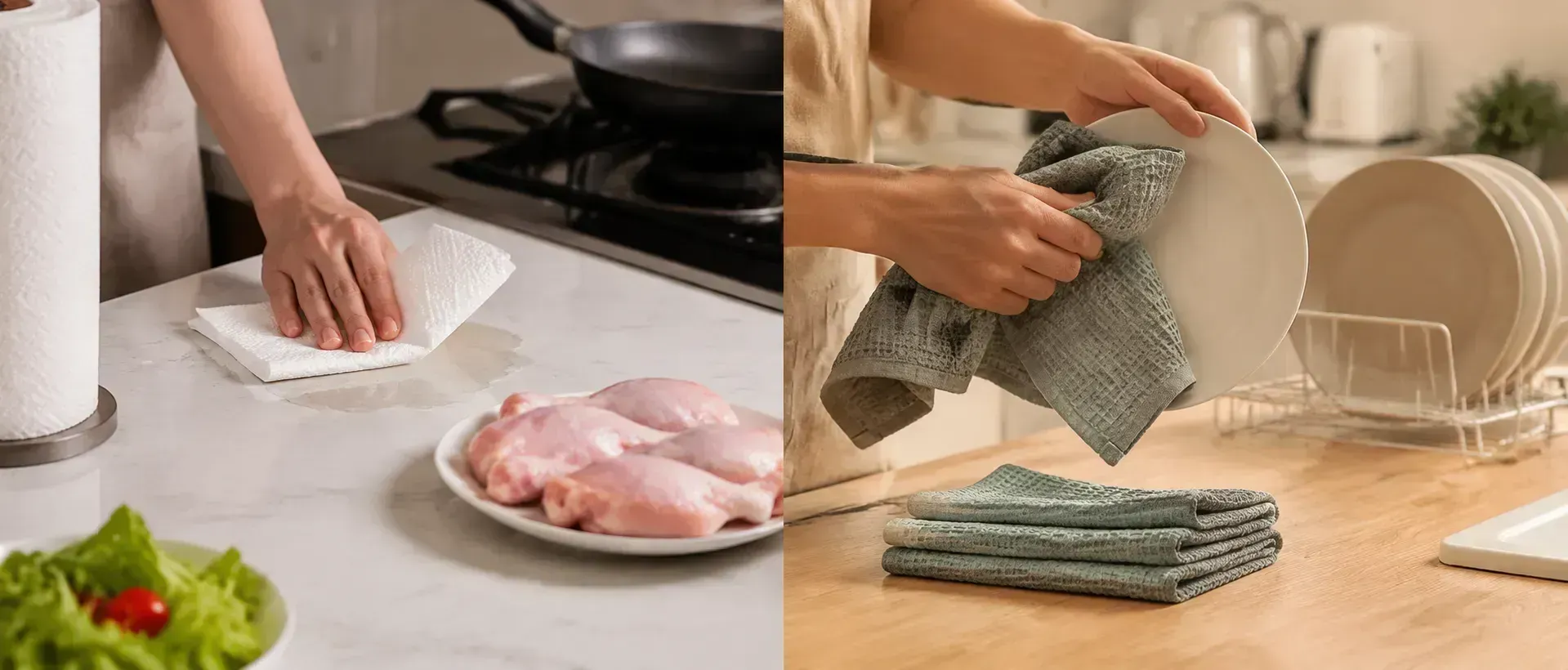
Choose Paper Towels:
- ✓
Want faster cleanup - ✓
Handle raw meat often - ✓
Need disposable hygiene - ✓
Prefer low-maintenance cleaning - ✓
Want something for unexpected spills
Choose Cloth Towels:
- ✓
Clean the kitchen every day - ✓
Want to reduce waste - ✓
Prefer long-term savings - ✓
Don’t mind washing towels regularly - ✓
Need a durable tool for repeated use
Choose Both:
- ✓
Want the best balance of hygiene, cost, and convenience - ✓
Cook frequently - ✓
Have a busy household - ✓
Need a practical system for different mess types
conclusion: Which Is Better?
There is no universal winner in the Kitchen Paper Towels vs. Cloth debate. Paper towels are better for hygiene, speed, and disposable cleanup. Cloth towels are better for cost savings, reuse, and lower waste.
If you are asking which one is better for every situation, the answer is neither.
If you are asking which one is better for the right job, paper towels often win on messy or sensitive tasks, while cloth wins on routine maintenance.
For most kitchens, the smartest answer is to keep both on hand and use each where it makes sense. That gives you better hygiene where it matters, lower costs where possible, and a cleaner workflow overall.
If you are looking for dependable Kitchen Paper Towels for wholesale, retail, or private label supply, Liansheng Sempo can help with consistent quality and stable production support. If you need product specifications, packaging options, or bulk sourcing guidance, contact us to discuss the right solution for your market.
FAQ
Are paper towels more hygienic than cloth towels?
Yes, for one-time use. Paper towels reduce the risk of spreading bacteria because you throw them away after use.
Are cloth towels more eco-friendly?
Usually yes, if you reuse and wash them efficiently. But the full impact depends on how often you wash them.
Which is cheaper in the long run?
Cloth towels are usually cheaper over time because you can reuse them many times.
Can paper towels be used for raw meat spills?
Yes. They are one of the safer choices for raw meat cleanup because they are disposable.
Are microfiber cloths better than paper towels?
For repeated cleaning, yes. For disposable hygiene and quick cleanup, paper towels are still better.
How often should kitchen cloth towels be washed?
Frequently. If you use them daily, wash them regularly to prevent odor and bacterial buildup.
Should I use both paper towels and cloth towels?
Yes. Most kitchens work better with both because each one is better for different tasks.
What is the best towel for kitchen cleaning?
It depends on the task. Paper towels are best for quick, hygienic cleanup. Cloth towels are best for routine reuse.


