
Paper Towel Absorbency Comes From Cellulose Fibers, Capillary Action, And Sheet Structure; In Practice, Multi-Ply Quilted Paper Towels Usually Absorb The Most Liquid And Handle Spills Faster.
If you choose paper towels for kitchen cleanup, spill control, or commercial use, absorbency is the feature that decides performance. For more product options, visit kitchen paper towels.
A paper towel that looks soft may still fail when it gets wet, while a denser, better-structured sheet can hold more liquid and stay intact longer.
✔Key Takeaways
- •
why paper towels absorb liquid, - •
which structural features improve performance, - •
how you can test paper towels absorbency at home, - •
and how popular brands compare in practical use.
How Paper Towel Absorbency Works
paper towel absorbency depends on how the fibers are built, how much open space exists between them, and how quickly liquid can move through that structure.
A good paper towel does two things well: it pulls water in fast and it keeps that water trapped long enough for you to wipe the spill without the sheet breaking apart.
Cellulose Composition
paper towels are made from cellulose, a plant-based material that naturally attracts water. When liquid touches the sheet, water molecules cling to the fiber surface through adhesion, while other water molecules pull more liquid along through cohesion. That is why a dry paper towel can start taking in a spill almost immediately.
In kitchen cleanup, bathroom use, and food-service settings, that speed makes a practical difference.
Capillary Action
Tiny spaces between fibers act like narrow channels, drawing liquid upward and inward by capillary action. The more open but controlled those channels are, the easier it is for the paper towel to move water away from the surface.
If the structure is too tight, water cannot move in fast enough. If it is too loose, the paper towel may absorb quickly but collapse when saturated. That balance is what separates a basic sheet from a high-performing one.
Texture & Plies
A quilted or embossed paper towel usually performs better because the raised pattern creates more surface area and more room to hold liquid. Multi-ply paper towels also add depth, which gives the sheet more internal space before saturation. That is why a thicker paper towel often outperforms a flat single-ply sheet in both absorbency and wet strength.
Absorbency is not only about thickness, but thickness plus structure. That is why premium kitchen paper towels often use embossed patterns and layered plies rather than simple flat sheets. You can also learn more about paper towel fold types when comparing structure and usage.
How To Test Paper Towel Absorbency At Home
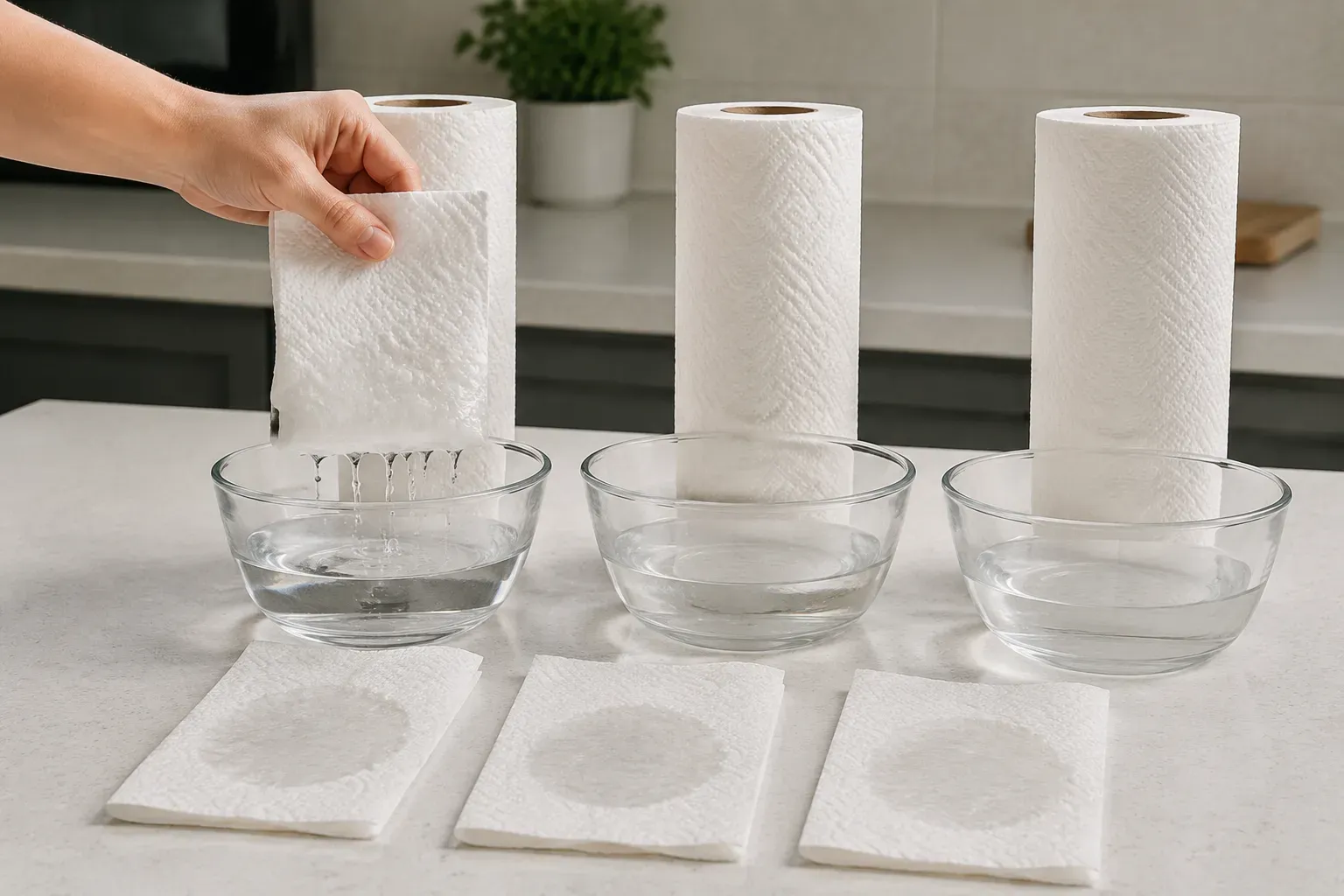
You can test paper towel absorbency in your kitchen with a simple water test, and the sheet that releases the most measured water after saturation is the one with the highest absorbency capacity. This method is easy to repeat, low-cost, and useful when you want to compare brands fairly.
What You Need
To keep the test consistent, use the same tools for every brand. That way, the difference comes from the paper towel.
| Item | Purpose |
|---|---|
| Measuring cup | Measures absorbed water after squeezing |
| Bowl | Holds the water for saturation |
| Timer | Keeps the soaking time consistent |
| paper towels from each brand | Test samples |
| Gloves or clean hands | Keeps handling consistent |
Step-By-Step Testing Method
Use this method when you want a fair, repeatable way to compare paper towel absorbency between different brands. The goal is to measure how much water one sheet can hold after full saturation, not just how fast it gets wet.
1. Prepare One Sheet From Each Brand
Take one full sheet from each paper towel brand you want to test. If one brand uses larger sheets, trim all samples to the same size, such as 11 x 11 inches or another fixed measurement. This is important because a larger sheet naturally holds more water and can make the result misleading.
Fold each sheet into the same shape, preferably a square folded twice. Do not press the folds too hard, because heavy compression can reduce the open pores inside the paper towel and affect absorbency.
2. Measure The Starting Water Volume
Pour a fixed amount of room-temperature water into a bowl, such as 500 ml. Use the same water volume for every test. Room-temperature water is recommended because very hot or very cold water can slightly affect how quickly the fibers absorb liquid.
Record the starting water amount before each test. If you are testing several brands, refill the bowl to the same volume every time.
3. Submerge The Paper Towel Fully
Place the folded paper towel flat into the bowl. Press it gently under the water with two fingers or a clean utensil until the full sheet is wet. Avoid squeezing or rubbing the paper towel while it is underwater, because that can force extra water into the sheet and distort the result.
Let the paper towel sit in the water for a fixed time, such as 10 seconds. If you are testing absorption speed separately, use a stopwatch and record how many seconds it takes for the paper towel to become fully saturated.
4. Lift And Drain The Paper Towel
Lift the paper towel from the bowl carefully, holding it from one corner or edge. Keep it directly above the bowl and let the excess water drip back naturally.
Drain it for a fixed time, such as 10 seconds, or until dripping stops. Use the same draining time for every sample. This step matters because one paper towel may release loose water faster than another, and inconsistent draining can change the final measurement.
5. Squeeze The Absorbed Water Into A Measuring Cup
After draining, place the saturated paper towel over a measuring cup and squeeze it firmly. Try to use the same hand pressure each time. For better consistency, squeeze each sample for 5 seconds and fold it once more to press out remaining water.
The amount of water collected in the measuring cup shows how much liquid the paper towel retained after saturation and draining. A higher number means stronger absorbency capacity.
6. Record And Repeat The Test
Write down the absorbed water volume for each brand. Repeat the same test three times per brand, using a fresh sheet each time, then calculate the average.
| Brand | Test 1 absorbed water | Test 2 absorbed water | Test 3 absorbed water | Average |
|---|---|---|---|---|
| Brand A | ||||
| Brand B | ||||
| Brand C |
The brand with the highest average absorbed water volume has the best liquid-holding capacity in this test. If two brands absorb similar amounts, compare wet strength next: the better paper towel is the one that holds water without tearing, stretching, or leaving pulp behind.
How To Ensure Fairness?
You should test each sample under the same conditions: same water volume, same soak time, same folding method, and same squeeze pressure. If one paper towel is folded tighter than another, it may appear to absorb more simply because it has less exposed surface area.
A better version of this test is to repeat it three times for each brand and average the results. That gives you a clearer picture of how the paper towel performs in real use, especially when you are comparing retail brands, private label options, or factory samples.
Different Brands And Performance
When comparing paper towel absorbency, consumer tests usually focus on two practical questions: how much water a single sheet can hold before reaching saturation and how quickly it absorbs liquid from a spill. Wet strength is also important, because a highly absorbent paper towel is less useful if it tears apart once soaked. If you want to see related product categories, check household paper.
Among different paper towel brands, performance can vary noticeably depending on sheet structure, thickness, and fiber bonding.
Bounty Select-A-Size
Bounty Select-A-Size is widely recognized as a strong performer in paper towel absorbency tests. Expert evaluations, including testing by Reviewed.com, have highlighted its fast liquid pickup and strong wet durability.
Its multi-ply construction and textured surface help it absorb spills quickly while maintaining enough strength for wiping and lifting wet messes. This makes it especially effective for demanding kitchen cleanup tasks where both absorbency and durability matter.
Kirkland Signature
Kirkland Signature paper towels are often valued for their balance of performance and cost. In many comparisons, they show absorbency levels that are close to premium brands, making them a practical choice for households that use paper towels frequently.
They can handle everyday spills efficiently without the higher per-roll cost of some leading national brands. However, when heavily soaked, they may lose more structural integrity than the strongest premium options.
Sempo
Sempo paper towels can also be considered in absorbency comparisons, especially in markets where the brand is widely available. As with other brands, its performance should be judged by the same criteria: water-holding capacity, absorption speed, and strength after saturation.
If Sempo uses thicker sheets, a textured surface, or multi-ply construction, it may perform better in spill pickup than flatter or thinner alternatives. For an accurate comparison, it should be tested side by side with other brands using the same single-sheet method.
Brand Comparison At A Glance
| Brand | Absorbency Performance | Wet Strength | Main Advantage |
|---|---|---|---|
| Bounty Select-A-Size | Very high | Very strong | Fast absorption and strong durability |
| Kirkland Signature | High | Good | Premium-like absorbency with bulk value |
| Sempo | Depends on product type | Depends on product type | Should be evaluated through direct testing |
The strongest performers combine cellulose fiber structure, capillary action, textured layers, and wet durability to absorb liquid quickly and hold it without falling apart.
Which Paper Towel Is The Most Absorbent?
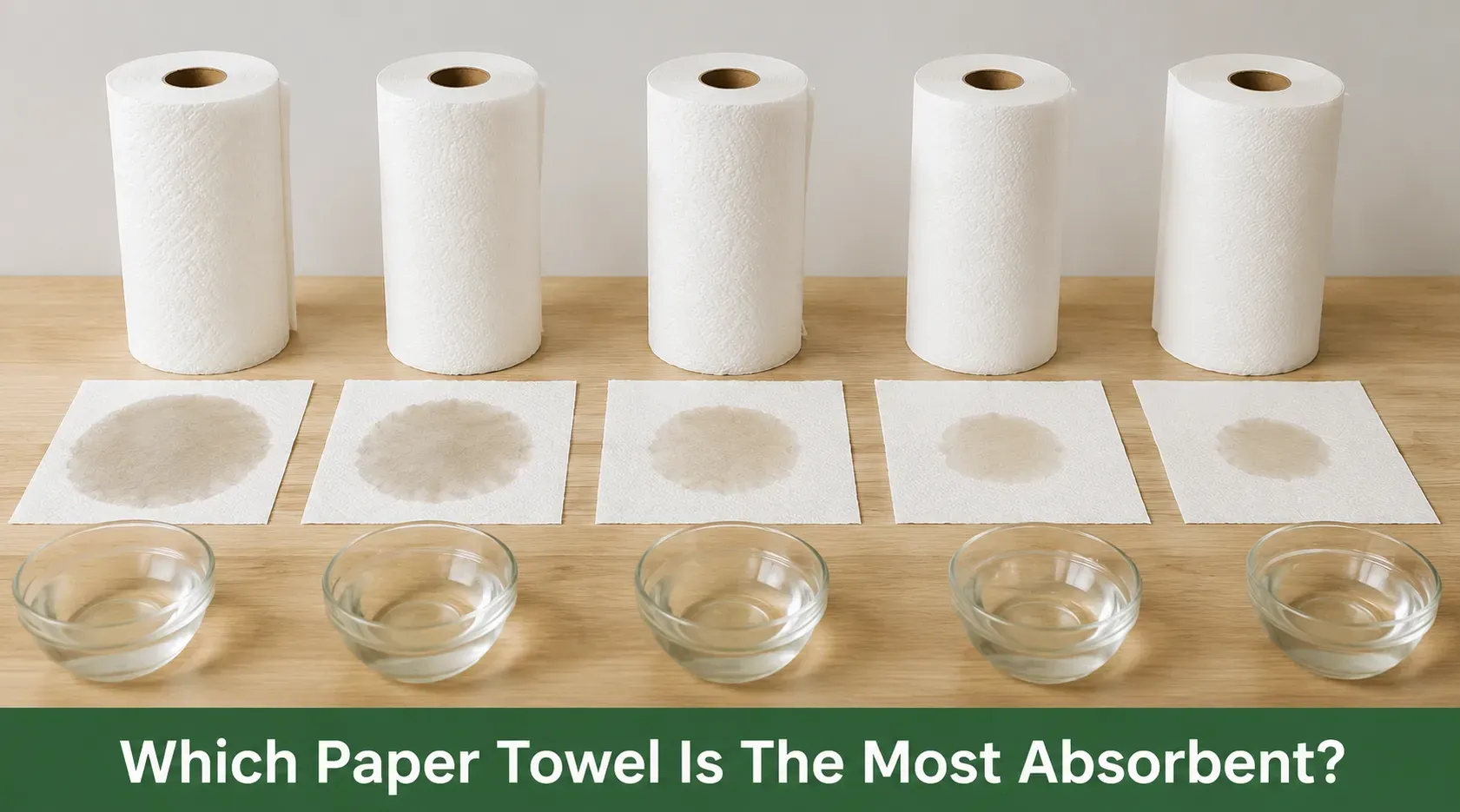
The most absorbent paper towel is usually the one with the best combination of fiber quality, ply count, embossing pattern, thickness, and wet strength. In many consumer tests, premium multi-ply paper towels tend to absorb more liquid than thin budget paper towels, but the “most absorbent” option depends on how you measure performance.
A paper towel that absorbs the largest amount of water in a bowl test may not always perform best during real kitchen cleanup. Real performance also depends on how quickly it pulls in liquid, how well it holds liquid without dripping, and whether it stays intact when wet.
What Makes A Paper Towel Highly Absorbent?
Highly absorbent paper towels are designed to create open spaces between fibers. These spaces act like tiny channels that pull in and hold liquid. Better paper towels usually have stronger fiber bonding and more structured embossing, which helps them stay thick and porous even when wet.
| Factor | How it affects absorbency |
|---|---|
| Ply count | More layers usually increase liquid capacity |
| Fiber type | Longer, higher-quality fibers often improve strength and absorbency |
| Embossing | Creates air pockets and channels for liquid |
| Sheet thickness | Thicker sheets can hold more liquid |
| Wet strength | Helps the paper towel stay intact after absorbing liquid |
| Sheet size | Larger sheets naturally hold more water |
This is why two paper towels that look similar may perform very differently. The difference is often in the fiber structure, not just the visible thickness.
Absorbency
Absorbency has two parts: capacity and speed.
Capacity means how much liquid the paper towel can hold. Speed means how quickly it takes up liquid from a surface. Some thick paper towels hold a lot of water but absorb more slowly. Some thinner paper towels absorb quickly but reach their limit sooner.
For kitchen spills, you often need both. A paper towel should pull liquid in quickly and hold it without falling apart. For cleaning glass or wiping hands, speed and low lint may matter more than maximum capacity.
How To Identify The Most Absorbent Paper Towel
To find the most absorbent paper towel, compare brands using the same sheet size and the same testing method. Do not rely only on brand claims such as “ultra absorbent” or “2x stronger.”
- 1.
Water capacity — how much liquid one sheet holds after saturation.
- 2.
Absorption speed — how fast the sheet becomes fully wet.
- 3.
Retention — how much water the paper towel keeps after lifting.
- 4.
Wet strength — whether it tears or stretches when wet.
- 5.
Sheets per cleanup — how many sheets are needed for the same spill.
Premium Paper Towels Usually Absorb The Most
In general, premium paper towels are the most absorbent because they are thicker, better bonded, and more structured. They often use multi-ply construction and deeper embossing to increase liquid-holding space.
Premium paper towels are best for:
- ✔ Large kitchen spills
- ✔ Grease cleanup
- ✔ Wet counter wiping
- ✔ Food preparation tasks
- ✔ Cleaning around sinks and stovetops
- ✔ Situations where fewer sheets are preferred
However, premium paper towels are usually more expensive. If you only need paper towels for light hand drying or small spills, a mid-range paper towel may be enough.
Budget Paper Towels May Absorb Less But Still Be Useful
Budget paper towels often have lower absorbency capacity, but they can still be practical for simple jobs. They are useful when the task does not require high wet strength or large liquid pickup.
Budget paper towels are suitable for:
- ✦ Small water drops
- ✦ Hand wiping
- ✦ Quick surface drying
- ✦ Covering food in the microwave
- ✦ Low-cost workplace use
The downside is that you may need more sheets for heavy spills. This can reduce the apparent savings.
Eco-Friendly Paper Towels Vary Widely
Eco-friendly paper towels can be highly absorbent, but performance depends heavily on the material and manufacturing process. Bamboo paper towels, recycled paper towels, and unbleached paper towels do not all perform the same.
Bamboo-based paper towels may offer good strength and absorbency because bamboo fibers can be durable. Recycled paper towels may be slightly less absorbent if the fibers are shorter after repeated processing. However, some recycled products are engineered well and perform competitively.
For eco-friendly options, compare both performance and sheet usage. A paper towel that is sustainable but requires many sheets per task may not be the best overall choice.
Best Choice By Use Case
| Use case | Most suitable paper towel type |
|---|---|
| Heavy liquid spills | Premium multi-ply paper towel |
| Everyday kitchen cleaning | Mid-range or premium paper towel |
| Greasy surfaces | Strong embossed paper towel |
| Hand drying | Commercial or mid-range paper towel |
| Glass cleaning | Low-lint paper towel |
| Eco-conscious use | Bamboo or recycled paper towel |
| High-volume business use | Commercial paper towel with low cost per use |
The most absorbent paper towel is typically a premium, multi-ply, strongly embossed paper towel with good wet strength. But the best paper towel overall is not always the one that holds the most water. The best choice is the paper towel that gives the right balance of absorbency, durability, speed, lint control, and cost for your actual cleaning needs.
Conclusion
paper towel absorbency depends mainly on cellulose fibers, capillary action, and sheet structure. Paper Towels with more texture, more plies, and a stronger fiber network usually hold more liquid and perform better on tough spills.
Overall, the most absorbent paper towel is the one that combines high water-holding capacity, quick absorption, and enough strength to stay intact when wet. For everyday use, the best choice is not just the paper towel that absorbs the most water, but the one that offers the best balance of performance and value.
If you want to find the best paper towel for your home, compare a few brands using the same simple test and choose the one that performs best for your needs.
You can also explore more product categories on our blog or browse our household paper collection.
FAQ: Paper Towel Absorbency
1. How Absorbent Are Paper Towels?
paper towels are highly absorbent because they are made from cellulose fibers that quickly pull in and trap water. However, absorbency can vary a lot depending on the brand, thickness, and sheet design.
2. How Do You Do The Paper Towel Absorbency Experiment?
A simple absorbency experiment involves using the same size sheet from each brand, dipping it into a measured amount of water, and then comparing how much liquid each paper towel holds before dripping or breaking apart.
3. What Affects Paper Towel Absorbency?
Several factors affect absorbency, including fiber structure, number of layers, sheet thickness, surface texture, and how tightly the fibers are packed together.
4. Do Paper Towel Layers Affect Absorption?
Yes. More layers usually mean more fiber material and more space to trap water, which can improve absorbency and make the paper towel stronger when wet.
5. What Paper Towels Are Best For Absorption?
In many consumer tests, premium brands like Bounty Select-A-Size perform especially well, but some store brands such as Kirkland Signature and Great Value can also offer strong absorbency.
6. Do Different Types Of Paper Towels Absorb The Same Amount Of Water?
No. Different types of paper towels can absorb very different amounts of water because of differences in material, thickness, layering, and overall design.
7. What Is More Absorbent Than Paper Towels?
Cloth paper towels, microfiber cloths, and reusable cleaning paper towels are often more absorbent than paper towels and can hold more liquid overall.
8. Which Type Of Paper Towel Absorbs The Most Water?
Microfiber paper towels usually absorb the most water because their fine synthetic fibers create a large surface area for trapping moisture.
9. Is A Paper Towel Absorbing Water A Physical Change?
Yes. When a paper towel absorbs water, it is usually considered a physical change because the paper towel and water are not chemically changed into a new substance.


