
If you are choosing between 2 ply and 3 ply toilet paper, the core difference is simple: 2 ply is thinner, more economical, and practical for everyday use, while 3 ply is thicker, softer, and usually more durable.
The better option depends on your budget, comfort expectations, and how much paper you use per visit.
If you want a more basic, cost-conscious choice, 2 ply works well. If you want a more premium feel and fewer sheets per use, 3 ply is usually the better fit.
Key takeaways
- 2 ply toilet paper is generally more affordable and widely available
- 3 ply toilet paper offers more thickness, softness, and durability
- Ply count matters, but paper quality, fiber type, and embossing also affect performance
- The best choice depends on your usage scenario, household size, and comfort preference
- Cost per use matters more than price per roll
What Does Ply Mean in Toilet Paper?
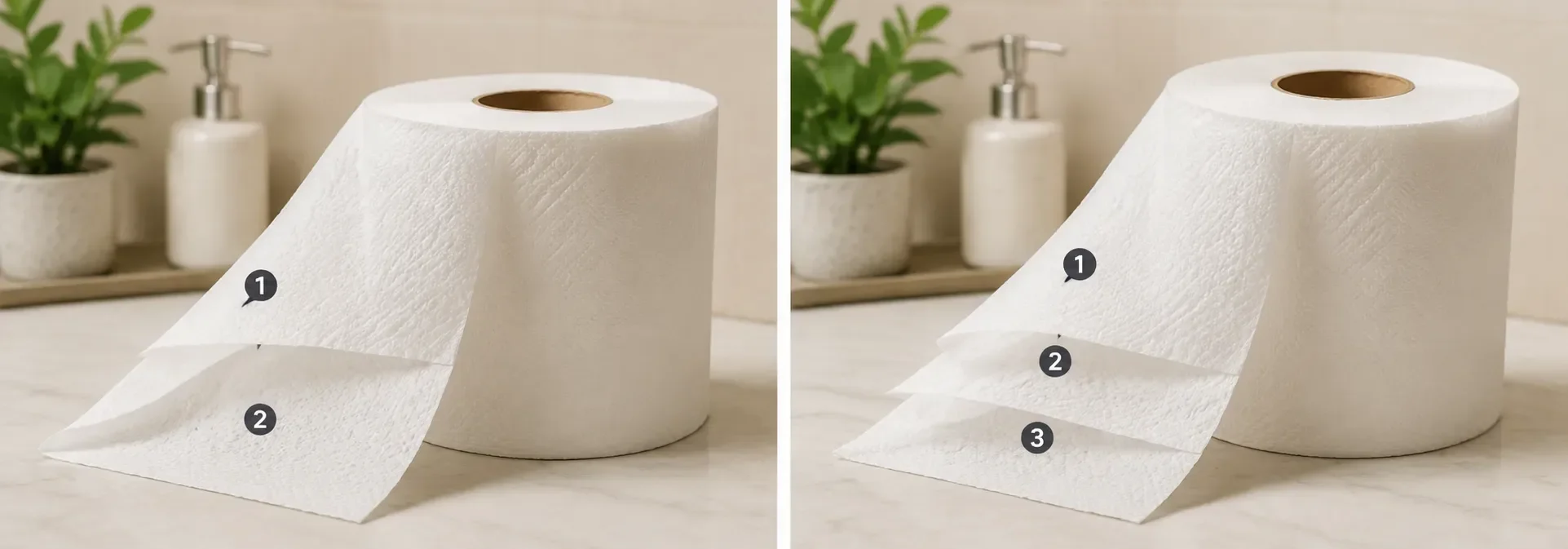
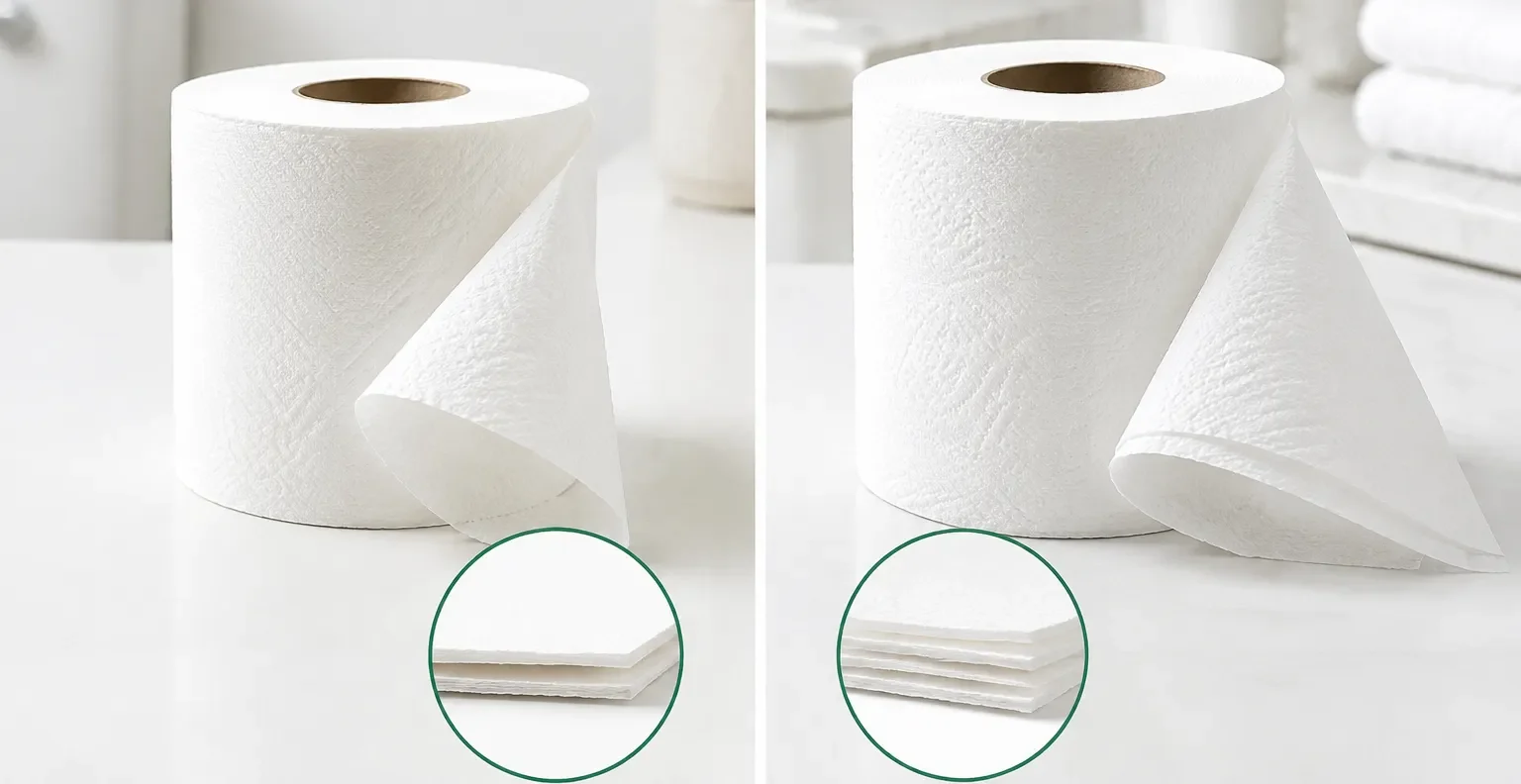
Ply means the number of layers in a single sheet of toilet paper. 2 ply toilet paper has two bonded layers, and 3 ply toilet paper has three. That extra layer changes how the paper feels, how much it absorbs, and how likely it is to tear during use.
Ply is only one part of the product. You also need to look at fiber quality, sheet size, embossing, softness treatment, and how the paper breaks down in water. That is why two products with the same ply count can still feel very different in daily use.
2 ply toilet paper
2 ply toilet paper is the standard choice in many markets. It usually balances price and function well, especially for high-volume household or commercial use. If you are buying for a family bathroom, office restroom, or hospitality setting with frequent replenishment, 2 ply often makes sense.
3 ply toilet paper
3 ply toilet paper adds another layer, which usually improves comfort and strength. It is often positioned as a premium product, especially in retail packaging, hotel-style bathrooms, and consumer markets that value a softer, thicker feel.
2 Ply vs 3 Ply Toilet Paper
2 ply is about practicality, while 3 ply is about comfort and premium feel. In real use, that means 2 ply may be better for budget control and daily replacement, while 3 ply may be better when you want fewer sheets and a softer touch.
Here is a simple comparison table you can use to evaluate the two options.
| Feature | 2 Ply Toilet Paper | 3 Ply Toilet Paper |
|---|---|---|
| Layer count | 2 layers | 3 layers |
| Thickness | Moderate | Thicker |
| Softness | Good | Usually softer |
| Strength | Sufficient for daily use | Typically stronger |
| Durability | Can tear more easily | Less likely to tear |
| Sheets needed per use | May need more | Often fewer |
| Price | Lower | Higher |
| User experience | Practical | More premium |
| Best for | Budget use, daily household replenishment | Comfort-focused use, premium bathrooms |
Which Is Better for Daily Use?
If your main concern is routine use, 2 ply toilet paper is often the more practical option. It is usually easier to source, cheaper to replenish, and suitable for homes and facilities where paper consumption is high.
If you tend to use more sheets with thinner paper, your actual consumption may rise. In that case, 3 ply can sometimes reduce the number of sheets needed per use, which may narrow the cost difference over time.
2 ply fits well in busy family bathrooms, office restrooms, and wholesale supply channels. It is also common in markets where users care more about function than luxury.
3 ply is a stronger fit for guest bathrooms, premium residential setups, and consumers who want a thicker feel. It also works well in retail categories where packaging, comfort, and product positioning matter.
Thickness and Comfort
The difference in thickness is one of the first things users notice. 2 ply toilet paper feels lighter and more flexible, while 3 ply feels fuller and more cushioned. If you are shopping for comfort, this is usually the deciding factor before anything else.
In a bathroom setting, comfort is not just about softness. It also includes how the paper folds, how it sits in the hand, and whether it feels stable during use. A well-made 3 ply product usually creates a more premium impression, which is why it is often used in higher-end home and hospitality settings.
Softness is not the same as ply count
A common mistake is assuming 3 ply is always softer. In reality, softness depends on fiber type, creping, embossing, and finishing. A high-quality 2 ply bamboo toilet paper can feel softer than a low-grade 3 ply virgin pulp product.
Comfort matters most in master bathrooms, guest bathrooms, hospitality environments, and households with sensitive users. In these cases, 3 ply often delivers a better first impression.
Strength and Durability
If you want a paper that holds together better during use, 3 ply usually has the advantage. The extra layer generally improves structural integrity, which helps reduce tearing and gives the sheet a more stable feel.
2 ply is still perfectly functional, but it may require more careful handling. In markets where people use smaller amounts at a time or where pricing matters more than feel, that is not a problem. In markets where users expect extra strength, though, 3 ply can reduce complaints.
Why durability matters in real bathrooms
Durability matters because torn paper creates a poor user experience. It can also increase consumption if people compensate by using more sheets.
A well-engineered 2 ply product can perform better than a weak 3 ply one. Fiber length, wet strength balance, embossing depth, and sheet bonding all affect durability.
Absorbency
In general, 3 ply toilet paper tends to absorb more, because there is more material in each sheet. That said, absorbency is not just a numbers game. A product can have more layers but still perform poorly if the paper structure is dense or the surface is not designed well.
For users, higher absorbency often means fewer sheets and a cleaner feel. For buyers, it means a product may justify a higher price. For factories, it means the way you build the sheet matters as much as the ply count.
What affects absorbency
Absorbency is influenced by pulp type, sheet embossing, air layering, and how the fibers are arranged. If you are comparing products in the same market, test their actual performance in use. Some premium 2 ply products absorb better than expected because the paper is engineered more carefully.
Higher absorbency is useful in family bathrooms, hospitality rooms, and premium residential products. It can also matter in export markets where consumers prefer thicker sheets. If your customer expects a softer, more absorbent feel, 3 ply is often the easier product to position.
Which One Is Better for Sensitive Skin?
If skin comfort is your priority, 3 ply often feels better, but sensitivity is not controlled by ply count alone. For sensitive skin, the more important factors are softness, fragrance-free formulation, low lint, and whether the paper uses clean, safe fibers.
A rough or dusty 3 ply product can still irritate skin. A smooth, well-made 2 ply product can sometimes be more comfortable than a cheap 3 ply roll. So if you are selecting toilet paper for sensitive users, focus on the full product specification, not just the number of layers.
What to look for
You should look for fragrance-free paper, low dust, smooth embossing, and consistent sheet strength. If your target market includes families, children, or older users, these details matter a lot.
Which Is Better for Septic Systems and Plumbing?
If you are concerned about plumbing, the answer is not automatically “choose thinner paper.” Septic safety depends on how quickly the paper breaks down, not only on whether it is 2 ply or 3 ply. Well-designed 3 ply papers disperse well, while some cheap 2 ply products can still create issues.
For homes with older plumbing or septic systems, you should look for toilet paper that is labeled as fast-dissolving or septic-safe.
How to Choose Between 2 Ply and 3 Ply Toilet Paper
The right choice depends on your use case.
If you want lower cost and steady everyday supply, choose 2 ply.
If you want a thicker feel, stronger performance, and a more premium experience, choose 3 ply.
Choose 2 ply:
- Lower upfront cost
- Strong availability
- Practical daily replenishment
- A value-driven product line
- Better fit for bulk purchasing
Choose 3 ply:
- Thicker and softer feel
- Fewer sheets per use
- A more premium bathroom experience
- Better fit for guest or master bathrooms
- Stronger comfort positioning in retail
What Matters Beyond Ply Count?
You need to look at sheet size, roll length, embossing, fiber quality, dispersibility, and packaging presentation. These details affect both consumer satisfaction and repeat purchase behavior.
Conclusion
If you compare 2 ply vs 3 ply toilet paper, the real difference comes down to how you balance price, comfort, and durability. 2 ply is usually the better choice for cost control and high-volume use. 3 ply is usually the better choice when you want a thicker feel, stronger performance, and a more premium user experience. Neither is universally better.
If you are looking for toilet paper supply, Liansheng Sempo can help you develop products that match your target market, from tissue paper to bamboo toilet paper. If you want to discuss specifications, packaging, or private label options, contact us to get a solution that fits your business needs.
FAQ
Is 3 ply toilet paper worth it?
Yes, if you value softness and a thicker feel. It is usually more comfortable than 2 ply, but it costs more.
Is 2 ply toilet paper strong enough?
Yes, for most daily household use. It is practical and widely used, especially in value-focused markets.
Which is more economical, 2 ply or 3 ply?
2 ply is usually cheaper per roll, but 3 ply may use fewer sheets. The better value depends on how much you use.
Is 3 ply better for sensitive skin?
Not always. Sensitive skin depends more on softness, fragrance, and fiber quality than ply count alone.
Does more ply mean better toilet paper?
Not automatically. More ply usually means more thickness, but paper quality and construction matter just as much.
Which toilet paper is best for daily use?
For most households, 2 ply is practical. For users who want more comfort, 3 ply is often preferred.
Is 3 ply toilet paper septic safe?
It can be, but septic safety depends on how fast the paper breaks down. Check whether the product is labeled septic-safe.
Why does toilet paper come in different ply counts?
Different ply counts help brands serve different users, from budget buyers to premium comfort buyers.


