
Paper towels are made mainly from cellulose fibers, usually virgin wood pulp, recycled paper fiber, or a blend. The pulp is formed into a lightweight sheet, dried, creped, and often embossed. Small amounts of functional additives may support wet strength, softness, color, or processing. The exact recipe varies by product, so fiber source alone does not tell you how a towel will absorb, feel, or hold together during use.
Key takeaways
- Cellulose fiber is the foundation: It usually comes from wood pulp, recovered paper, bamboo, or another plant-based source.
- Fiber blends balance performance: Longer fibers contribute strength, while shorter fibers can support softness, formation, and surface uniformity.
- Wet strength is engineered: Paper towels need to absorb liquid without immediately separating like bathroom tissue.
- Structure matters as much as ingredients: Creping, ply bonding, embossing, and open space between fibers influence absorbency and handling.
- Products are not interchangeable: Kitchen paper towels, folded hand towels, industrial paper wipers, and nonwoven wipes may have different compositions.
The Main Material in Paper Towels
The main material in paper towels is cellulose, a structural substance found in plant cell walls. During pulping, plant material is separated into individual fibers, suspended in water, and brought together as a thin web. As water leaves the web and the sheet dries, contact between the fibers creates the network that becomes paper. Wood is the most common commercial source because it provides dependable fibers with useful papermaking properties. The pulp can be washed, screened, refined, and, when a white product is required, bleached through a controlled mill process. Paper towel base tissue is then designed to be lightweight, porous, flexible, and capable of handling liquid. What you feel in the finished sheet is the result of that entire chain, not cellulose in isolation.
Paper towels are not woven fabric. The sheet is a bonded network of fibers rather than threads crossing over and under each other. This distinction helps explain why the product can tear along a perforation, shed lint on some surfaces, and soften or lose strength after prolonged contact with water.
Long Fibers and Short Fibers
Paper towel pulp can include fibers with different lengths and surface characteristics. Softwood species generally provide longer fibers, which form more fiber-to-fiber connections across the sheet and help support tensile and tear strength. Hardwood species generally provide shorter fibers that can improve sheet formation, softness, and surface coverage. The practical recipe is often a blend rather than a single fiber type.
That blend is one reason two rolls with similar thickness can perform differently. A bulky sheet is not automatically strong, and a dense sheet is not automatically absorbent. Fiber selection works together with refining, sheet formation, drying, creping, ply count, and embossing. You experience the combined result when you pull a wet sheet across a counter or press it onto a spill.
Virgin Fiber, Recycled Fiber, and Alternative Plant Fiber
Paper towels can be made from virgin fiber, recycled fiber, or a mixture. These labels describe the source history of the fiber, not the complete quality of the finished product. Virgin pulp is produced from plant material that has not previously been made into paper. It gives the papermaker direct control over fiber species, length, cleanliness, brightness, and processing history. In many consumer kitchen rolls, virgin wood pulp is selected when the target includes softness, consistent appearance, controlled lint, and reliable wet performance. The way those fibers are processed and converted still matters just as much as the source label.
Recycled pulp begins with recovered paper. The material is sorted, repulped, cleaned, and may be deinked before it returns to a paper machine. Each recycling cycle changes the fibers: repeated wetting, drying, and mechanical treatment generally make them shorter and alter their bonding behavior. A well-designed recycled paper towel can still provide useful strength and absorbency, but performance depends on the recovered furnish, cleaning process, fiber blend, additives, and sheet design.
The U.S. Environmental Protection Agency includes paper towels within commercial and industrial sanitary tissue guidance and recognizes products containing recovered and postconsumer fiber. That is useful evidence that recycled content is a normal paper towel material option, not an unusual exception. It is still important to distinguish recycled content in the product from whether a used sheet can enter a local recycling bin. Used sheets are often wet, soiled, food-contaminated, or made from fibers that are already too short for another recycling cycle. Those disposal questions are covered separately in our explanation of whether paper towels are recyclable.
Bamboo and Other Nonwood Sources
Bamboo, bagasse, wheat straw, and other plant residues can also supply cellulose fiber. The raw plant source changes fiber dimensions and processing requirements, but it does not remove the need for pulping, cleaning, sheet formation, and performance control. A bamboo paper towel is still an engineered paper product, not a sliced or woven piece of bamboo.
A source claim should therefore be read together with the finished specification. Ask how the sheet performs, what percentage of the furnish comes from the named source, whether other fibers are blended in, and what evidence supports environmental claims. The word bamboo alone does not tell you absorbency, wet strength, lint level, or suitability for food-related tasks.
What Else Is Added to Paper Towels?
Cellulose supplies most of the sheet, but paper towels may also contain small amounts of processing aids and performance additives. The formulation depends on the product, mill, region, intended application, and applicable requirements, so you should not assume that every brand uses the same chemical system. The most important functional difference from ordinary writing paper or bathroom tissue is often wet integrity. Water competes with the natural hydrogen bonding between cellulose fibers, so an untreated sheet loses much of its strength when saturated. Paper towels are expected to pick up liquid and remain usable long enough to blot, wipe, or transfer a spill. Papermakers can support that performance through fiber choice, refining, sheet structure, ply design, and wet-strength chemistry.
| Material or treatment | Main purpose | What it changes in use |
|---|---|---|
| Cellulose fiber | Forms the absorbent sheet network | Influences absorbency, softness, strength, lint, and appearance |
| Wet-strength system | Helps fiber bonds remain effective after wetting | Reduces immediate tearing or separation during wiping |
| Dry-strength or retention aids | Support sheet formation and fiber bonding | Can improve handling, converting stability, and consistency |
| Softening treatment | Adjusts surface feel and flexibility | May produce a less harsh hand feel, depending on the recipe |
| Color-control process | Creates the intended white, natural, or colored appearance | Changes visual presentation but does not alone define quality |
| Ply adhesive or mechanical ply bonding | Keeps multiple tissue layers aligned | Affects delamination, bulk, and stability when wet |
Not every item in the table is present in every product, and a function can be achieved in more than one way. For example, plies may be joined through embossing and pressure, an adhesive system, or a combination. Color may come from the natural furnish, bleaching, dye, or printing. A technical data sheet or supplier declaration is more reliable than guessing from touch or appearance.
Do Paper Towels Contain Plastic?
Standard tissue-based paper towels are primarily cellulose paper, not a woven plastic fabric. However, some functional additives are synthetic polymers, and specialized heavy-duty wiping products may include regenerated or synthetic fibers. That is why the product category matters.
Do not use the composition of a standard kitchen roll to describe a shop towel, disinfecting wipe, wet wipe, or nonwoven cleaning cloth. If plastic-free composition is a purchasing requirement, ask for a written material declaration that covers the specific product rather than relying on the word paper in a marketing name.
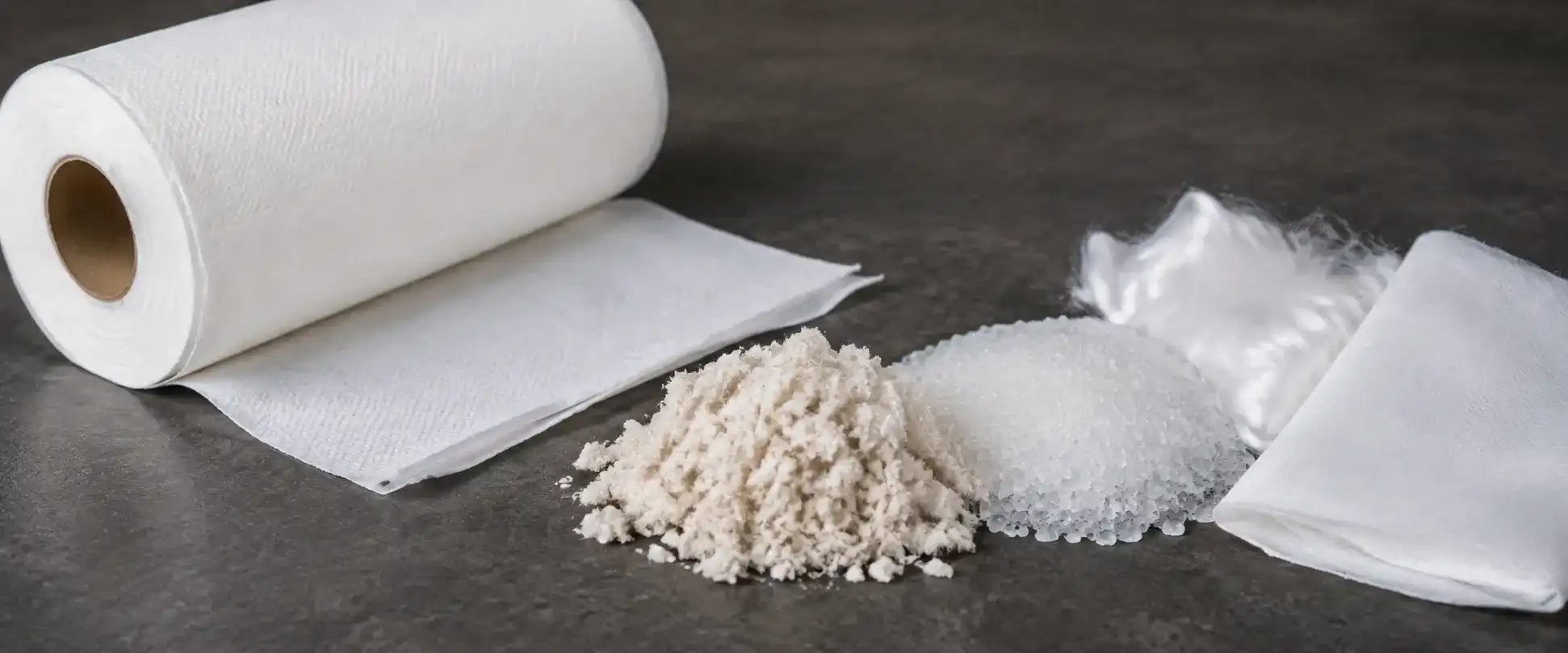
Why Paper Towel Structure Changes Performance
Ingredients alone cannot explain how a paper towel works. Absorbency depends on how water interacts with cellulose and how liquid moves through the spaces within the sheet. Cellulose attracts water, while pores and channels between fibers help distribute it through capillary action. A sheet with useful open volume can take up liquid quickly; a tightly compressed sheet may feel substantial yet provide less space for holding a spill.
Creping creates controlled microfolds.
During tissue production, the sheet is commonly removed from a drying surface in a way that creates fine folds in the web. Creping contributes softness, flexibility, stretch, and bulk. It also changes how the sheet contacts a wet surface. The effect must be balanced: too little structure can produce a flat, stiff sheet, while excessive disruption can reduce strength or create lint.
Embossing presses a pattern into one or more plies. It can add bulk, create channels and pockets, improve contact with a spill, and help bond layers. A visible pattern is therefore not only decoration, although pattern depth alone does not guarantee better results. The fiber furnish, basis weight, embossing geometry, ply alignment, and bonding pressure all contribute. Our explanation of embossed tissue covers the structural role in more detail.
Ply count is another visible feature that can be misunderstood. A two-ply product contains two base tissue layers, but it is not automatically twice as absorbent as a one-ply product. Each layer can have a different basis weight and fiber structure. Two light plies may provide useful bulk and flexibility; one heavier ply may provide different wiping strength. You need the complete construction, not the ply number alone.
Absorbency, Capacity, and Wet Strength Are Different
Absorbency is often used as one broad marketing word, but three practical questions are involved: how fast the towel takes up liquid, how much it holds, and whether it remains intact while wet. A product can perform well in one area and less well in another. Do not use thickness as a shortcut for all three measurements.
- Absorption speed: How quickly the liquid enters and spreads through the sheet after contact.
- Holding capacity: How much liquid remains in the sheet before dripping, saturation, or transfer.
- Wet tensile strength: How much pulling force the sheet tolerates after it has absorbed water.
- Surface pickup: How effectively the texture contacts droplets, grease, crumbs, or residue on a real surface.
This is why a controlled comparison should use the same liquid volume, surface, contact time, and wiping action. Our guide to paper towel absorbency separates these performance factors instead of treating thickness as the only measure.
How the Materials Become a Paper Towel
Paper towel production turns a highly diluted fiber suspension into a dry, converted roll or folded sheet. Exact machinery varies, but the sequence explains how raw material choices become visible product properties.
- Pulp preparation: Virgin pulp, recycled pulp, or a planned blend is dispersed in water. Contaminants and oversized particles are removed, and the furnish is adjusted for the target sheet.
- Refining and additive control: Fiber surfaces may be mechanically developed to influence bonding. Required process and performance additives are introduced under controlled conditions.
- Sheet formation: The dilute furnish is delivered onto a moving forming fabric. Water drains away while fibers settle into a continuous web.
- Water removal and drying: Vacuum, pressing, heated drying, or through-air drying reduces moisture. The selected drying method affects bulk, softness, energy use, and absorbent structure.
- Creping and base-roll winding: The dry tissue structure is developed and wound into large parent reels for converting.
- Embossing and ply assembly: One or more layers may be patterned, aligned, and bonded to create the required texture and roll construction.
- Perforating, cutting, and packaging: The web becomes consumer rolls, jumbo rolls, or folded towels. Finished products are checked against specifications before packing.
A material specification does not end at the pulp chest. Poor converting can cause loose plies, uneven perforations, crushed embossing, telescoped rolls, inconsistent sheet size, or dust at the cut edge.
For that reason, evaluating kitchen paper towels requires both composition and finished-product measurements. Roll diameter, sheet count, sheet dimensions, core size, ply, basis weight, absorbency, wet strength, embossing, perforation quality, packaging, and intended market can all belong in the same product discussion.
Paper Towel Composition by Product Type
The phrase paper towel covers several formats. A household kitchen roll typically prioritizes absorbency, softness, wet handling, perforation, and convenient sheet dispensing. A folded paper hand towel must also dispense reliably from a compatible unit. Commercial roll towels may prioritize controlled dispensing, roll length, and service intervals. Industrial paper wipers can emphasize abrasion resistance, oil pickup, or low lint.
These priorities can change the furnish and structure.
- Household kitchen rolls: Often designed around quick liquid pickup, comfortable handling, visible embossing, and useful strength for wiping.
- Folded paper hand towels: Need predictable fold geometry, separation, dispenser compatibility, and sufficient wet strength for hand drying.
- Commercial roll towels: May use virgin, recycled, or blended fiber and must balance roll length, dispensing resistance, absorbency, and cost per use.
- Industrial paper wipers: Can use heavier tissue structures or specialized materials for demanding wiping conditions; composition should be verified rather than assumed.
- Nonwoven wipes: Are a separate category and may include regenerated cellulose or synthetic fibers. They should not be described automatically as ordinary paper towels.
Intended use also affects which documentation matters. A towel used only for general surface cleaning raises different questions from one expected to touch food, sensitive equipment, solvents, or a controlled production area. Product claims should match the actual application and applicable market requirements.
Conclusion
What are paper towels made of? Most are made primarily from plant-based cellulose fiber, usually virgin wood pulp, recycled paper fiber, or a blend. Functional additives may support wet strength, softness, bonding, color, or manufacturing control, while creping, embossing, ply construction, and pore structure determine how those materials perform as a finished sheet.
Liansheng Sempo is a tissue factory. If you are discussing a paper towel product, contact us with the intended use, fiber preference, ply, sheet or roll format, absorbency and wet-strength expectations, packaging requirements, and target market. A clear specification makes it easier to compare the material claim with the performance you actually need.
FAQ
Are paper towels made from trees?
Most paper towels use cellulose pulp made from wood, so trees are a common fiber source. Some products use recovered paper, bamboo, bagasse, or other plant fibers instead.
Are paper towels made from recycled paper?
Some are. Paper towels may contain virgin fiber, recovered fiber, postconsumer recycled fiber, or a blend. Check the product claim for the stated percentage and type of recycled content.
Do paper towels contain plastic?
Standard tissue-based paper towels are mainly cellulose. They may use small amounts of synthetic polymer additives for performance, while specialized nonwoven or industrial wipes can contain synthetic fibers. Verify the specific product if plastic-free composition matters.
Why are paper towels so absorbent?
Cellulose attracts water, and liquid moves through pores between the fibers by capillary action. Creping, embossing, bulk, ply structure, and fiber arrangement create additional space for liquid pickup and storage.
What keeps paper towels from falling apart when wet?
Wet performance comes from the fiber blend, bonding, sheet structure, ply construction, and often a wet-strength system. The formulation varies by manufacturer and intended use.
Are brown paper towels unbleached?
A brown or natural appearance may indicate an unbleached or recycled furnish, but color alone is not proof. Read the material description or request documentation for the specific product.
Are paper towels biodegradable?
Cellulose fiber is biodegradable, but the rate and acceptable disposal route depend on additives, contamination, local conditions, and the product type. Biodegradable does not automatically mean suitable for recycling, flushing, or every compost system.


