
Soft tissue paper grades are mainly classified by fiber composition, manufacturing process, strength, absorbency, and surface feel.
Premium soft tissue is usually made from 100% virgin pulp and is designed for facial tissues, luxury hospitality, and healthcare. Mid-grade tissue balances virgin and recycled fibers for everyday use. Economy tissue relies more heavily on recycled or recovered fibers for high-volume, cost-sensitive applications. Specialty grades add functions such as hypoallergenic performance, biodegradability, compostability, lotion treatment, aloe, or antimicrobial properties.
The right grade depends on where the tissue will be used, how it will be dispensed, the required softness and strength, and your target price. A soft facial tissue needs a different fiber structure from commercial toilet tissue used in a busy airport restroom.
Key Takeaways
- Premium tissue grades use high-quality virgin pulp for softness, absorbency, and strength.
- Mid-grade tissue offers a practical balance between comfort and cost.
- Economy tissue is built for high-volume distribution and controlled purchasing budgets.
- Specialty tissue is developed for specific hygiene, environmental, or skin-contact requirements.
- GSM, ply count, fiber selection, and creping all influence the final feel and performance.
- Tissue buyers should evaluate softness together with wet strength, lint, absorbency, converting quality, and compliance documentation.
What Defines a Soft Tissue Paper Grade?
A soft tissue paper grade is not determined by one specification alone. Manufacturers assess the combination of raw material, sheet formation, basis weight, bulk, creping, embossing, ply construction, and converting performance. Two products with a similar GSM can feel very different if they use different pulp blends or manufacturing settings.
The practical question is not simply whether a tissue is “soft.” You need to identify how the sheet performs in its intended setting. Facial tissue should feel gentle against the skin. Toilet tissue should balance softness with disintegration and strength. Hand towels need absorbency and wet strength. Napkins must provide a clean appearance, folding quality, and sufficient stiffness for food-service use.
| Factors | Influence | Importance |
|---|---|---|
| Fiber composition | Softness, strength, absorbency, sustainability profile | Helps match the product to the end use |
| GSM | Sheet weight, bulk, and material usage | Affects feel, cost, and packaging calculations |
| Ply count | Strength, cushioning, and thickness | Supports product positioning and user comfort |
| Creping | Stretch, bulk, surface softness, and absorbency | Strongly affects tactile performance |
| Embossing | Appearance, ply bonding, and bulk | Helps create a stable, premium-feeling sheet |
| Wet strength | Resistance to breakdown when wet | Important for hand towels and selected commercial products |
| Lint level | Surface cleanliness and user experience | Relevant to facial tissue, healthcare, and professional cleaning |
A higher GSM or ply count does not automatically guarantee better softness, and recycled content does not automatically mean poor performance. Manufacturing control and product design determine how the material behaves in use.
Premium Soft Tissue Grade
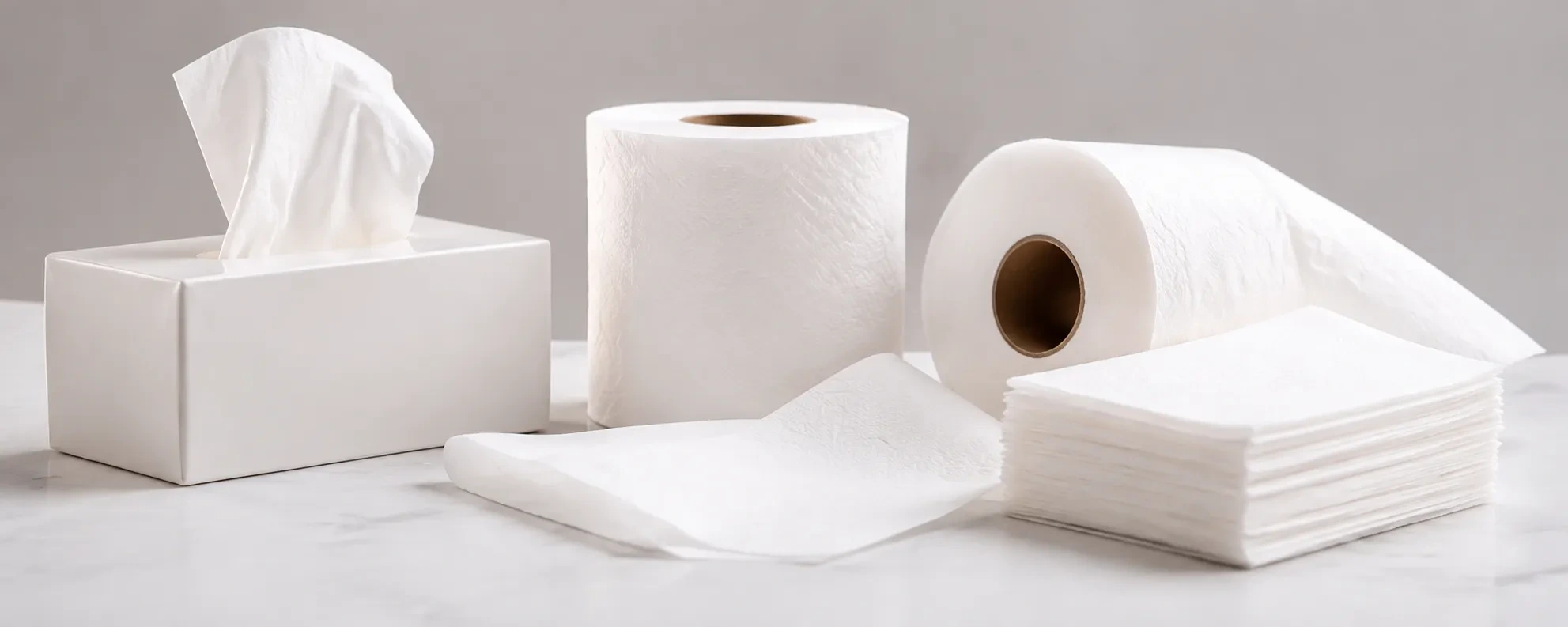
Premium soft tissue is generally produced from 100% virgin pulp, often using carefully selected hardwood fibers such as eucalyptus. It offers a smooth, gentle surface with strong absorbency and reliable tensile performance. This grade is commonly selected for high-end facial tissues, premium bathroom tissue, luxury hotels, airlines, spas, and healthcare environments where skin comfort and product presentation are important.
Virgin pulp gives manufacturers greater control over fiber cleanliness, formation, softness, and sheet consistency. Hardwood fibers can contribute to a fine, smooth surface, while the final result also depends on refining, drying, creping, embossing, and converting. Premium tissue may use two or three plies, depending on whether the priority is a soft facial sheet, a thicker bathroom tissue, or a more substantial hospitality product.
Where Premium Tissue Works
- Facial tissues for frequent skin contact.
- Luxury hotel and resort bathrooms.
- Private clinics, hospitals, and patient-care areas.
- Premium household bathroom tissue.
- Corporate offices and executive facilities.
- Branded retail products positioned around comfort.
Virgin pulp and tighter quality control usually increase the material price, but they can reduce complaints related to roughness, lint, inconsistent sheet formation, and weak wet performance. For premium products, buyers should request softness, absorbency, tensile strength, lint, and appearance data together with a physical sample.
Mid-Grade Soft Tissue
Mid-grade tissue is designed to provide dependable comfort without the cost of a fully premium construction. It may use a blend of virgin and recycled fibers, or it may use a selected pulp formulation optimized for everyday performance. This grade is widely used in homes, standard office restrooms, mid-range hotels, clinics, and general institutional settings.
A well-designed value grade should still provide acceptable softness, absorbency, sheet integrity, and converting consistency. The objective is not to maximize one performance characteristic. Instead, the manufacturer balances raw material cost, ply structure, basis weight, packaging, and production efficiency so the finished tissue performs reliably in normal daily use.
Why Choose Mid-Grade Tissue
- Private-label household tissue.
- Office and commercial restroom programs.
- Mid-range hospitality products.
- Retail facial tissues with controlled pricing.
- Institutional purchasing where comfort and budget both matter.
“Value,” “pure pulp,” and “standard” are not globally uniform technical classifications. Ask for the fiber source, recycled content, basis weight, ply construction, and test standards used for the product.
Economy Soft Tissue Grade
Economy tissue is developed for cost control, high-volume distribution, and frequent replacement. It often contains a higher percentage of recycled or recovered fibers and is commonly supplied to schools, airports, public buildings, transport facilities, factories, and high-traffic restrooms. The priority is usually adequate function at a low unit cost rather than the softest possible tactile experience.
A product that is too weak can create waste, block dispensers, increase maintenance, or cause user complaints. A product that is unnecessarily heavy can raise purchasing and logistics costs. The best economy grade is therefore engineered for the application, not simply made as thin or inexpensive as possible.
| Application | Purchasing | Product Consideration |
|---|---|---|
| Schools | Low cost and dependable supply | Controlled softness and adequate strength |
| Airports | High volume and dispenser compatibility | Consistent roll size and sheet release |
| Public restrooms | Cost per use and maintenance | Fast replenishment and acceptable comfort |
| Factories | Durability and supply efficiency | Suitable sheet size and reliable dispensing |
| Large institutions | Budget control and standardization | Stable specifications across deliveries |
When purchasing economy tissue, evaluate cost per usable sheet or cost per hand dry, not only cost per case. Roll length, sheet count, core size, dispenser fit, packaging, and wastage can materially change the real operating cost.
Specialty Soft Tissue Grades
Specialty tissue grades are formulated for a defined functional requirement beyond basic softness. They may be designed for sensitive skin, reduced environmental impact, enhanced absorbency, premium sensory performance, or a particular commercial application. Examples include hypoallergenic facial tissue, biodegradable or compostable tissue, lotion-infused tissue, aloe tissue, recycled-content tissue, and selected antimicrobial products.
Each specialty claim needs technical support. A product described as hypoallergenic should be evaluated against the intended market’s labeling and testing requirements. Biodegradable and compostable claims must reflect the relevant certification or regulatory framework. Lotion, aloe, and antimicrobial treatments also require careful control of formulation, skin-contact safety, fragrance, shelf stability, and declaration requirements.
| Specialty Type | Purpose | Verification |
|---|---|---|
| Hypoallergenic | Reduce common irritation concerns | Ingredient review and applicable testing |
| Lotion or aloe | Improve skin-contact comfort | Formula safety and stability |
| Biodegradable | Support environmental positioning | Recognized test method or certification |
| Compostable | Designed for defined composting conditions | Applicable compostability standard |
| Antimicrobial | Provide a specific treated-product function | Active substance rules and claims support |
| High-recycled-content | Increase recovered fiber use | Documented fiber sourcing and consistency |
Specialty tissue should be specified by its measurable function and market requirements.
How GSM Affects Tissue Softness And Quality
GSM means grams per square meter and describes the weight of the paper sheet. It influences bulk, thickness, opacity, absorbency, and material usage, but it does not directly measure softness. A lighter sheet can feel soft when it has effective creping and a well-formed surface. A heavier sheet can feel rough if its fibers, drying conditions, or surface treatment are poorly controlled.
As a general reference, facial tissue often falls around 12–15 GSM per tissue layer, while standard bathroom tissue may commonly fall around 20–30 GSM per layer. These ranges vary by market, product format, ply, converting method, and manufacturer specification. Buyers should always compare samples made to the same intended use instead of using GSM as the only quality benchmark.

| Tissue Product | GSM Consideration | Performance Focus |
|---|---|---|
| Facial tissue | Light, soft layers | Skin comfort, absorbency, low lint |
| Bathroom tissue | Moderate basis weight | Softness, strength, dispersibility, bulk |
| Hand towel | Higher material requirement | Absorbency, wet strength, sheet size |
| Napkin | Application-dependent | Fold quality, appearance, absorbency |
For accurate purchasing, request whether the stated GSM applies to one layer, one ply, or the finished multi-ply sheet. This prevents misleading comparisons between suppliers.
Ply Count, Creping, And Embossing
Two-ply tissue usually provides a practical balance between softness, strength, and cost. Three-ply tissue can offer more cushioning, bulk, and durability, but it generally requires more material and may cost more. Ply count alone does not establish quality because layer formation, bonding, fiber selection, and embossing also affect performance.
Creping is the controlled process of creating small folds or waves in the tissue web. Effective creping increases stretch, bulk, surface area, and perceived softness. It can also improve absorbency by creating more space within the sheet structure. The result depends on blade condition, creping angle, machine speed, drying control, and the characteristics of the paper web.
Embossing can improve the appearance and bulk of multi-ply tissue while helping hold layers together. Excessive embossing may reduce the smooth contact area or affect the sheet’s perceived softness, so the pattern should match the intended product position. For private-label orders, review the embossing pattern, ply bonding, roll diameter, sheet dimensions, and dispenser compatibility during sample approval.
How To Select The Soft Tissue Grade
Choose the grade according to the user, environment, and operating cost. Premium tissue is suitable when skin comfort and presentation lead the decision. Mid-grade tissue is appropriate for everyday use where you need a reliable balance. Economy tissue works well in high-traffic locations with strict cost targets. Specialty tissue should be selected when a verified functional or environmental property is required.
A clear buying process helps prevent quality problems after production. Before confirming an order, define the product’s intended use, required dimensions, ply, roll or folded format, packaging, core size, and compliance needs.
Tissue Paper Manufacturing Quality Control
Softness is created through a controlled manufacturing system, not a single additive or machine setting. Quality control may cover incoming pulp inspection, stock preparation, sheet formation, drying, creping, embossing, rewinding, cutting, packaging, and final inspection. The relevant test methods depend on the product type and the destination market.
Useful documentation may include product specifications, fiber information, dimensions, ply, roll length or sheet count, packaging details, and applicable safety or environmental certificates. Batch consistency is also important. A sample that performs well should represent the material and process used for the production order.
Liansheng Sempo manufactures tissue paper products for customers who need a defined balance of softness, strength, application performance, and cost. Our product development approach can support premium, mid-grade, economy, and specialty tissue requirements, subject to the selected material, format, and market specification.
Provide the intended application, target market, tissue format, ply, sheet or roll dimensions, packaging requirements, estimated order volume, and any fiber or certification expectations. This information allows the factory team to recommend a more suitable specification instead of assigning a generic grade name.
Conclusion
Soft tissue paper grades range from premium virgin-pulp products to value, economy, and specialty constructions. The right choice depends on the application rather than the grade name alone. Evaluate fiber composition, GSM, ply, creping, absorbency, strength, lint, dispenser compatibility, and verified claims before placing an order.
Liansheng Sempo can help you develop tissue paper specifications for household, hospitality, healthcare, office, institutional, and commercial applications. Contact our team with your target market, product format, performance requirements, packaging needs, and expected volume to discuss a suitable manufacturing solution.
Frequently Asked Questions
What is the softest grade of tissue paper?
Premium tissue made from selected virgin pulp is generally the softest grade, especially when combined with effective creping and a well-controlled surface. The final feel also depends on GSM, ply, drying, embossing, and converting quality.
Is virgin pulp tissue softer than recycled tissue?
Virgin pulp tissue is often softer and more consistent because its fibers are cleaner and less processed. However, well-engineered recycled tissue can provide acceptable softness, strength, and absorbency for many commercial and household applications.
What does 2-ply tissue mean?
Two-ply tissue consists of two paper layers joined together. It usually provides a balance of softness, strength, thickness, and price. The actual performance depends on the fiber blend, GSM, embossing, and ply bonding.
What is the difference between premium and economy tissue paper?
Premium tissue typically uses more virgin pulp and places greater emphasis on softness, absorbency, appearance, and consistency. Economy tissue usually uses more recycled or recovered fibers and is optimized for high-volume use and lower cost per unit.
Is higher GSM tissue always better?
No. Higher GSM can increase bulk and material weight, but it does not automatically make tissue softer or more absorbent. Creping, fiber quality, formation, ply construction, and the intended application must also be considered.
What type of tissue paper is best for sensitive skin?
A soft, low-lint facial tissue with a smooth surface and no unnecessary fragrance is often suitable for sensitive skin. If the product makes a hypoallergenic or lotion-related claim, review its ingredients, testing, and applicable labeling requirements.
Which tissue grade is best for hotels?
The best grade depends on the hotel’s positioning and operating budget. Luxury hotels often choose premium virgin-pulp tissue, while mid-range properties may select a value grade that balances softness, appearance, supply reliability, and cost.
What tissue paper is best for public restrooms?
Economy or commercial tissue is commonly used in public restrooms because it supports high-volume consumption and budget control. The product must still match the dispenser, roll dimensions, sheet release, and expected level of softness and strength.
Can tissue paper be biodegradable or compostable?
Some tissue products are designed to biodegrade or meet compostability requirements, but the claim depends on the materials, additives, processing, and applicable standard. Ask for supporting test results or certification before using the claim in commercial packaging.


