
The right tissue paper depends on where and how you will use it. For facial care, prioritize softness and skin comfort. For bathrooms, look for softness, strength, and fast dissolvability. For kitchens, food service, and cleaning, absorbency and wet strength matter more. Healthcare and industrial environments also require reliable hygiene, low lint, controlled dispensing, or resistance to tearing.
By comparing fiber quality, ply, thickness, surface texture, roll design, chemical safety, sustainability, and total cost per use, you can select tissue paper that performs well without creating unnecessary waste.
At Liansheng Sempo, we manufacture tissue paper products for household, commercial, hospitality, healthcare, and industrial applications. The product should always be matched to the actual use scenario, expected traffic, dispensing system, storage conditions, and purchasing budget.
Key Takeaways
- ✓Match softness, absorbency, strength, and wet strength to the intended application.
- ✓Choose facial tissue for skin comfort and toilet tissue for softness, strength, and dissolvability.
- ✓Select paper towels and kitchen tissue with strong liquid absorption and wet performance.
- ✓Use thicker napkins and premium tissue products when presentation affects the customer experience.
- ✓Choose low-lint and hygienically controlled products for healthcare and cleanroom environments.
- ✓Compare ply, sheet size, roll length, and dispensing format instead of judging price alone.
- ✓Assess recycled fibers, bamboo fibers, responsible sourcing, and manufacturing practices as part of sustainability.
Understanding The Basic Characteristics Of Tissue Paper
The best way to choose tissue paper is to evaluate the characteristics that affect performance in your specific setting. A soft facial tissue and a heavy-duty industrial wiping tissue are both made from paper, but they are engineered for very different tasks.
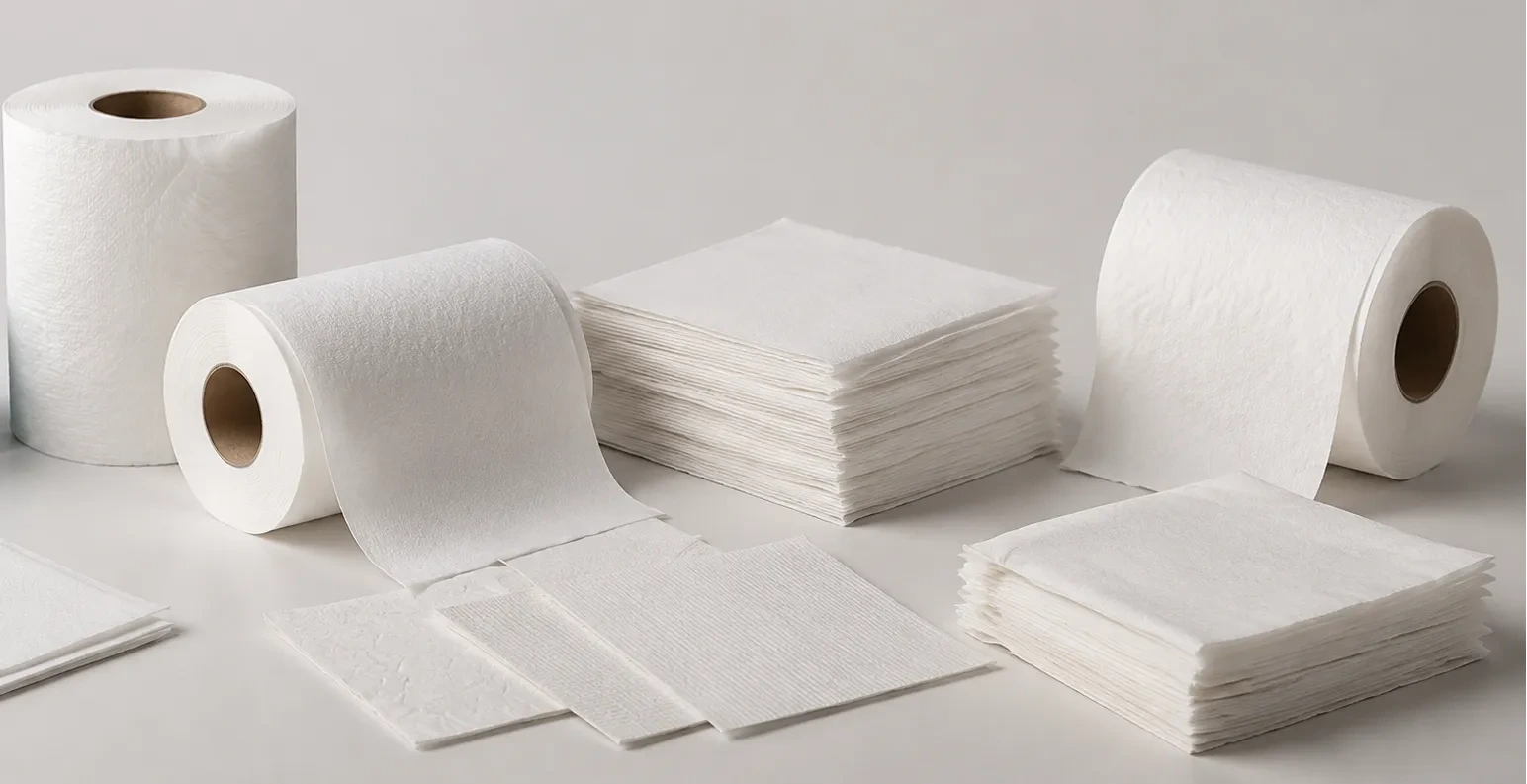
Softness
Softness describes how smooth and comfortable the tissue feels against the skin. It is especially important for facial tissue, baby tissue, medical tissue, and products used repeatedly during colds, allergies, or skincare routines.
Softness is influenced by fiber quality, refining, sheet formation, basis weight, ply structure, and surface treatment. A tissue may feel soft because it uses fine fibers, a smoother surface, an embossed structure, or a lotion treatment. However, softness should not be assessed alone. A very soft tissue that tears during use may create more waste and provide a poor experience. For repeated skin contact, you should look for:
- 1.A smooth surface with limited roughness.
- 2. Consistent softness across the full sheet.
- 3. Low odor and suitable chemical control.
- 4. Enough strength to prevent tearing during normal use.
Absorbency
Absorbency is the ability of tissue paper to take in and retain liquids. It is a primary performance factor for paper towels, kitchen tissue, hand towels, medical hand-drying products, and industrial wiping tissue.
A tissue’s absorbency depends on fiber composition, sheet density, porosity, embossing, ply bonding, and the type of liquid being absorbed. Water, oil, grease, cleaning chemicals, and food residues do not behave in the same way. A product that performs well with water may not be suitable for oil or solvent-related cleaning.
High absorbency can reduce the number of sheets needed for a task. That makes it relevant to both user convenience and operating cost. When evaluating a product, consider whether you need rapid liquid uptake, high retention, or the ability to absorb while remaining intact.
Strength and Wet Strength
Dry strength refers to the tissue’s ability to resist tearing during normal dry handling. Wet strength refers to how well it maintains its structure after contact with water or another liquid.
Toilet tissue usually needs to dissolve efficiently after flushing, so it is not designed to have the same wet strength as a kitchen towel. Paper towels and industrial wiping tissue, by contrast, must remain usable when wet. Selecting a product with the wrong strength profile can lead to tearing, excessive consumption, blocked plumbing, or inefficient cleaning. You should consider:
- Dry strength: Important for facial tissue, toilet tissue, napkins, and general wiping.
- Wet strength: Important for kitchen cleaning, hand drying, healthcare, and industrial wiping.
- Tear resistance: Important when wiping rough surfaces or handling oil and grease.
- Dissolvability: Important for toilet tissue and applications connected to wastewater systems.
Fiber Quality
Fiber quality affects softness, strength, absorbency, bulk, and product consistency. Virgin wood pulp, recycled fiber, bamboo fiber, and blended fiber structures each offer different performance characteristics.
Longer fibers generally contribute to strength, while carefully processed shorter fibers can support softness and sheet formation. Recycled fiber can support waste reduction goals, but its performance depends on the quality of the recovered material and the manufacturing process. Bamboo fiber is renewable and can provide a useful balance of softness and strength when processed correctly.
The material decision should reflect the application. For example, a premium facial tissue may require a different fiber blend from an industrial wiper designed to handle grease. A tissue paper manufacturer should be able to explain the intended performance of each material option rather than treating all fiber types as interchangeable.
Ply Structure
Ply refers to the number of tissue layers bonded together. Single-ply tissue is generally lighter and can be suitable for basic, high-volume applications. Two-ply and three-ply products usually provide more softness, bulk, strength, and absorbency.
However, more plies do not automatically mean better value. A two-ply product with efficient embossing and good fiber quality may outperform a poorly designed three-ply product. You should compare the complete product specification, including sheet size, roll length, basis weight, embossing, and actual usage.
Thickness and Basis Weight
Thickness describes the bulk or caliper of the tissue sheet. Basis weight, commonly measured in grams per square meter, describes the weight of the paper per unit area.
These measurements influence:
- Perceived quality and comfort.
- Liquid absorption and retention.
- Resistance to tearing.
- Material consumption.
- Packaging volume and storage requirements.
A thicker tissue may be preferable for kitchen cleaning or premium napkins, while a lighter tissue may be more appropriate for controlled dispensing in a busy public restroom. The most suitable thickness depends on the task, not simply on the product’s appearance.
Surface Texture and Embossing
Embossing creates a raised pattern on the tissue surface. It can improve perceived softness, increase bulk, support ply bonding, and create additional space for liquid absorption.
Embossing also affects appearance. In hospitality and food service, a controlled pattern can make a napkin feel more substantial and fit the visual identity of a venue. For industrial cleaning, performance and strength usually matter more than decorative appearance.
Surface texture should remain compatible with the intended use. A rough or heavily patterned surface may not be suitable for sensitive skin, while a very smooth, lightweight sheet may not provide enough grip for wiping.
Chemical Safety and Moisture Resistance
Fragrances, dyes, lotions, adhesives, and other processing additives can affect the suitability of tissue paper for different users and environments. Products intended for babies, sensitive skin, healthcare, food contact, or cleanroom use may require tighter control over odor, additives, lint, and contamination.
Moisture resistance is also important during storage. Tissue paper should be protected from humidity, water exposure, dust, and direct contact with contaminated surfaces. Even a correctly specified product can lose performance if it is stored in a damp warehouse or left outside its protective packaging.
Manufacturing Consistency
Manufacturing consistency is often overlooked during product selection. A tissue product should maintain stable softness, sheet dimensions, ply bonding, thickness, roll length, and appearance from batch to batch.
In commercial and industrial purchasing, inconsistent quality can create hidden costs. Staff may use more sheets, dispensers may jam, packaging may not fit the system, and users may complain about changes in performance. Ask suppliers about quality control procedures, production capacity, batch traceability, and pre-shipment inspection when consistent supply is important.
Types Of Tissue Paper For Different Applications
Different tissue paper products are designed around different user needs.
| Type of Tissue Paper | Common Applications | Main Performance Requirements |
|---|---|---|
| Facial Tissue Paper | Personal care, skincare, cold and allergy care | Softness, low irritation, light strength |
| Toilet Tissue Paper | Residential and commercial bathrooms | Softness, absorbency, strength, dissolvability |
| Paper Towels | Hand drying, spills, surface cleaning | Absorbency, wet strength, tear resistance |
| Napkin Tissue Paper | Restaurants, hotels, catering, events | Softness, appearance, food-use suitability |
| Baby Tissue Paper | Baby care and sensitive skin cleaning | Softness, low odor, gentle materials |
| Medical Tissue Paper | Hospitals, clinics, nursing facilities | Hygiene, low lint, reliable strength |
| Industrial Wiping Tissue | Equipment, oil, grease, and residue removal | High strength, absorption, wet durability |
| Jumbo Roll Tissue Paper | High-traffic public and commercial restrooms | Capacity, controlled consumption, easy replacement |
| Recycled Tissue Paper | Household and commercial sustainability programs | Recycled content, acceptable softness and strength |
| Specialty Decorative Tissue | Packaging, events, decoration | Color, pattern, appearance, sheet quality |
| Cleanroom Tissue | Precision manufacturing and controlled spaces | Low particle generation, cleanliness, low lint |
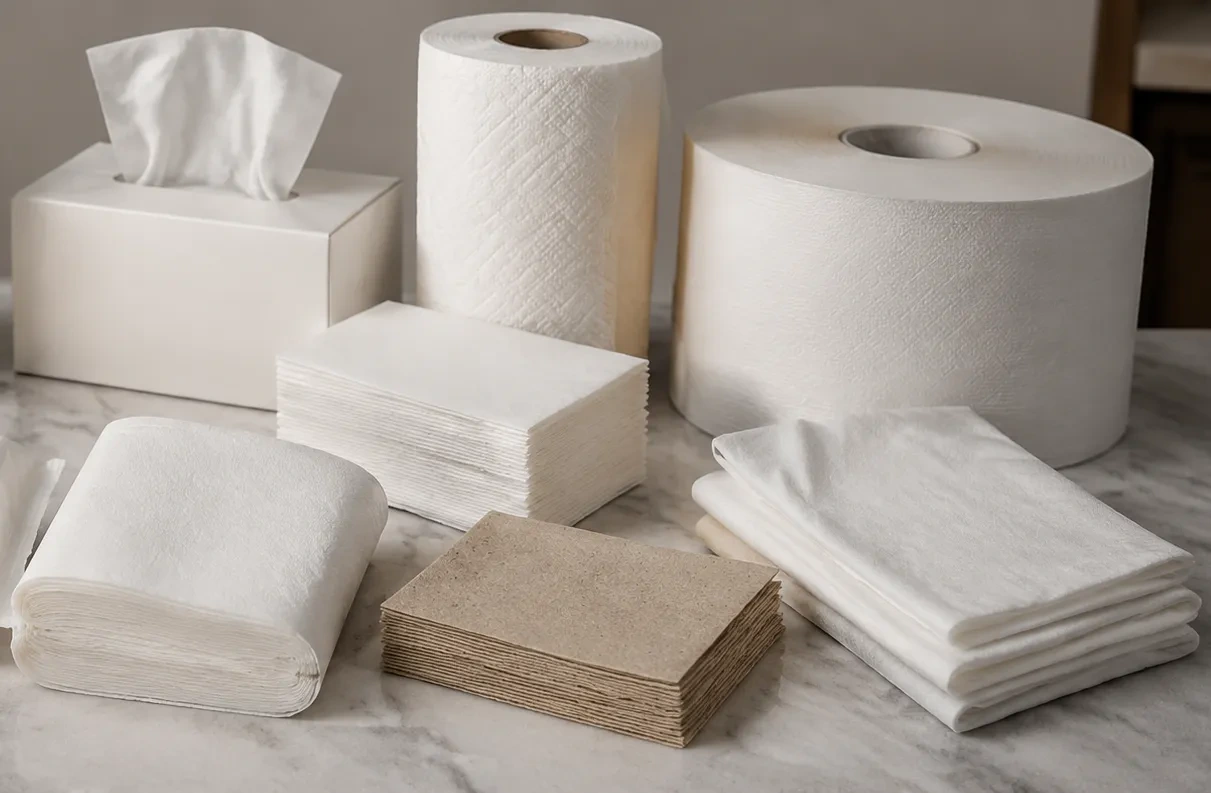
1. Facial Tissue Paper
Facial tissue paper should focus on softness, skin comfort, and adequate dry strength. Since it is used on the face, the surface must feel gentle during repeated wiping. A tissue that is too rough can increase discomfort, particularly for people with allergies, colds, or sensitive skin.
Two-ply and three-ply facial tissues are commonly selected when users expect additional softness and durability. Some products include lotion or other surface treatments, but you should check whether those additives are suitable for the intended users. Fragrance-free options may be preferable in healthcare settings, childcare environments, and locations serving people with sensitive skin.
2. Toilet Tissue Paper
Toilet tissue paper must balance comfort, strength, absorbency, and dissolvability. For residential bathrooms, you may prioritize softness and compatibility with septic systems. For public or commercial bathrooms, roll capacity, dispensing control, and replacement frequency become more important.
A toilet tissue product with excessive wet resistance may not break down as efficiently after flushing. Always consider local plumbing conditions and follow the guidance of the product supplier and wastewater system manufacturer.
3. Paper Towels and Kitchen Tissue Paper
Paper towels and kitchen tissue paper need to absorb liquids quickly while maintaining their structure. They are used for drying hands, wiping counters, cleaning spills, and handling moisture during food preparation.
A thicker multi-ply construction can provide more absorption capacity, but the best product depends on how much liquid users typically handle. In a controlled dispenser, a strong single-ply towel may reduce consumption. In a household kitchen, a two-ply or embossed towel may offer a better balance of performance and convenience.
4. Napkin Tissue Paper
Napkin tissue paper is used in restaurants, hotels, cafés, catering operations, and events. It has both a functional and a presentation role. The napkin must work for wiping hands and faces, but it also contributes to the perceived standard of service.
Casual dining may use economical single-ply or two-ply napkins. Fine dining, hotels, and formal events often select thicker two-ply or three-ply napkins with stronger structure and a more refined appearance. Color, folding format, embossing, and packaging can be adjusted to match the service environment.
For food-related applications, check that the product is suitable for the intended use and meets applicable food-contact requirements in the target market. Tissue should be clean, odor-free, and protected from contamination during transportation and storage.
5. Baby Tissue Paper
Baby tissue paper should be soft, low-lint, and gentle on sensitive skin. Fragrance-free and carefully controlled material options are often preferred, although the precise requirements depend on the product category and local regulations.
When choosing baby tissue for wipes, cleaning, or personal care, you should separate dry tissue performance from wet wipe performance. Wet wipes may include different fibers, lotions, preservatives, and packaging requirements. The supplier should clearly identify whether the product is intended for dry use, wet use, or both.
6. Medical Tissue Paper
Medical tissue paper is used in patient care, examination areas, hand drying, facial care, and general hygiene routines. In these environments, softness matters, but cleanliness, low lint, dependable strength, and packaging control are equally important.
Disposable paper towels can support hygiene routines by reducing the need to reuse cloth materials. However, the product should be integrated with correct hand hygiene, waste handling, and infection-control procedures. Tissue paper alone does not replace a facility’s established hygiene protocols.
7. Industrial Wiping Tissue
Industrial wiping tissue is selected for demanding cleaning tasks, including removing oil, grease, dust, lubricants, and residue from tools, machinery, and work surfaces. It needs higher tear resistance than ordinary facial or bathroom tissue.
The right industrial wiper depends on the contaminant. Water-based spills, oils, solvents, and abrasive particles require different combinations of absorbency, wet strength, and surface durability. Before placing a large order, test the product on the actual equipment and cleaning process.
8. Jumbo Roll Tissue Paper
Jumbo roll tissue paper is designed for high-traffic restrooms in offices, airports, shopping centers, schools, factories, and other public facilities. Its larger capacity reduces replacement frequency and can lower maintenance labor.
The roll must match the dispenser dimensions. Check core size, roll diameter, sheet width, perforation, and dispensing direction. A high-capacity roll that does not fit the existing system is not a practical choice.
Key Considerations For Choosing The Right Tissue Paper For Different Applications
For household use, choose tissue paper room by room because each task has different requirements. Facial tissue should prioritize softness, toilet tissue should balance comfort and dissolvability, and kitchen towels should focus on absorbency and wet strength.
1. For Household Use
You may use facial tissue several times a day, especially during seasonal allergies or illness. A soft two-ply or three-ply product with a smooth, low-irritation surface is usually more comfortable than a thin, rough sheet.
If your skin is sensitive, compare fragrance-free options and review the product information for lotions, dyes, and other additives. Softness should be paired with enough strength to prevent the tissue from breaking apart during use. When selecting toilet paper, consider:
- 1. Softness and surface comfort.
- 2. Ply and sheet strength.
- 3. Dissolvability after flushing.
- 4. Compatibility with septic or wastewater systems.
- 5. Roll length and storage space.
Kitchen paper towels should be selected according to the type of cleaning you perform. For drying hands and wiping small spills, a medium-weight towel may be enough. For repeated wiping, soaking up larger spills, or cleaning wet surfaces, choose a thicker product with stronger wet strength.
Do not assume that the thickest towel is always the most economical. A well-formed, absorbent towel can complete a task with fewer sheets, which is often more important than thickness alone.
2. For Food Service and Hospitality
Food service and hospitality operations should evaluate tissue paper as part of the guest experience and the facility’s hygiene process. Appearance, softness, food-use suitability, dispenser compatibility, packaging, and consumption rate all affect the final choice.
A quick-service restaurant may need a cost-controlled napkin that is easy to dispense at high volume. A hotel restaurant may require a thicker napkin with better presentation. Catering companies may value folded formats and packaging that simplify transport and event setup. The following factors help narrow the selection:
- Service style and expected customer perception.
- Required napkin size and fold.
- One-ply, two-ply, or three-ply construction.
- White, colored, printed, or embossed appearance.
- Storage and dispenser requirements.
- Suitability for contact with food.
Hotels and public venues commonly use facial tissue, toilet tissue, hand towels, and napkins across several locations. Guest rooms may require softer, more presentable products, while public restrooms prioritize capacity and maintenance efficiency.
Individually wrapped tissues can help protect unused sheets in guest rooms, clinics, transport hubs, and other shared environments. Interfold towels and controlled dispensers can also reduce unnecessary contact and help manage consumption.
3. For Healthcare and Medical Applications
Healthcare facilities should choose tissue paper based on hygiene, low lint, skin comfort, packaging protection, and consistent performance. Product selection should support established infection-control procedures and safe disposal practices.
Facial tissues used around patients should be soft enough for repeated contact but strong enough to avoid tearing. Fragrance-free or low-additive products may be preferred for sensitive users, depending on the facility’s purchasing policy.
Nursing homes and long-term care facilities may have additional needs because tissues are used frequently and by people with delicate skin. In these settings, softness and dependable supply are operational requirements, not simply premium features.
Hand Drying and General Cleaning
Hand-drying towels should absorb moisture quickly and remain intact during use. A suitable towel can help users dry their hands effectively while limiting excess sheet consumption.
For general cleaning, low lint and packaging control matter. Tissue that sheds fibers can be unsuitable around medical equipment, sensitive surfaces, or areas where cleanliness is closely monitored.
4. For Commercial and Industrial Applications
Commercial and industrial tissue paper must deliver reliable performance under repeated use. Offices, factories, workshops, warehouses, and public facilities generally care about durability, consumption control, maintenance time, and total operating cost.
Office Bathrooms and Public Facilities
In an office bathroom, you may need a balance between user comfort and economical consumption. Jumbo rolls, high-capacity systems, or interfold dispensers can reduce refill frequency in busy locations.
A low-cost roll may become expensive if it runs out quickly, jams, or encourages users to take excessive sheets. The complete system should make appropriate consumption easy.
Industrial Wiping
Industrial wiping tissue should be chosen after identifying the surface and contaminant. Oil and grease usually require a stronger, more absorbent product than ordinary dusting or light surface wiping.
- Wet strength after contact with the liquid.
- Resistance to tearing during scrubbing.
- Absorbency and liquid retention.
- Lint generation.
- Compatibility with the surface or equipment.
- Sheet size and ease of handling.
- Disposal requirements after use.
Cleanroom and Controlled Environments
Cleanroom tissue is used where particle generation and contamination must be controlled. It may be required in electronics, laboratories, pharmaceuticals, optics, and other precision manufacturing environments.
You should not treat ordinary tissue paper as a substitute for cleanroom-approved materials. Review the required cleanliness class, packaging method, lint level, particle performance, and handling procedure before purchasing. The product must fit the facility’s complete contamination-control system.
5. Environmental Impact and Sustainability
Sustainability should be assessed across materials, manufacturing, packaging, transportation, use, and disposal. Choosing tissue paper with recycled fibers or bamboo fibers can support environmental objectives, but material selection alone does not provide a complete environmental assessment.
1. Recycled Tissue Paper
Recycled tissue paper reduces reliance on virgin fiber and supports the use of recovered paper materials. Its softness, color, strength, and absorbency can vary according to the quality of the recovered fiber and the manufacturing process.
Recycled tissue can be appropriate for offices, public facilities, household use, and many general cleaning applications. For sensitive applications, compare the product’s hygiene controls, softness, odor, lint, and strength before making a decision.
2. Bamboo Tissue Paper
Bamboo tissue paper uses bamboo fiber from a fast-growing renewable resource. It can offer a practical alternative to conventional wood-based materials while providing useful softness and strength.
You should still ask how the bamboo is sourced, processed, and blended. A sustainability claim is more meaningful when supported by clear information about raw materials, production, packaging, and relevant certifications where applicable.
6. Ply, Thickness, and Roll Design
Ply, thickness, sheet size, perforation, embossing, core size, and roll length all influence how tissue paper performs in real use. These specifications should be evaluated together.
1. Choosing the Right Ply
Single-ply tissue is often suitable for basic, high-volume use where cost and controlled dispensing are priorities. Two-ply tissue provides a broader balance of softness, strength, and absorbency. Three-ply tissue is more likely to be selected for premium facial care, hospitality, or applications where comfort is important.
A busy public restroom may benefit from a high-capacity two-ply jumbo roll, while a guest room may use a smaller premium roll with a softer feel.
2. Thickness and Embossing
Thicker tissue generally feels more substantial and can absorb more liquid, but thickness may increase unit cost and packaging volume. Embossing can add bulk and help bond multiple layers, but it does not replace good fiber quality or appropriate basis weight.
When comparing products, examine the sheet dimensions and roll length. A thicker roll with fewer sheets may not offer better value than a slightly lighter roll with efficient sheet formation.
3. Roll and Dispensing Design
Roll design should match the dispenser and the traffic level. Consider whether the site uses standard rolls, jumbo rolls, center-pull rolls, folded towels, or interfold systems.
| Application | Ply and Design | Reason |
|---|---|---|
| Facial Care | Two-ply or three-ply soft tissue, possibly embossed | Supports comfort and reduces skin irritation |
| Bathroom Use | Two-ply or three-ply standard rolls or jumbo rolls | Balances comfort, strength, and capacity |
| Kitchen Cleaning | Thick multi-ply rolls with high absorbency | Handles spills and repeated wiping |
| Restaurants and Hotels | Premium two-ply or three-ply napkins | Improves presentation and user experience |
| Healthcare Facilities | Soft multi-ply tissue with controlled dispensing | Supports hygiene and reliable handling |
| Industrial Cleaning | Heavy-duty multi-layer rolls with wet strength | Resists tearing during demanding tasks |
| Public Facilities | Jumbo rolls or interfold systems | Reduces maintenance frequency and consumption |
How To Select The Tissue Paper
Step 1: Identify the Use Scenario
Start with the exact task. Ask whether the tissue will contact skin, absorb water, handle oil, support food service, or be flushed through a plumbing system.
Step 2: Define the Required Performance
- 1. Softness and skin comfort.
- 2. Absorbency and liquid retention.
- 3. Dry strength and tear resistance.
- 4. Wet strength.
- 5. Dissolvability.
- 6. Low lint and cleanliness.
- 7. Appearance and presentation.
- 8. Storage and dispensing compatibility.
Step 3: Match the Product Format
Select the appropriate roll, fold, sheet size, pack size, and dispenser format. The correct paper in the wrong format can still cause operational problems.
Step 4: Test Samples in the Real Environment
Use samples in the actual bathroom, kitchen, hotel room, clinic, workshop, or production area. Check how the tissue performs under normal handling and whether users take more sheets than expected.
Step 5: Compare Total Value
Compare performance, consumption, labor, packaging, storage, and supply reliability. This produces a more accurate decision than comparing the price per case alone.
Conclusion
Selecting the right tissue paper requires more than choosing the softest or least expensive product. You need to match the tissue’s fiber quality, ply, thickness, absorbency, strength, wet performance, dissolvability, packaging, and sustainability profile to the application. Facial care, bathrooms, kitchens, hospitality, healthcare, public facilities, and industrial cleaning each require a different balance of properties.
Liansheng Sempo supplies tissue paper solutions for household and professional use, with product options that can be evaluated according to application, dimensions, ply, material, embossing, packaging, and dispensing requirements. Contact Liansheng Sempo to discuss your tissue paper specifications, private-label needs, bulk purchasing requirements, and application conditions. A product sample and clear technical requirements are the best starting point for selecting a tissue that performs consistently and controls long-term cost.
Frequently Asked Questions
What type of tissue paper is best for daily household use?
For daily household use, choose facial tissue for skin contact, toilet tissue for bathroom hygiene, and absorbent paper towels for kitchen cleaning. Two-ply products are often a practical balance of softness, strength, and cost, but the best choice depends on the specific task.
How do I choose tissue paper for a commercial restroom?
Choose tissue paper based on visitor traffic, dispenser compatibility, roll capacity, softness, strength, and replacement frequency. Jumbo roll tissue paper or interfold systems are often suitable for high-traffic restrooms because they reduce refill requirements.
Is two-ply or three-ply tissue paper better?
Three-ply tissue paper is generally thicker and may provide greater softness and strength, while two-ply tissue often offers a more economical balance. Neither is automatically better; compare fiber quality, sheet size, basis weight, embossing, and actual performance.
What is the difference between tissue paper and paper towels?
Tissue paper is a broad category that includes facial tissue, toilet tissue, napkins, and paper towels. Paper towels are designed specifically for absorption and hand drying, so they usually have higher wet strength and a more durable structure than facial or toilet tissue.
What tissue paper is best for sensitive skin?
Soft, low-lint, fragrance-free facial tissue is generally a suitable starting point for sensitive skin. Check the product information for lotions, dyes, fragrances, and other additives, especially when the tissue will be used repeatedly.
Is recycled tissue paper safe to use?
Recycled tissue paper can be safe when it is manufactured for the intended application and meets relevant product and hygiene requirements. You should evaluate its softness, strength, odor, lint, cleanliness, and suitability for skin contact or food-related use.
Is bamboo tissue paper more environmentally friendly?
Bamboo tissue paper can reduce reliance on conventional wood fiber because bamboo is a renewable resource. Its overall environmental impact also depends on cultivation, processing, energy use, transportation, packaging, and manufacturing practices.
What does wet strength mean in tissue paper?
Wet strength is the ability of tissue paper to maintain its structure after becoming wet. It is important for paper towels, kitchen tissue, healthcare hand towels, and industrial wiping tissue, but toilet tissue usually needs controlled dissolvability instead.
How can you reduce tissue paper waste?
You can reduce waste by choosing tissue with suitable absorbency and strength, using controlled dispensers, matching sheet size to the task, and avoiding products that require multiple sheets for one use. Consistent product quality also helps prevent waste caused by tearing or dispensing problems.
Can tissue paper be customized for private-label brands?
Yes. Depending on the manufacturer and order requirements, tissue paper can often be customized by material, ply, sheet size, roll length, embossing, color, folding format, packaging, carton design, and private-label branding. Product testing should be completed before confirming a large production order.
How should tissue paper be stored?
Store tissue paper in a clean, dry, well-ventilated area away from moisture, direct sunlight, chemicals, dust, and floor contact. Keep the original protective packaging intact until the product is needed to maintain quality and hygiene.
How do I choose an industrial wiping tissue?
Identify the liquid or residue, surface type, required wet strength, lint tolerance, sheet size, and disposal method. Test the tissue on the actual equipment because oil, grease, chemicals, and abrasive surfaces can produce different results from water-based cleaning.


