
Folded hand paper towels are usually the better choice when hygiene, controlled dispensing, and a compact dispenser matter most. Roll hand paper towels are generally more economical for high-traffic facilities because each roll holds more paper and requires fewer refills. Neither format is automatically more absorbent or sustainable. Performance depends on the paper grade, ply, basis weight, embossing, recycled content, dispenser design, and how people use the product.
For a small office, healthcare treatment room, or customer-facing washroom, folded towels provide tidy, one-at-a-time access. For a busy airport restroom, school, commercial kitchen, or industrial facility, roll towels often reduce servicing time and cost per hand dry. Your best option should match the location’s traffic, hygiene requirements, available wall space, maintenance schedule, and total operating cost.
Key Takeaways
- Understanding Folded Hand Paper Towels: Compact, pre-cut sheets support controlled use and fit small or presentation-sensitive washrooms.
- Understanding Roll Hand Paper Towels: High-capacity rolls work well in busy facilities and typically need fewer refills.
- Key Differences Between Folded and Roll Hand Paper Towels: The main differences involve dispensing, capacity, waste control, maintenance, and dispenser size.
- Key Factors to Consider: Evaluate hygiene, cost per use, refill frequency, space, absorbency, application, and sustainability.
- Choosing the Right Format: Folded towels suit controlled hand drying, while roll towels suit sustained demand and larger wiping tasks.
Understanding Folded Hand Paper Towels
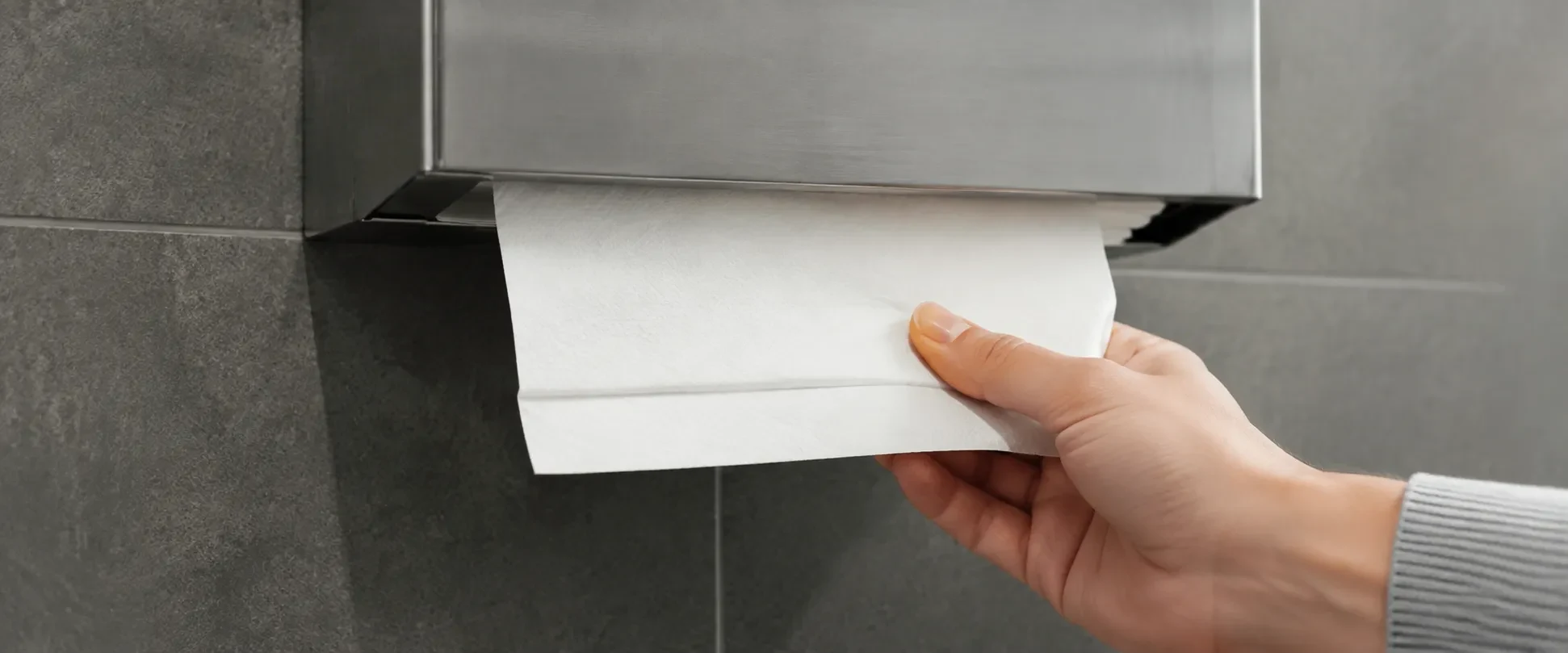
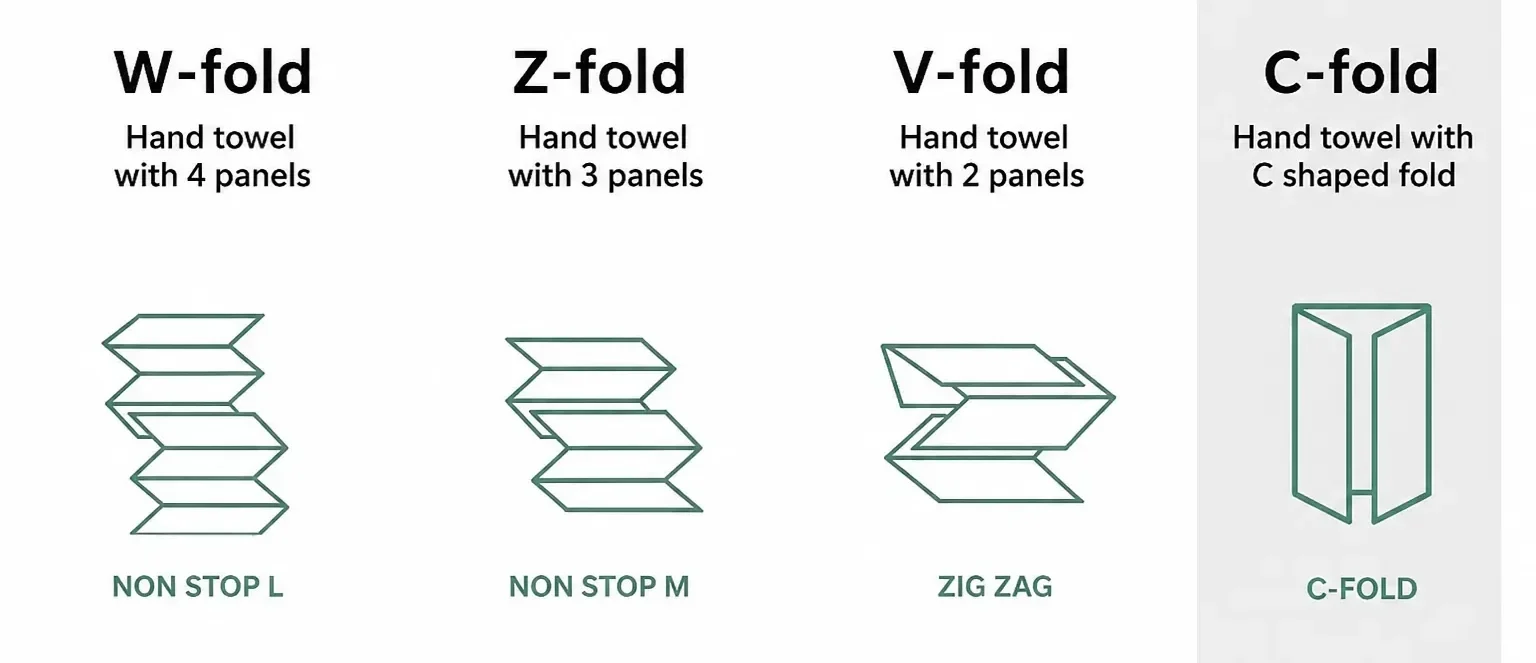
Folded hand paper towels are individual sheets folded and packed into a stack. Depending on the format, the sheets may be placed separately or interlocked so that the next towel presents itself after one is removed. Common products include C-fold, Z-fold, multifold, N-fold, and single-fold towels. Each format must be matched to a compatible dispenser.
You will often find folded towels in office washrooms, hotel guest areas, medical settings, restaurants, and smaller commercial facilities. Their compact dispenser footprint and orderly appearance make them useful where space and presentation are important. Their fixed sheet size also makes consumption easier to predict, although actual usage still depends on sheet quality and dispenser performance.
Common Types of Folded Paper Towels
1. C-Fold Paper Towels
C-fold towels have two inward folds that create a C-shaped profile. The sheets usually sit independently in the dispenser rather than interlocking. They are simple to load and widely available, but several towels may come out together if users pull too quickly or if the dispenser is overfilled.
This format can work in low- to medium-traffic washrooms where product availability and straightforward refilling are more important than strict consumption control. You should confirm the dispenser depth and opening size because an incorrect fit can cause bunching or multiple-sheet dispensing.
2. Multifold, Z-Fold, and N-Fold Paper Towels
Multifold, Z-fold, and N-fold towels are typically interfolded. Pulling one sheet partially presents the next, allowing users to touch only the towel they take. This design often provides better dispensing control than loose C-fold stacks.
These formats are suitable for offices, clinics, restaurants, and other settings where you need a compact system with predictable sheet delivery. Fold dimensions vary among manufacturers, so the towel specification should be checked against the dispenser rather than selected by name alone.
3. Single-Fold Paper Towels
Single-fold towels are folded once and commonly used in simple wall-mounted dispensers. They tend to have a larger folded footprint than multifold products and can be easy for maintenance teams to load.
They remain practical for schools, workshops, older public facilities, and locations with existing single-fold dispensers. However, their dispenser size and sheet presentation may be less suitable for modern washrooms where wall space and controlled dispensing are priorities.
Advantages of Folded Hand Paper Towels
- Controlled dispensing: A well-matched interfold dispenser presents one sheet at a time. This helps limit accidental overuse and keeps the remaining supply protected.
- Compact installation: Folded-towel dispensers are generally shallower than high-capacity roll dispensers. They fit more easily beside sinks, between fixtures, or in narrow washrooms.
- Simple operation: Users do not need to measure or tear the paper. They pull a ready-sized sheet and begin drying immediately.
- Orderly presentation: Folded hand paper towels create a clean, consistent appearance in customer-facing environments such as hotels, offices, restaurants, and private clinics.
- No batteries or cutting mechanism: Most folded-towel dispensers have few moving parts. They can be installed without electrical access, battery replacement, or an internal cutting system.
Limitations of Folded Hand Paper Towels
- More frequent refilling: A folded-towel dispenser usually carries less paper than a high-capacity roll unit. In busy public restrooms, the stack may need to be checked several times per day.
- Higher labor demand: More frequent inspections and refills can raise the total operating cost, even when the case price appears competitive.
- Possible multiple-sheet dispensing: C-fold towels and poorly matched interfold towels may release several sheets at once. Overfilling the dispenser can also increase drag and cause tearing.
- Storage requirements: Folded towels are packed in bundles and cases that may use storage space less efficiently than dense hardwound rolls. The practical difference depends on case dimensions and the amount of usable paper inside each case.
- Fixed sheet size: A fixed sheet improves portion control for hand drying, but it offers less flexibility for large spills or surface cleaning.
Understanding Roll Hand Paper Towels
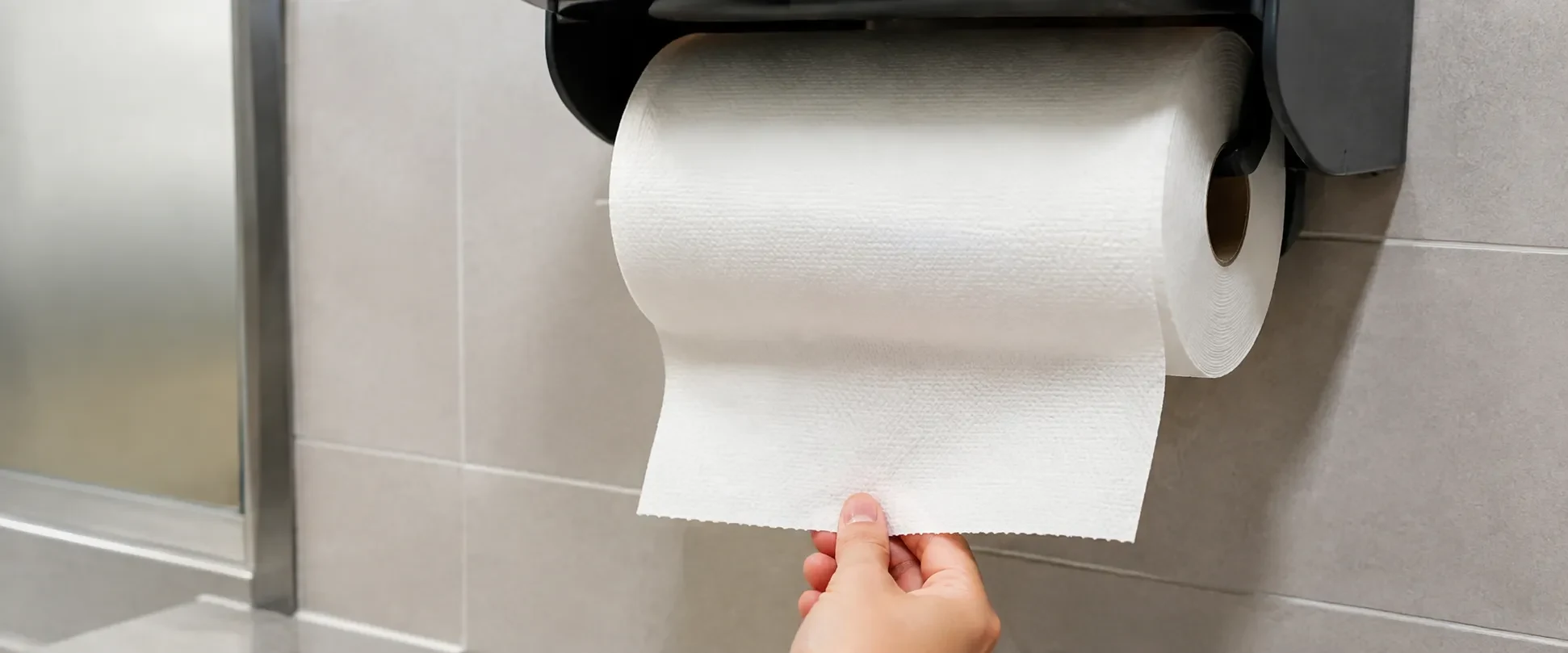
Roll hand paper towels consist of a continuous length of paper wound around a core or configured as a center-pull roll. The dispenser delivers a measured portion through a manual lever, mechanical cutting system, electronic sensor, or center-pull opening. Common formats include hardwound roll towels, center-pull paper towels, perforated rolls, and stub-roll systems.
Roll systems are widely used in airports, schools, stadiums, factories, commercial kitchens, and other high-traffic settings. Their main advantage is capacity: one roll can provide many more hand dries than a compact folded stack. That capacity reduces refill frequency, but the dispenser is usually larger and may require more installation clearance.
Common Types of Roll Paper Towels
1. Hardwound Roll Towels
Hardwound roll towels are tightly wound and designed for commercial dispensers. They may be dispensed with a lever, mechanical pull mechanism, or electronic sensor. Many dispensers control the delivered sheet length, which improves consumption forecasting.
This format is a practical choice for busy public restrooms because it combines high capacity with controlled dispensing. When comparing products, check roll diameter, width, core diameter, roll length, and dispenser compatibility.
2. Center-Pull Paper Towels
A center-pull roll dispenses paper from the middle of the roll. Users touch the section they remove, while the remaining paper stays inside the dispenser. The format allows quick access and flexible sheet use.
Center-pull paper towels are common in commercial kitchens, food preparation support areas, workshops, and cleaning stations. They are convenient for repeated wiping tasks, but the correct tail must be prepared during loading to prevent difficult pulling or tearing.
3. Perforated Roll Towels
Perforated roll towels allow users to tear off sheets along preset lines. They are familiar in residential kitchens, break rooms, and light commercial environments.
Because users handle and tear the exposed roll, this format provides less controlled dispensing than an enclosed commercial system. It is generally better for multipurpose wiping than for a high-volume public washroom.
Advantages of Roll Hand Paper Towels
- High dispenser capacity: A commercial roll holds a substantial length of paper, helping maintenance teams keep busy washrooms supplied for longer periods.
- Fewer service visits: Longer refill intervals reduce the time spent opening dispensers, replacing stock, and checking supply levels.
- Competitive cost per use: Roll towels often provide a lower material and labor cost per hand dry, particularly in high-volume facilities. The result depends on dispensed sheet length and the number of portions each user takes.
- Flexible paper length: Center-pull and some manual systems let users take more paper for a large spill or less for a small wiping task.
- Controlled dispenser options: Mechanical and sensor dispensers can release a preset length. Some units include a delay between portions to discourage unnecessary use.
Limitations of Roll Hand Paper Towels
- Larger dispenser footprint: High-capacity units require more wall area and depth. Installation can be difficult in narrow stalls, small kitchens, or washrooms with limited clearance.
- Initial equipment cost: Touchless and automatic dispensers cost more than basic folded-towel cabinets. Battery replacement, sensors, drive components, and cutting mechanisms may also require maintenance.
- Risk of over-dispensing: Open rolls and uncontrolled center-pull systems can allow users to take more paper than necessary. Controlled-length dispensers reduce this problem.
- Mechanical problems: Incorrect loading, unsuitable roll dimensions, damp paper, or worn components may cause jams and incomplete cuts.
- Dispenser dependency: Commercial rolls are not universally interchangeable. A small difference in width, diameter, core size, or winding tension can affect operation.
Key Differences Between Folded and Roll Hand Paper Towels
Folded and roll hand paper towels perform the same basic job, but they create different operating demands. Folded systems prioritize individual sheets, compact installation, and straightforward dispensing. Roll systems prioritize capacity, longer service intervals, and cost efficiency in high-volume locations.
The comparison should be based on the complete system, including the towel, dispenser, user behavior, storage, and maintenance labor. Comparing case prices alone can produce a misleading result because a cheaper case may provide fewer effective hand dries or require more staff time.
| Aspect | Folded Hand Paper Towels | Roll Hand Paper Towels |
|---|---|---|
| Product design | Pre-cut, folded sheets | Continuous paper wound into a roll |
| Common formats | C-fold, Z-fold, N-fold, multifold, single-fold | Hardwound, center-pull, perforated, stub-roll |
| Dispensing | Usually one pre-sized sheet at a time | Preset or user-selected paper length |
| Capacity | Lower capacity per dispenser | Higher capacity per dispenser |
| Refill frequency | More frequent in busy areas | Usually less frequent |
| Dispenser size | Compact and relatively shallow | Larger to accommodate the roll |
| Waste control | Good with compatible interfold systems | Good with controlled-length dispensers |
| Maintenance | Simple mechanism but frequent stocking | Less stocking but more complex equipment |
| Large wiping tasks | Less flexible | Better suited to variable-size tasks |
| Typical locations | Offices, clinics, hotels, small washrooms | Airports, schools, factories, busy kitchens |
| Cost structure | May have a higher cost per sheet | Often lower cost per use at high volume |
| Hygiene | Users touch the sheet they take | Strong with enclosed, touchless dispensing |
Key Factors to Consider for Choosing Between Folded and Roll Hand Paper Towels
Your decision should reflect how the towels will be used in a specific facility. A low-traffic executive washroom and a stadium restroom need different dispensing systems, even when both require reliable hand drying. Start with daily traffic, then consider hygiene, refill labor, dispenser space, paper performance, and disposal requirements.
A short on-site trial is often the most reliable selection method. Install the proposed dispenser, record consumption and refill frequency, and ask cleaning staff about loading problems. This provides evidence that cannot be obtained from unit price alone.
1. Hygiene and Contamination Control
For a healthcare room, food preparation area, school, or busy public restroom, choose a system that prevents users from touching the unused paper supply. Interfold dispensers and enclosed touchless roll dispensers can both meet this objective when maintained correctly.
Also consider the refill process. Staff should be able to load towels without placing them on wet counters or other contaminated surfaces. The dispenser should open easily for authorized staff, close securely, and protect the product from splashes.
2. Total Cost Effectiveness
Calculate total cost using paper consumption, dispenser cost, installation, batteries or replacement parts, storage, and maintenance labor. A roll system may have a higher initial equipment cost but lower ongoing service costs. A folded system may require little equipment investment but more frequent refilling.
A practical cost calculation is:
Total monthly cost = towel purchases + refill labor + dispenser supplies + estimated product waste
For a fair comparison, divide the monthly total by the estimated number of completed hand dries. This gives you a more useful figure than cost per roll, case, or sheet.
3. Frequency of Refills and Maintenance
In high-traffic locations, capacity often becomes the deciding factor. A large roll can remain available through busy periods when a folded stack would need to be replenished. This is useful in airports, schools, shopping centers, event venues, and manufacturing facilities.
In low-traffic settings, refill frequency may be less important. A basic folded dispenser can be easier to inspect and maintain because it has no sensor, motor, or cutting blade. Match the equipment complexity to the available maintenance resources.
4. Space Requirements and Dispenser Size
Measure wall width, installation height, dispenser depth, sink clearance, door movement, and accessibility requirements before selecting a system. Folded dispensers suit narrow spaces, but they still need enough internal capacity to avoid constant refilling.
Roll dispensers require more room, especially when they hold high-capacity or reserve rolls. However, one larger unit may be more practical than several smaller folded dispensers in a busy washroom. Use the manufacturer’s dimensional drawing during planning rather than relying on product photographs.
5. Waste Control
For controlled hand drying, use an interfold dispenser that releases one towel cleanly or a roll dispenser with a fixed sheet length. Both systems can limit waste when the paper portion is large and absorbent enough to complete the task.
Avoid assuming that the smallest portion creates the least waste. If users need several portions, total consumption may increase. Review waste bins during a product trial: large amounts of clean, unused paper usually indicate over-dispensing or an unsuitable sheet size.
6. Flexibility for Larger Tasks
Folded hand paper towels work well for routine hand drying and small spot cleaning. Their fixed size is less convenient for cleaning counters, wiping equipment, or handling large spills because users may need several sheets.
Roll hand paper towels offer more flexibility in commercial kitchens, janitorial stations, workshops, and industrial areas. A center-pull or perforated roll lets you adjust the amount used for each task. For food-contact surfaces, confirm that the paper and cleaning procedure meet the applicable local requirements.
7. Environmental Impact and Sustainability
The environmental impact of hand paper towels depends on raw materials, manufacturing efficiency, transport, consumption, and disposal. Both folded and roll towels can be made from recycled fiber, responsibly sourced virgin fiber, bamboo pulp, or blended materials.
Look for credible sourcing and environmental certifications relevant to your market, such as FSC or PEFC chain-of-custody certification and recognized recycled-content standards. Also compare case yield, packaging weight, shipping volume, and actual consumption. Claims such as “biodegradable” or “eco-friendly” should be supported by specific evidence and appropriate disposal conditions.
Which Hand Paper Towel Format Fits Each Environment?
Folded systems are useful where traffic is moderate, wall space is limited, and a neat presentation matters. Roll systems are useful where demand is continuous and maintenance teams need longer intervals between refills.
| Environment | Recommended Starting Point | Main Reason |
|---|---|---|
| Small office washroom | Multifold or Z-fold towels | Compact, simple, and tidy |
| Hotel or premium customer washroom | High-quality interfold towels | Controlled presentation |
| Healthcare treatment area | Enclosed interfold or touchless roll system | Reduced contact with unused paper |
| Restaurant restroom | Interfold or controlled roll system | Balance of hygiene and capacity |
| Commercial kitchen | Center-pull or controlled roll towels | Flexible wiping and fast access |
| School or university | High-capacity roll towels | Lower refill frequency |
| Airport or stadium | Touchless hardwound roll system | High capacity and controlled portions |
| Factory or workshop | Center-pull or durable roll towels | Suitable for larger wiping tasks |
| Small residential bathroom | Folded towels or compact perforated roll | Limited installation space |
How to Choose a Paper Towel Supplier
A reliable supplier should help you match the paper specification to the dispenser and application. Ask for the towel’s unfolded size, folded size or roll dimensions, ply, basis weight, fiber composition, case quantity, compatible dispenser type, and available certifications. Product samples should be tested before a long-term order.
As a paper tissue manufacturer, Liansheng Sempo supplies folded hand paper towels and roll hand paper towels for commercial, institutional, and private-label applications. Specifications can be aligned with your dispenser, packaging, absorbency target, and destination market. Clear technical documentation is particularly important when you are replacing an existing product because small dimensional changes can affect dispensing.
Frequently Asked Questions
Are folded paper towels more hygienic than roll paper towels?
Not necessarily. Interfold towels are hygienic when users touch only the sheet they take. An enclosed touchless roll dispenser can offer the same benefit. Hygiene depends more on dispenser design, cleaning, refilling practices, and user contact than on the towel format.
Which is cheaper, folded or roll hand paper towels?
Roll hand paper towels usually have a lower cost per use in high-traffic facilities because they provide greater capacity and need fewer refills. Folded towels may be more economical in low-traffic locations where a basic dispenser is sufficient. Compare total monthly cost rather than package price.
What is the difference between C-fold and multifold paper towels?
C-fold towels are separate sheets folded into a C shape. Multifold towels are normally interlocked so that removing one presents the next. Multifold dispensing generally provides better one-at-a-time control, while C-fold towels may release several sheets if the dispenser is overfilled or poorly matched.
Do roll paper towels create more waste?
They can create more waste when users control the length and pull more than necessary. A dispenser with a fixed portion length can reduce this problem. Folded towels can also be wasted when several sheets dispense together or when users need multiple sheets to dry their hands.
Which paper towel is best for public restrooms?
A high-capacity hardwound roll towel in an enclosed manual or touchless dispenser is often the best option for a busy public restroom. In lower-traffic or space-limited restrooms, an interfold towel system may be more practical.
Which paper towels are the most absorbent?
Absorbency depends on fiber quality, basis weight, ply, embossing, wet strength, and sheet area. Format alone does not determine performance. Compare product specifications and test how much paper is required for one complete hand dry.
Are recycled paper towels hygienic?
Yes. Properly manufactured recycled paper towels can be suitable for hygienic hand drying. Select products from a qualified manufacturer and check applicable quality, safety, and recycled-content documentation for your market.
Are paper towels better than hand dryers?
Paper towels dry hands quickly and remove residual moisture through physical contact. Hand dryers eliminate paper purchasing but require electricity and may take longer to use. The best choice depends on hygiene policies, traffic, maintenance, accessibility, energy use, and waste management.
How many paper towels should you use to dry your hands?
Use only the amount needed to dry your hands completely. With an appropriately sized, absorbent towel, one or two folded sheets or one controlled roll portion may be sufficient. Actual usage varies with towel dimensions and paper quality.
Can roll paper towels fit any dispenser?
No. You must match the roll width, diameter, core diameter, winding direction, and paper type to the dispenser. Using an incompatible roll can cause jams, poor cutting, excessive resistance, or failure to dispense.
Can folded paper towels fit any folded-towel dispenser?
No. C-fold, multifold, Z-fold, N-fold, and single-fold products have different folded dimensions and dispensing behavior. Check the dispenser specifications before ordering replacement towels.
What paper towels are best for commercial kitchens?
Center-pull or controlled roll hand paper towels are often suitable because they provide quick access and flexible lengths for hand drying and general wiping. For foodservice use, verify product suitability and follow local hygiene and food-contact procedures.
Conclusion
Choose folded hand paper towels when you need a compact dispenser, fixed portions, simple equipment, and a tidy presentation. Choose roll hand paper towels when your facility has sustained traffic, limited maintenance time, or frequent cleaning tasks that require different paper lengths. For either system, dispenser compatibility and paper quality have a direct effect on hygiene, waste, and operating cost.
Liansheng Sempo manufactures hand paper towels for commercial washrooms, kitchens, healthcare settings, hospitality businesses, and public facilities. Contact Liansheng Sempo with your dispenser dimensions, target paper specification, expected usage, packaging requirements, and destination market to discuss a suitable folded or roll towel solution.


