
A standard household toilet paper roll is usually 60 to 120 feet (18 to 36 meters) long when fully unrolled. The exact length depends on the sheet count and sheet length. Mega rolls may contain 150 to 300 feet or more, while commercial jumbo toilet rolls can extend far beyond household sizes.
Most standard rolls are approximately 4 to 4.5 inches wide, with an outer diameter of about 4 to 5 inches and a cardboard core measuring 1.5 to 1.75 inches in diameter. Ply, embossing, paper thickness, winding tension, and core size affect the finished roll diameter, but sheet count and sheet length determine the actual total length.
Key Takeaways
- Standard toilet paper roll length: Usually 60 to 120 feet (18 to 36 meters)
- Mega roll length: Often 150 to 300 feet or more
- Roll width: Approximately 4 to 4.5 inches (9.4 to 11.4 cm)
- Standard outer diameter: Approximately 4 to 5 inches (10 to 12.7 cm)
- Inner core diameter: Usually 1.5 to 1.75 inches (38 to 45 mm)
- Typical sheet count: About 200 to 500 sheets per household roll
- Main length factors: Sheet count, sheet length, ply, paper thickness, embossing, and winding tension
How Long Is A Toilet Paper Roll?
A standard toilet paper roll is generally 60 to 120 feet long when fully unrolled, although there is no single universal roll length. A compact household roll with 200 sheets may be close to 67 feet long if each sheet measures 4 inches. A 300-sheet roll using the same sheet length would contain approximately 100 feet of toilet paper.
Larger rolls can exceed this range. A mega roll with 500 sheets measuring 4 inches long contains about 167 feet of paper. If the sheet is 4.5 inches long, the same 500-sheet roll contains approximately 188 feet. Some high-capacity household products reach 300 feet or more by using a higher sheet count, thinner tissue, tighter winding, or a combination of these specifications.
Compare the sheet count, sheet dimensions, ply, net weight, and total roll length to determine how much usable toilet paper you are receiving.
| Toilet Paper Type | Typical Sheet Count | Approximate Total Length | Common Use |
|---|---|---|---|
| Compact or regular roll | 150-250 sheets | 50-85 ft (15-26 m) | Small households, hospitality |
| Standard household roll | 200-400 sheets | 60-135 ft (18-41 m) | Everyday residential use |
| Mega roll | 400-800 sheets | 135-300+ ft (41-91+ m) | High-use households |
| Commercial jumbo roll | 1,000+ sheets or continuous tissue | 500-2,000+ ft (152-610+ m) | Offices, airports, public washrooms |
What Are The Standard Toilet Paper Roll Dimensions?
Standard toilet paper roll dimensions are approximately 4 to 4.5 inches in width, 4 to 5 inches in outer diameter, and 1.5 to 1.75 inches in core diameter. These dimensions allow the roll to fit most household toilet paper holders, but regional preferences and dispenser designs can lead to different specifications.
Two rolls with the same diameter may contain different amounts of tissue because paper thickness, ply construction, embossing depth, and winding tension affect how tightly the tissue sits on the core. For a precise product comparison, sheet count and sheet size are more useful than visual roll size.
Toilet Paper Roll Width
The roll width, sometimes called roll height, is measured from one flat side of the roll to the other. A common household width is about 4 inches, or approximately 101 to 102 mm. Wider rolls may measure 4.5 inches, or about 114 mm.
Roll width affects user comfort, dispenser compatibility, and the amount of raw material required for each sheet. If you are sourcing toilet paper for a particular market, you should confirm the dispenser width before setting the finished product specification. A roll that is too wide may bind against the holder, while a roll that is too narrow may move excessively during use.
How Width Affects Sheet Size
Many household toilet paper sheets are close to square, such as 4 × 4 inches or 4.5 × 4.5 inches. However, some manufacturers reduce the sheet length while maintaining a familiar roll width. This changes the total length and paper weight even if the sheet count printed on the package remains the same.
A 300-sheet roll with 4-inch sheets contains 100 feet of tissue. A 300-sheet roll with 4.5-inch sheets contains 112.5 feet. The sheet count is identical, but the second roll provides 12.5 additional feet.
Toilet Paper Roll Outer Diameter
The outer diameter of a standard toilet paper roll is commonly 4 to 5 inches, or approximately 10 to 12.7 cm. Mega rolls may have a larger diameter, depending on the core, paper caliper, sheet count, and winding method.
A larger diameter does not always mean a proportionally longer roll. Soft, heavily embossed tissue occupies more space than thin, lightly embossed tissue. A loosely wound roll may also appear larger while containing less paper than a tightly wound roll. In retail production, the diameter must balance shelf appearance, packaging dimensions, dispenser fit, and reliable unwinding.
Measuring The Outer Diameter
Place the roll upright on a flat surface and measure straight across the circular face through the center. Do not measure around the circumference. Use calipers for production inspection or a rigid ruler for a general household measurement.
Tissue compresses during packing and transport, so minor differences are normal. For quality control, diameter should be evaluated together with roll weight, sheet count, perforation spacing, and winding firmness.
Toilet Paper Roll Core Diameter
The cardboard tube inside a household toilet paper roll usually has a diameter of 1.5 to 1.75 inches, equivalent to about 38 to 45 mm. Coreless rolls remove the tube entirely, while commercial jumbo toilet rolls may use larger cores designed for dedicated dispensers.
A smaller core can create more room for tissue without increasing the outer diameter. However, the core must still fit the intended holder and remain stable during converting, packing, transport, and use. For custom toilet paper production, core material, wall thickness, diameter, and crush resistance should be specified rather than treated as packaging details.
Cored And Coreless Rolls
Cored rolls are widely compatible with residential holders and are easier to manufacture on many conventional converting lines. The tube also helps the finished roll retain its shape. Coreless toilet paper reduces cardboard use and can place more tissue within a similar roll diameter, but it may require a compatible dispenser.
Neither format is automatically better for every application. You should choose based on dispenser design, distribution conditions, sustainability targets, expected usage, and the equipment available at the converting facility.
How Do You Calculate Toilet Paper Roll Length?
To calculate toilet paper roll length, multiply the number of sheets by the length of each sheet. Convert the result into feet or meters as needed. This method is more reliable than estimating length from the roll diameter.
For example, a roll with 300 sheets, each 4 inches long, contains 1,200 inches of toilet paper. Divide 1,200 by 12 to convert inches to feet. The result is 100 feet. In metric units, 100 feet equals approximately 30.5 meters.
| Sheet Count | Sheet Length | Calculated Roll Length |
|---|---|---|
| 200 sheets | 4 in | 66.7 ft (20.3 m) |
| 250 sheets | 4 in | 83.3 ft (25.4 m) |
| 300 sheets | 4 in | 100 ft (30.5 m) |
| 400 sheets | 4 in | 133.3 ft (40.6 m) |
| 500 sheets | 4 in | 166.7 ft (50.8 m) |
| 500 sheets | 4.5 in | 187.5 ft (57.2 m) |
| 800 sheets | 4.5 in | 300 ft (91.4 m) |
Perforation spacing normally corresponds to the listed sheet length. During physical testing, you may find small differences caused by tissue stretch, moisture conditions, converting tolerances, or where the first and last sheets are cut.
Calculating Length In Feet
When the sheet length is listed in inches, use this formula:
A 450-sheet roll with a 4-inch perforation length contains:
This calculation measures the nominal tissue length. It does not indicate softness, absorbency, tensile strength, basis weight, or how many sheets a person will use during each visit.
Calculating Length In Meters
When the sheet dimensions are provided in millimeters, use this formula:
A 400-sheet roll with a sheet length of 110 mm contains:
For procurement, keep one measurement system throughout the specification. Repeated conversion between imperial and metric units can introduce rounding differences, especially when packaging artwork and inspection documents are prepared by different suppliers.
What Changes The Length Of A Toilet Paper Roll?
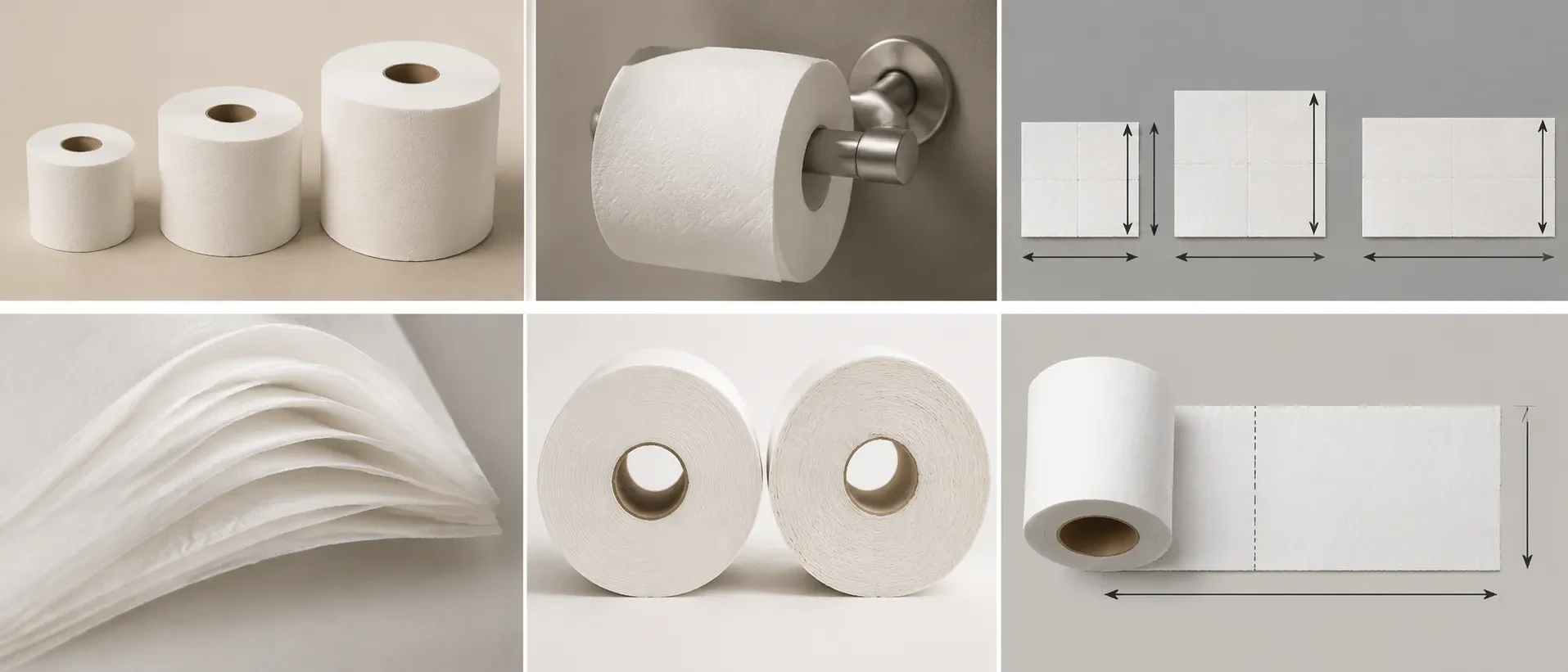
The length of a toilet paper roll is primarily determined by sheet count and sheet length. Ply, tissue thickness, embossing, core diameter, and winding tension affect how that length fits into the finished roll. These variables explain why rolls with similar dimensions can provide different amounts of tissue.
You should review the full construction rather than judging the product by roll diameter or package claims. A high sheet count may be achieved with shorter sheets. A large-looking roll may use deeper embossing or looser winding. A compact roll may contain a substantial length of thin, tightly wound tissue.
Sheet Count
Standard household toilet paper rolls commonly contain 200 to 500 sheets, while mega rolls may contain 500 to 800 sheets or more. Commercial products can use much higher counts or specify total length instead of individual sheets.
Sheet count has a direct relationship with total roll length when the sheet size stays constant. Doubling the count from 250 to 500 sheets doubles the total length. It does not necessarily double the roll diameter because diameter is influenced by paper thickness, compression, and the space available around the core.
Sheet Size
Individual toilet paper sheets often measure around 4 × 4 inches or 4.5 × 4.5 inches, but smaller and rectangular formats are also common. Even a half-inch difference in perforation length becomes substantial across several hundred sheets.
For example, 400 sheets at 4 inches provide about 133 feet of tissue. At 4.5 inches per sheet, 400 sheets provide 150 feet. When evaluating toilet paper roll size, sheet dimensions should therefore appear alongside sheet count in any meaningful comparison.
Ply And Paper Thickness
Ply describes the number of tissue layers combined to make the finished sheet. Common products include 1-ply, 2-ply, and 3-ply toilet paper. Increasing the ply generally increases sheet thickness and roll bulk, although the final result also depends on the basis weight and structure of each layer.
A 3-ply roll may contain fewer feet of paper than a 2-ply roll of the same outer diameter because each sheet occupies more space. This does not by itself mean the roll offers less value. Your evaluation should account for intended use, strength, absorbency, softness, sheet consumption, and price per unit.
Embossing And Winding Tightness
Embossing creates a raised pattern in the tissue and can help bond multiple plies. Deeper embossing adds bulk, which may increase the roll diameter without increasing its total length. Lamination, lotion application, and paper moisture can also affect the finished caliper.
Winding tension controls how compactly the tissue is wrapped around the core. Excessive tension can compress the embossing or affect softness. Insufficient tension can produce a loose, unstable roll. A toilet paper manufacturer must control winding tension to maintain consistent diameter, roll firmness, appearance, and dispensing performance.
How Long Does A Roll Of Toilet Paper Last?
A household toilet paper roll may last several days to more than a week, depending on the number of users, sheet count, sheet size, ply, and personal usage.
You can estimate usage by dividing the total sheet count by the household’s average daily consumption. If a 300-sheet roll is used at a rate of 50 sheets per day, it will last approximately six days. In a commercial washroom, traffic levels, cleaning schedules, dispenser controls, and peak periods must be considered.
| Usage Scenario | Estimated Daily Use | Approximate Life of a 300-Sheet Roll |
|---|---|---|
| One person, light use | 20-30 sheets | 10-15 days |
| One person, moderate use | 40-50 sheets | 6-8 days |
| Two-person household | 70-100 sheets | 3-4 days |
| Shared or high-traffic use | 150+ sheets | 2 days or less |
How Should You Compare Toilet Paper Rolls?
Compare toilet paper using total length, net tissue weight, sheet dimensions, sheet count, and ply construction. Package labels such as “double roll” and “mega roll” can be useful within one product line, but they are not standardized across manufacturers.
For an accurate cost comparison, calculate the price per 100 sheets, price per 100 feet, or price per kilogram of tissue. Then review performance factors such as wet strength, softness, absorbency, dust level, flushability, perforation quality, and dispensing reliability. The lowest cost per roll may not provide the lowest cost per use if more sheets are required.
- Confirm the number of sheets per roll.
- Check the length and width of each sheet.
- Calculate the total roll length.
- Review the ply count and basis weight.
- Compare net tissue weight rather than packaged weight.
- Verify outer diameter and core diameter against the dispenser.
- Test samples under the conditions where the product will be used.
Standard Rolls Vs. Mega Rolls Vs. Jumbo Rolls
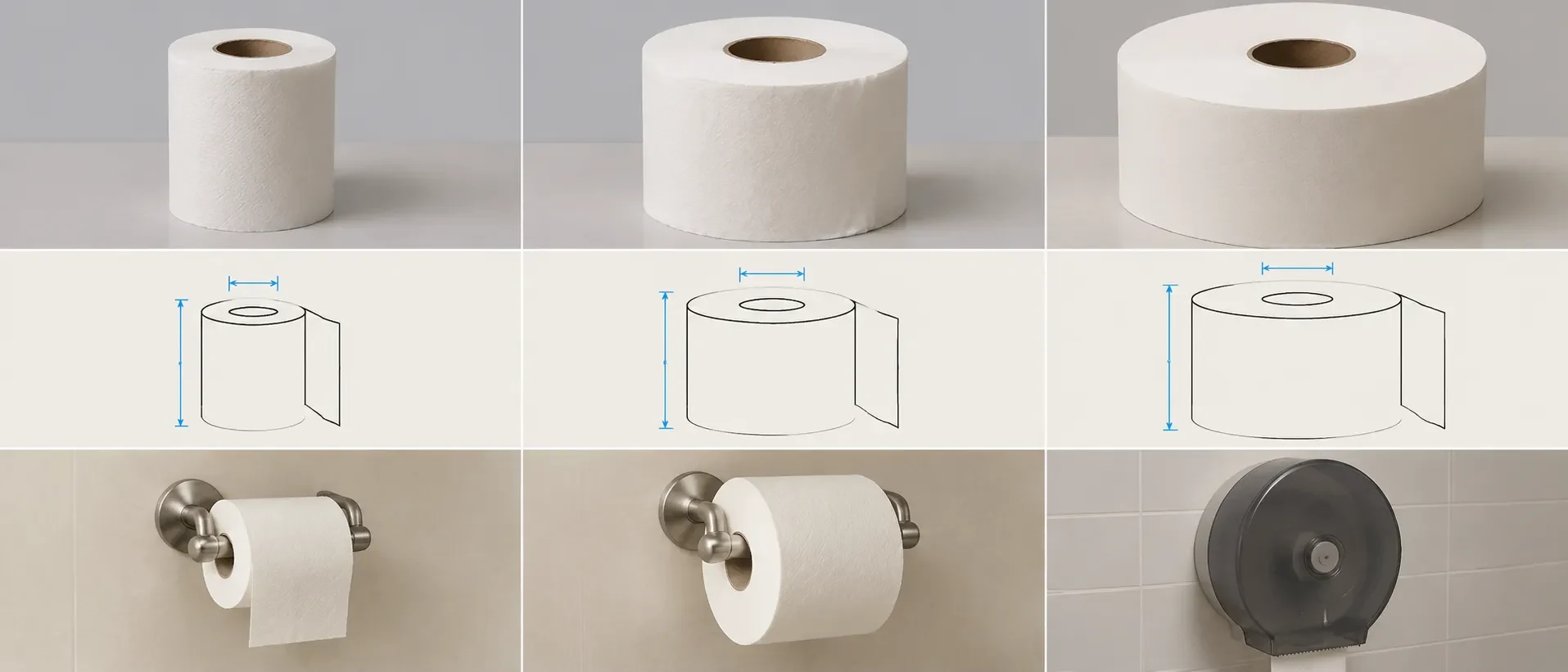
A standard roll is designed for an ordinary household holder. A mega roll contains more sheets and may have a larger outer diameter, although it generally uses the same type of core. A commercial jumbo toilet roll is a separate format intended for high-capacity dispensers.
The right option depends on the usage environment. Standard rolls are easier to store and fit most residential bathrooms. Mega rolls reduce replacement frequency in homes and small businesses. Jumbo rolls reduce maintenance in high-traffic facilities but require compatible dispensers and more storage space per case.
| Feature | Standard Roll | Mega Roll | Commercial Jumbo Roll |
|---|---|---|---|
| Typical environment | Home, hotel room | Home, small office | Public or high-traffic washroom |
| Approximate length | 60-120 ft | 150-300+ ft | 500-2,000+ ft |
| Dispenser type | Household holder | Household or extended holder | Dedicated jumbo dispenser |
| Replacement frequency | Moderate | Lower | Much lower |
| Main purchasing concern | Comfort and compatibility | Capacity and diameter | Capacity and service efficiency |
Choosing Toilet Paper Specifications
When selecting toilet paper specifications, begin with the target dispenser, user expectations, sales channel, and price position. A supermarket household roll has different requirements from toilet paper supplied to hotels, offices, hospitals, or transport facilities.
You should define measurable values for roll width, sheet length, sheet count, ply, basis weight, core diameter, roll diameter, embossing, perforation, and packaging.
Conclusion
A standard toilet paper roll is generally 60 to 120 feet long, while mega rolls can reach 150 to 300 feet or more. Sheet count and sheet length determine total length; ply, thickness, embossing, core size, and winding tension determine how that tissue fits into the finished roll.
For custom household, mega, or commercial toilet paper, contact Liansheng Sempo with your target dimensions, ply, sheet count, core size, packaging format, and destination market. Our team can help you define a practical specification for sampling, production, and private-label supply.
Frequently Asked Questions
How many feet are in a regular roll of toilet paper?
A regular household toilet paper roll usually contains 60 to 120 feet of tissue. The exact length depends on the number of sheets and the length of each sheet.
How many meters long is a toilet paper roll?
A standard toilet paper roll is commonly 18 to 36 meters long. Mega rolls may contain 45 to 90 meters or more.
How many sheets are in a standard toilet paper roll?
Most standard household rolls contain about 200 to 500 sheets. Sheet counts vary by brand, region, ply, and product format.
What is the standard size of a toilet paper roll?
A typical household roll is approximately 4 to 4.5 inches wide, 4 to 5 inches in outer diameter, and has a 1.5 to 1.75-inch core diameter.
How long is a toilet paper tube?
The cardboard tube is usually about the same length as the roll width, commonly 4 to 4.5 inches. Its inner diameter is generally 1.5 to 1.75 inches.
How do you measure toilet paper roll length?
Multiply the sheet count by the length of one sheet. For example, 300 sheets measuring 4 inches each produce 1,200 inches, or 100 feet, of toilet paper.
Is a mega roll longer than a double roll?
Usually, but the terms are not standardized. Compare the listed sheet count and sheet dimensions to determine which roll contains more tissue.
Does 2-ply toilet paper have two sheets?
No. 2-ply toilet paper has two tissue layers in each sheet. A roll labeled 300 sheets still contains 300 finished sheets, not 600.
Why are some toilet paper rolls narrower?
Manufacturers may adjust roll width to meet regional preferences, reduce material use, fit certain dispensers, or achieve a specific price point. Check the printed sheet dimensions before comparing rolls.
How long does one roll of toilet paper last one person?
For one person, a 300-sheet roll may last approximately 6 to 15 days, depending on daily usage. Individual consumption can differ significantly.
Can a mega roll fit a standard toilet paper holder?
It depends on the roll’s outer diameter and the clearance around the holder. Some mega rolls fit standard holders, while larger formats require an extended holder.
What is the difference between household and jumbo toilet paper?
Household toilet paper fits standard residential holders and usually contains a few hundred sheets. Jumbo toilet paper is much longer and is designed for dedicated dispensers in high-traffic washrooms.


