
Bathroom paper hand towels can replace kitchen paper towels for drying hands, wiping water, and light cleaning, but not for every kitchen task.
Kitchen paper towels usually provide higher liquid capacity, stronger wet performance, and clearer food-contact guidance.
If a towel will touch food, absorb hot oil, cover a dish in the microwave, or scrub a greasy surface, use a kitchen paper towel approved for that purpose.
Key Takeaways
- Use bathroom paper hand towels for clean-hand drying, water spills, and light-duty wiping.
- Use kitchen paper towels for food contact, grease, high absorbency, microwave use when permitted, and stronger wet wiping.
- Check the supplier’s food-contact declaration instead of assuming every white paper towel is suitable for food.
- Compare cost per completed task, not price per sheet; a less absorbent hand towel may require more sheets.
Can Bathroom Paper Hand Towels Replace Kitchen Paper Towels?
Yes, but only when the task does not depend on food-contact suitability, high wet strength, or large liquid capacity.
In a home kitchen, you can use a fresh hand towel to dry washed hands, wipe water from a sink, or pick up a small drink spill.
In a restaurant, hotel, or workplace kitchen, the same substitution can work at a dedicated handwashing station if the towel is stored in a clean dispenser and used once.
Kitchen roll is designed for broader cleanup and is often embossed to create liquid-holding pockets. It may also be manufactured under specifications intended for food-service use.
Paper Hand Towels vs. Kitchen Paper Towels
The products share a cellulose-fiber base, but their converting specifications reflect different use cases. Paper hand towels prioritize controlled dispensing, fast hand drying, and cost per user. Kitchen paper towels prioritize absorption, wet durability, surface contact, and flexible sheet use.
| Factor | Bathroom Paper Hand Towels | Kitchen Paper Towels |
|---|---|---|
| Primary job | Drying washed hands | Spill pickup, wiping, and food-related tasks |
| Absorbency | Moderate to high per dispensed sheet | Usually higher liquid capacity |
| Wet strength | Varies by grade | Usually designed for sustained wet wiping |
| Food contact | Only when supplier documentation permits it | Often intended for kitchen use; verify the label |
| Format | C-fold, V-fold, multifold, or dispenser roll | Perforated household or commercial roll |
| Consumption control | Strong with one-at-a-time dispensing | Depends on sheet size and user behavior |
| Best setting | Washrooms and handwashing stations | Home and commercial kitchens |
Why the Products Perform Differently
Fiber furnish, ply count, basis weight, embossing, and wet-strength treatment determine how a towel behaves. The label “paper towel” does not define one performance level.
Absorbency and Wet Strength
Absorbency measures how much liquid the structure can take in and how quickly it does so. Embossing increases bulk and creates channels between plies, while fiber selection affects capillary action. Kitchen rolls commonly use these features to capture spills without immediate saturation. You can review the main variables in our guide to paper towel absorbency.
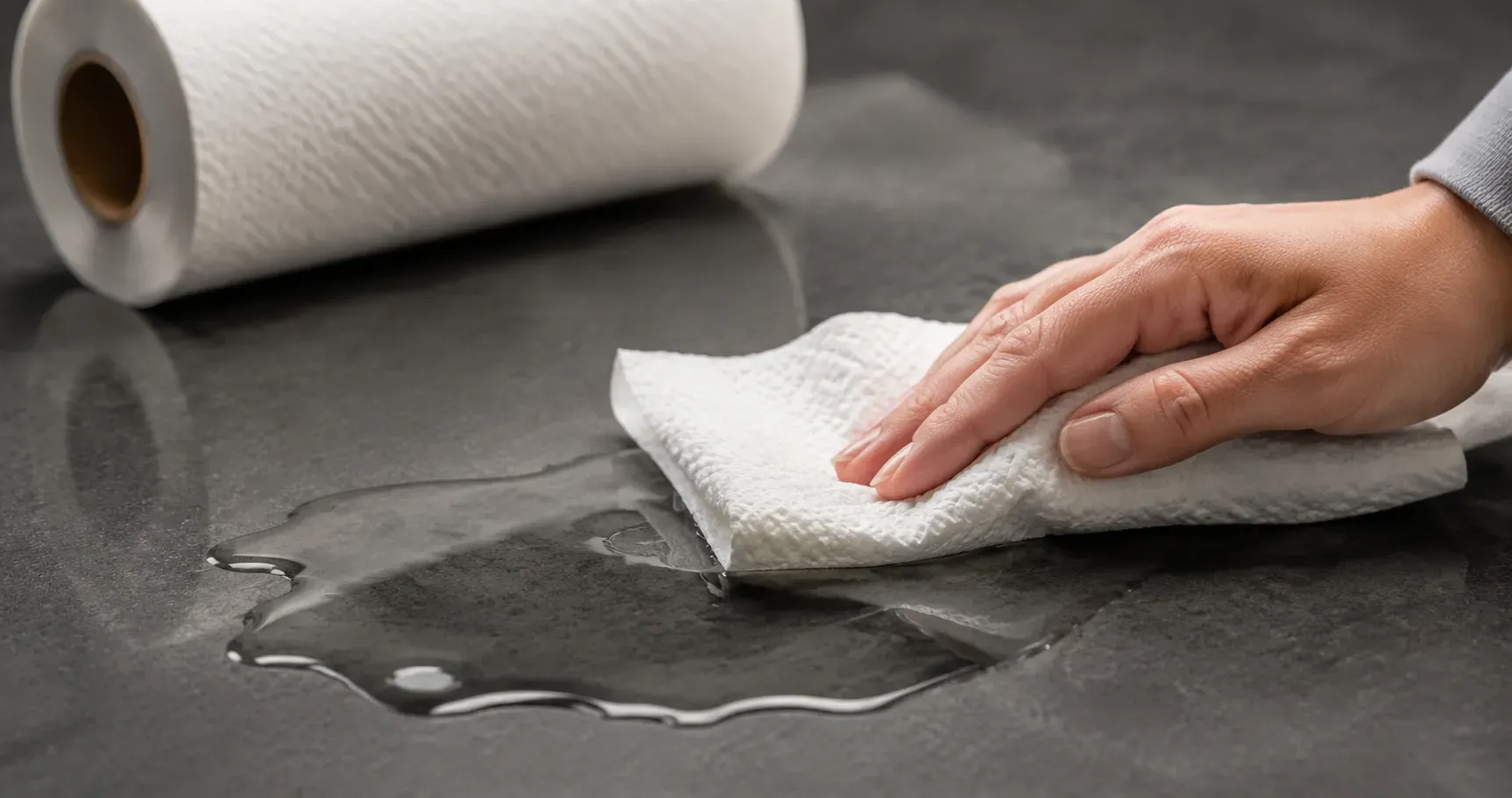
Wet strength is a separate property. A towel may absorb quickly yet lose integrity when you drag it across a counter. Kitchen paper generally receives enough wet-strength treatment to support wiping and light scrubbing. Hand towels need sufficient strength to dry hands, but an economy grade may be designed to release after a short use cycle. That difference explains why two hand towels can be less effective than one kitchen sheet on a greasy or saturated surface.
Format, Dispensing, and Sheet Control
Folded hand towels interlock so the next sheet presents itself when one is removed. Roll hand-towel systems may use mechanical or sensor dispensing to deliver a fixed length. Both formats reduce contact with unused paper and make consumption easier to predict. Our overview of paper towel fold types explains how C-fold, V-fold, Z-fold, and multifold products differ.
Kitchen rolls favor access over control. Perforations let you select one or more sheets, and larger sheet dimensions cover more surface area. This flexibility works well beside a food-preparation area, but an exposed roll can collect splashes or be handled by several people. In a shared kitchen, place hand towels in a protected dispenser near the sink and keep the kitchen roll in a clean, dry zone reserved for food and surface tasks.
When a Paper Hand Towel Is a Good Substitute
A bathroom paper hand towel is a good substitute when the job is brief, water-based, and unrelated to direct food contact. The towel should come from a clean pack or enclosed dispenser, and you should discard it after one task.
- Drying washed hands at a kitchen handwashing sink
- Wiping water around a basin, faucet, or counter edge
- Picking up a small spill of water, coffee, or a soft drink
- Drying the outside of clean containers or equipment
- Light dusting on a non-food-contact surface
When You Should Keep Use the Kitchen Paper Towel
Use a kitchen paper towel when the sheet will touch food, encounter heat, absorb oil, or remain wet during wiping. These scenarios demand a product whose intended use and technical performance match the task. A hand towel may look similar, but color and softness do not confirm food-contact compliance or microwave suitability.
- Patting moisture from meat, fish, fruit, vegetables, or tofu
- Draining fried food or absorbing cooking oil
- Covering food in a microwave, when the product instructions allow it
- Wiping grease, sauce, or a large saturated spill
- Scrubbing a worktop without the sheet breaking apart
- Lining a food container or wrapping produce for storage
Microwave use needs particular care because metallic decoration, recycled inclusions, or unsuitable additives may not be apparent. Follow the package instructions and read our specific guidance on whether you can put paper towels in the microwave. Never use a towel near an exposed heating element or flame.
Conclusion
Bathroom paper hand towels can replace kitchen paper towels for hand drying and simple water cleanup. They should not be treated as a universal substitute for food contact, oil absorption, microwave covering, or demanding wet wiping. Match the specification to the scenario, verify compliance where food is involved, and measure how many sheets the task actually consumes.
Liansheng Sempo supplies paper hand towels and kitchen paper towels for wholesale, private-label, and commercial programs. Contact our tissue manufacturing team with your dispenser format, market, application, and performance targets to compare the right samples for your project.
Frequently Asked Questions
Can you use bathroom paper towels in the kitchen?
Yes. Use a clean bathroom paper towel for drying hands, wiping water, or light non-food cleanup. Choose a kitchen towel for food contact, grease, heat, or heavy wet wiping.
What is the difference between paper towels and paper hand towels?
Kitchen paper towels are designed for spills and kitchen tasks; paper hand towels are designed for one-time hand drying through a controlled dispenser.
Are recycled paper hand towels food-safe?
Only when the manufacturer confirms food-contact suitability. Recycled fiber content alone does not prove or disprove compliance; use the product documentation.
Can you use paper hand towels to dry food?
Do so only if the towel is approved for direct food contact. Otherwise, use a food-suitable kitchen paper towel.
Can paper hand towels go in the microwave?
Not unless the product instructions explicitly permit microwave use. Use an approved kitchen paper towel and keep it away from exposed heating elements.
Which paper towel is more absorbent?
Kitchen paper towels usually hold more liquid per sheet, but absorbency varies by fiber, basis weight, ply, embossing, and sheet size.


