
Yes, embossed toilet paper typically absorbs more liquid than plain toilet paper when the fiber composition, basis weight, ply count, and sheet size are comparable. Embossing creates raised patterns, recessed areas, and small channels that increase usable surface area and form spaces where liquid can spread and collect. In multi-ply toilet tissue, the embossed structure can also improve bulk and help the layers remain aligned during use.
However, embossing is not the only factor that determines toilet paper absorbency. Fiber quality, tissue thickness, ply construction, wet strength, and the selected embossing pattern all affect performance. A well-engineered embossed sheet generally offers a better balance of absorption, softness, and structural integrity than a smooth, flat sheet made to the same basic specification.
Key takeaways:
- ✦
Embossing increases the effective surface area of toilet tissue. - ✦
Raised patterns create micro-pockets that receive and retain moisture. - ✦
Proper embossing helps stabilize multi-ply toilet tissue. - ✦
Embossed sheets often feel bulkier and softer without requiring excessive fiber. - ✦
Deep embossing does not automatically mean better absorption. - ✦
Fiber furnish, basis weight, ply count, and converting settings remain important. - ✦
Laboratory testing is the most reliable way to compare embossed toilet paper with plain toilet paper.
How Does Embossing Improve Toilet Paper Absorbency?
Embossing improves toilet paper absorbency by changing a flat sheet into a three-dimensional structure. The raised and recessed pattern gives liquid more points of contact and creates channels through which moisture can spread. It also introduces controlled spaces between the tissue layers. These spaces increase apparent bulk and provide temporary storage for liquid before it is absorbed into the fibers. When two samples have similar fiber content and ply construction, this structural difference usually allows embossed toilet paper to hold slightly more liquid than smooth tissue.
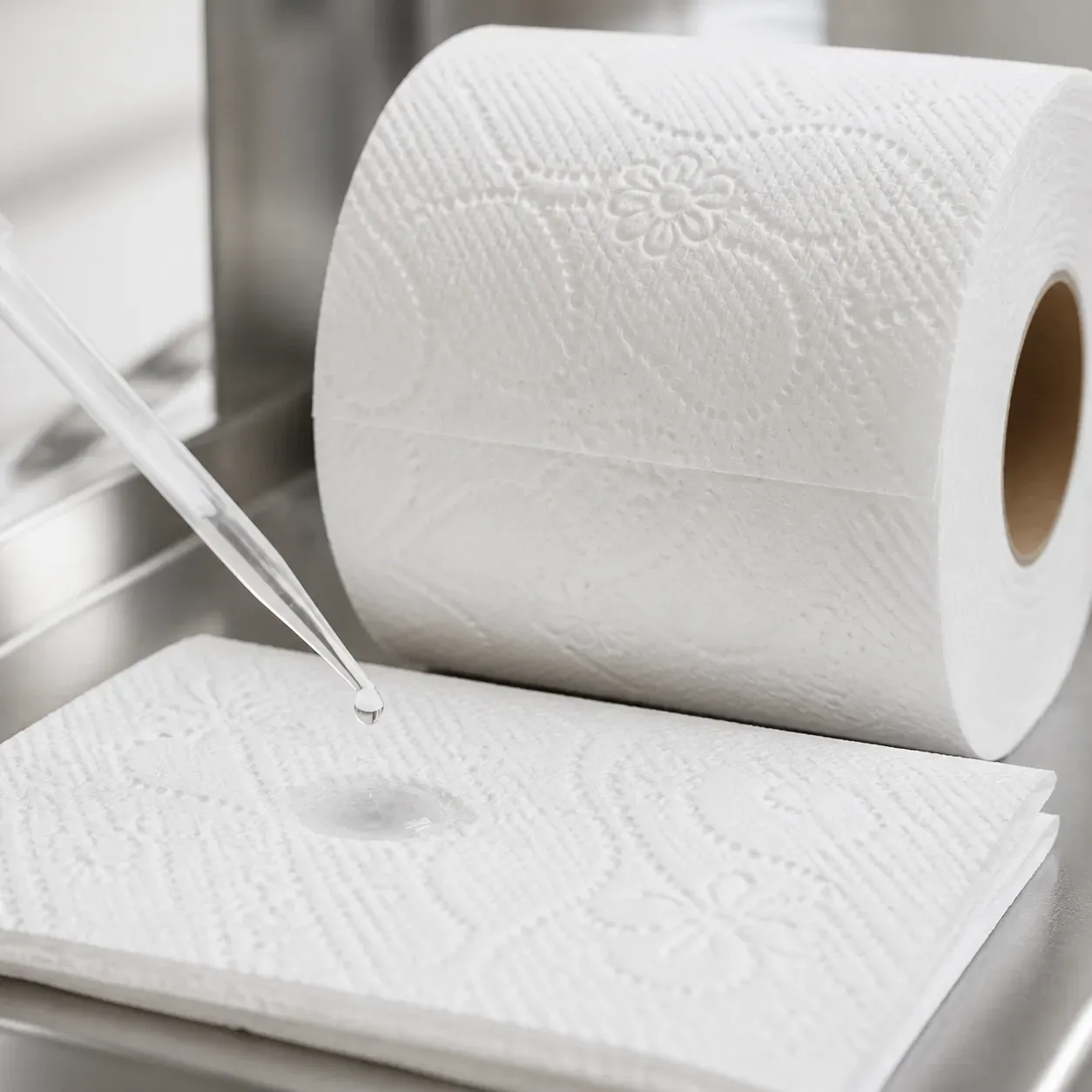
If the embossing pressure is too low, the pattern may not create enough definition or stable bulk. If it is too high, the rollers can compress the web, damage fibers, or reduce softness. Effective embossing therefore requires a balance between pattern depth, contact area, pressure, speed, and the physical properties of the tissue base sheet.
Greater Surface Area And Faster Liquid Contact
A plain sheet presents a relatively uniform surface. Liquid tends to remain in one area until it penetrates the fiber network or spreads across the sheet. An embossed surface contains peaks, valleys, and pattern edges. These features increase the number of contact points available when moisture reaches the paper.
The channels around an embossed pattern can also support capillary movement. Instead of pooling only at the initial contact point, liquid can spread through the pattern and reach a wider section of the sheet. This does not change the absorbent nature of the cellulose itself, but it helps the available fibers participate more efficiently. Pattern geometry matters: moderate, evenly distributed embossing often produces more consistent results than isolated, very deep decorative elements.
Micro-Pockets Increase Liquid-Holding Capacity
Embossing creates small spaces both on the surface and between plies. These micro-pockets contribute to the sheet’s bulk and provide room for moisture. They are one reason embossed toilet paper can feel thicker than plain toilet paper with a similar basis weight.
The additional capacity is generally incremental rather than unlimited. Toilet paper remains a lightweight hygiene product, not a substitute for paper towels or industrial wiping paper. Its performance should be assessed according to its intended use, including comfort, absorbency, strength, and dispersibility. A bulky embossed sheet can improve the user experience, but the design still needs to break down appropriately after flushing.
Why Pocket Distribution Matters
A consistent distribution of small pockets is usually more useful than a few large cavities. Uniform pockets help moisture spread across the sheet and reduce weak areas. Large or aggressive patterns may look distinctive, but they can create uneven thickness or concentrated stress points if the tissue furnish and converting process are not matched to the design.
At Liansheng Sempo, embossing specifications can be evaluated alongside ply count, basis weight, roll dimensions, and the required softness profile. This integrated approach is more reliable than selecting a pattern based only on appearance.
Embossed Toilet Paper Vs. Plain Toilet Paper
Embossed toilet paper generally offers higher apparent bulk, better layer stability, and slightly greater liquid-holding capacity than plain toilet paper with an equivalent material specification. Plain toilet paper has a flatter, denser structure and fewer spaces for liquid to enter and spread. It may still perform well when produced from absorbent fibers or at a higher basis weight, but it usually lacks the structural advantages created by embossing.
A heavy, high-quality plain sheet can absorb more than a lightweight embossed sheet. Likewise, three-ply plain toilet tissue may outperform thin one-ply embossed tissue. Embossing should therefore be treated as one part of the complete product design rather than proof of quality on its own.
| Performance factor | Embossed toilet paper | Plain toilet paper |
|---|---|---|
| Effective surface area | Higher because of raised and recessed patterns | Lower because the surface is relatively flat |
| Liquid distribution | Channels help spread moisture | Liquid may remain concentrated in one area |
| Apparent bulk | Usually higher | Usually lower at the same basis weight |
| Liquid-holding space | Micro-pockets provide additional capacity | Limited internal spacing |
| Ply stability | Embossing can help keep plies aligned | Plies may shift or separate more easily |
| Perceived softness | Raised areas can cushion skin contact | Feel depends more directly on fiber and calendering |
| Visual appearance | Decorative and brandable | Simple and uniform |
| Manufacturing complexity | Requires controlled embossing settings | Simpler converting process |
Absorbency Capacity
Embossed toilet paper often retains slightly more total liquid because its textured structure contains more available space. The effect is most noticeable when comparing samples made from the same base tissue, with the same sheet size, basis weight, and ply count. Under those conditions, embossing becomes a clear structural variable.
Absorption capacity and absorption speed should not be confused. Capacity refers to the amount of liquid a sample can hold, while speed measures how quickly liquid enters the sheet. A pattern may improve distribution and perceived performance without producing the same percentage improvement in both measurements. For product development or supplier evaluation, you should test both values rather than relying on hand feel alone.
Structural Integrity During Use
In multi-ply toilet tissue, embossing can help the plies work as one sheet. Pressure applied through matched or nested embossing patterns creates contact points between the layers. Depending on the converting method, those points may be mechanically interlocked or supported by controlled lamination.
Better ply stability reduces sliding, peeling, and uneven folding during use. It can also improve the way moisture is distributed between the outer and inner layers. However, embossed toilet paper is not automatically stronger when wet. Wet performance still depends on fiber bonding, ply construction, converting conditions, and any permitted wet-strength strategy used for the target market.
Softness And Hand Feel
Embossed toilet paper often feels softer because the raised structure reduces the amount of flat surface pressing directly against your skin. The pattern acts as a cushion and increases perceived thickness. This can make the product feel more substantial even when its fiber weight is similar to a plain sheet.
Softness is still influenced by fiber selection, creping, refining, lotion treatment, calendering, and base-sheet formation. Excessive embossing pressure can flatten the web or create hard pattern points, which may reduce comfort. The best result comes from matching the embossing design to the tissue’s physical properties rather than applying the deepest possible pattern.
Does Embossing Hold Multi-Ply Toilet Tissue Together?
Yes, embossing can improve the bonding and alignment of multi-ply toilet tissue. As two or more layers pass through embossing rollers, selected areas are pressed together to form repeated contact points. These points help the plies behave as a combined sheet instead of separate layers. The improvement is especially relevant for two-ply and three-ply products, where uncontrolled ply movement can affect dispensing, folding, absorption, and perceived quality.
The exact bonding method varies between converting lines. Some products rely mainly on mechanical engagement, while others use embossing-lamination systems with a small, controlled amount of adhesive. The correct process depends on the embossing pattern, production speed, base-sheet strength, and required softness.
Common Embossing Configurations
Point-to-Point Embossing
Point-to-point embossing aligns raised elements from two rollers so that the tissue plies meet at defined positions. It can create clear pattern registration and stable bonding points. Precise roller alignment is essential because inaccurate contact can damage the sheet or produce inconsistent embossing.
Nested Embossing
Nested embossing places the raised elements of one ply between those of another. This configuration can create greater bulk and a cushioned structure. It is often selected when softness, thickness, and visual definition are priorities.
Edge Embossing
Edge embossing concentrates the bonding pattern near the sides of the roll. It can keep layers together while leaving much of the central sheet relatively smooth. This approach may be suitable for simpler products, although it offers less full-sheet structural control than a distributed embossing pattern.
Which Factors Matter Besides Embossing?
Embossing affects absorbency, but fiber quality, basis weight, ply count, sheet formation, and converting settings can have an equal or greater effect. To compare toilet paper accurately, you need to review the complete specification. Looking only at the pattern can lead to an incorrect conclusion because an embossed low-basis-weight product may still hold less liquid than a heavier plain product.
Retail toilet paper, hospitality rolls, jumbo roll toilet tissue, and private label products can require different balances of cost, softness, roll length, absorbency, and dispersibility. The most effective specification is the one that meets the use scenario without adding unnecessary material.
| Production variable | Effect on toilet paper performance |
|---|---|
| Fiber furnish | Influences softness, absorption, strength, and sheet formation |
| Basis weight | Affects the amount of fiber available to hold liquid |
| Ply count | Adds layers and potential liquid-holding space |
| Embossing pattern | Controls texture, bulk, contact points, and visual identity |
| Embossing pressure | Determines pattern definition and possible fiber compression |
| Creping | Influences stretch, softness, and bulk |
| Calendering | Improves smoothness but may reduce thickness if excessive |
| Lamination quality | Helps multi-ply tissue remain aligned |
| Perforation quality | Affects dispensing and sheet separation |
| Dispersibility | Determines how readily tissue breaks down in water |
Fiber Selection
Cellulose fibers absorb moisture through their porous structure and the spaces between fibers. Virgin pulp often provides consistent softness, cleanliness, and strength, while suitable recycled furnish can support cost and sustainability objectives. The performance of either option depends on pulp quality, processing, and the final furnish blend.
A well-formed base sheet distributes fibers evenly and reduces weak spots. Embossing can improve the structure of that sheet, but it cannot fully correct poor formation or unsuitable fiber preparation. This is why base tissue quality should be evaluated before embossing settings are finalized.
Basis Weight And Ply Count
Higher basis weight generally provides more fiber per unit area, which can increase absorption capacity. More plies also add material and internal spaces. However, increasing fiber weight is not always the most efficient way to improve performance because it may raise cost, reduce roll length, or slow disintegration.
A controlled embossing pattern can create bulk without relying entirely on additional fiber. This allows manufacturers to target a fuller hand feel while maintaining practical roll dimensions. The final design should be confirmed through testing rather than estimated from ply count alone.
Embossing Depth And Pressure
Deeper embossing can create more pronounced pockets, but the relationship between depth and performance is not linear. Beyond an appropriate range, additional pressure may compress the web, puncture thin areas, or produce rough contact points.
Roller condition, production speed, web moisture, and tissue tension also affect pattern quality. Consistent converting controls are therefore necessary to reproduce the same absorbency and softness across production batches.
How Should Toilet Paper Absorbency Be Tested?
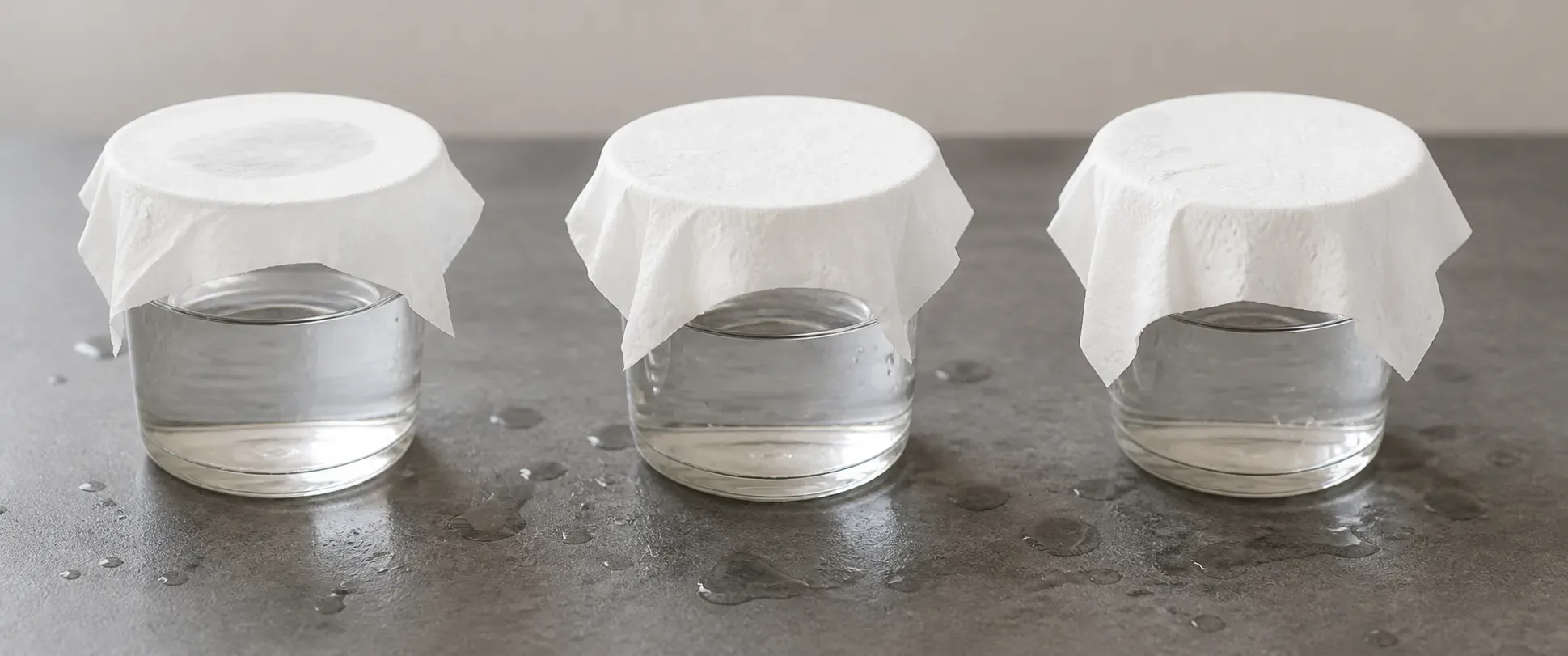
Toilet paper absorbency should be measured under controlled conditions using representative samples and consistent test procedures. Hand tests can help with preliminary product screening, but they are not reliable enough for supplier qualification or specification approval. Samples should be conditioned, cut to the same dimensions, and compared by dry weight, absorbed liquid weight, absorption time, and relevant strength properties.
ISO 12625-8 is commonly used to evaluate the water-absorption time and water-absorption capacity of tissue paper and tissue products. Related tissue test methods can be used to assess thickness, grammage, tensile strength, and other properties. The chosen protocol should be documented so that results from different production batches remain comparable.
A Practical Comparison Method
A useful comparison starts with embossed toilet paper and plain toilet paper made from the same or closely matched base tissue. Each sample should have the same ply count, sheet area, and basis weight. After conditioning, multiple specimens are tested rather than relying on one sheet. The average result is then reported together with the range or variation.
You should record both absorption capacity and absorption time. Thickness, dry tensile strength, ply bonding, and dispersibility can be added when the product is being developed for retail or private label use. This broader evaluation prevents a product from gaining absorbency at the expense of softness, sheet integrity, or flush performance.
How To Choose An Embossing Pattern For Your Toilet Paper Product
Choose an embossing pattern according to the target product position, ply construction, base-sheet characteristics, and required performance. A premium retail roll may need a visible full-width pattern with controlled softness, while a hotel or commercial product may prioritize consistent dispensing, compact roll dimensions, and cost efficiency. The pattern should improve function without weakening the tissue or reducing dispersibility.
Decorative embossing can also support brand recognition. Geometric motifs, floral patterns, logos, and border designs can distinguish private label toilet paper at the point of sale. Branding should not dominate the engineering decision, however. Pattern coverage, depth, repeat distance, and pressure must remain compatible with the tissue web.
Before production, specify the target ply count, basis weight, roll diameter, sheet size, roll length, perforation interval, core size, packaging format, and expected absorbency level. You should also confirm whether the embossing is decorative, functional, or intended to serve both purposes.
Conclusion
Embossed toilet paper typically absorbs better than plain toilet paper because its three-dimensional texture increases effective surface area, creates moisture-holding pockets, and supports liquid distribution. In multi-ply toilet tissue, embossing can also improve layer stability and produce a softer, bulkier hand feel. The actual difference depends on fiber furnish, basis weight, ply count, pattern geometry, embossing pressure, and converting quality.
Liansheng Sempo manufactures toilet tissue for brand owners, distributors, retailers, hospitality buyers, and private label programs. If you need to compare embossing patterns, develop custom embossed toilet paper, or confirm absorbency and product specifications for your market, contact Liansheng Sempo to discuss sampling, packaging, and production requirements.
Frequently Asked Questions
Q.
What is embossed toilet paper?
A.
Embossed toilet paper is tissue that has been pressed between patterned rollers to create raised and recessed areas. The texture can improve bulk, softness, liquid distribution, ply stability, and appearance.
Q.
Why is toilet paper embossed?
A.
Toilet paper is embossed to create a thicker hand feel, improve absorbency, help multi-ply sheets remain aligned, and add a decorative or branded pattern.
Q.
Is embossed toilet paper more absorbent?
A.
Usually, yes. When fiber content, basis weight, ply count, and sheet size are comparable, embossed toilet paper generally holds slightly more liquid because it has greater surface area and additional internal spaces.
Q.
Does thicker toilet paper absorb more?
A.
Thicker toilet paper often absorbs more, but thickness alone is not a guarantee. Fiber quality, basis weight, ply count, sheet formation, and embossing structure also affect absorption capacity.
Q.
Is two-ply toilet paper more absorbent than one-ply?
A.
Two-ply toilet paper is usually more absorbent per sheet because it contains an additional tissue layer. However, a heavy or high-quality one-ply product may outperform a lightweight two-ply product in some tests.
Q.
Does embossing make toilet paper softer?
A.
Embossing can make toilet paper feel softer by creating a cushioned surface and reducing flat contact against the skin. Actual softness also depends on fiber furnish, creping, calendering, and embossing pressure.
Q.
Does deeper embossing mean better absorbency?
A.
Not necessarily. Moderate embossing can improve surface area and bulk, but excessive depth or pressure may compress fibers, weaken the sheet, or create a rougher surface.
Q.
Is embossed toilet paper septic-safe?
A.
Embossing by itself does not determine septic safety. Septic suitability depends on how quickly the complete tissue product disperses in water. An embossed product should be tested for breakdown and used according to local wastewater guidance.
Q.
Does embossed toilet paper dissolve more slowly?
A.
It can, especially if embossing creates strong ply bonding or the product uses more fiber. However, properly designed embossed toilet paper can still disperse effectively. Ply count, fiber treatment, additives, and sheet strength also influence breakdown time.
Q.
Is plain toilet paper better for plumbing?
A.
Not automatically. Plain tissue may be thinner, but plumbing suitability depends mainly on dispersibility, the amount used, and the condition of the drainage system. Embossed and plain products should be evaluated using the same breakdown criteria.
Q.
How is toilet paper absorbency measured?
A.
Absorbency is measured by recording how much water a conditioned tissue sample absorbs and how quickly absorption occurs. ISO 12625-8 is a commonly used method for tissue water-absorption time and capacity.
Q.
What is the best embossing pattern for toilet paper?
A.
There is no single best pattern. The appropriate design depends on the base tissue, ply count, desired softness, absorbency target, branding requirements, production equipment, and price position.


