
Clean packaging tissue paper can often be recycled, but acceptance depends on your local recycling facility. Plain tissue paper without foil, glitter, plastic film, tape, or heavy coatings may also be suitable for home or commercial composting. If neither option is available, it should go in general waste.
Used facial tissues, toilet tissue, and tissue contaminated with food, oil, cosmetics, or cleaning products should not be placed in paper recycling.
Reuse tissue paper first. If it is clean, check whether your local recycling program accepts it. If recycling is unavailable, plain, uncoated tissue paper may be composted. Tissue paper containing synthetic decorations, plastic coatings, or unknown additives belongs in general waste.
Key Takeaways
- Packaging tissue paper is technically recyclable because it is made from paper fibers.
- Not every material recovery facility accepts it because tissue paper has short fibers and can be difficult to sort.
- Clean, plain tissue paper is generally the easiest type to recycle or compost.
- Foil, glitter, plastic laminates, tape, and metallic decorations can prevent recycling and composting.
- Heavily dyed or fully printed tissue paper should only be composted when the inks and finished product are confirmed as suitable.
- Used facial tissue and other hygiene paper should not enter paper recycling.
- Local collection rules take priority over recycling symbols or general packaging claims.
- Reusing tissue paper usually preserves more value than immediately recycling or composting it.
Is Tissue Paper Recyclable?
Tissue paper is recyclable in principle, but it is not universally accepted in curbside or kerbside recycling. Clean packaging tissue paper can be repulped, allowing its fibers to be used in another paper product. However, whether you can place it in your recycling bin depends on the equipment, sorting process, and end markets available to your local waste provider.
Unlike cardboard or office paper, tissue paper is lightweight and made from relatively short fibers. Small or crumpled sheets may be difficult for automated sorting equipment to identify. They can fall through screens, become mixed with other materials, or be treated as residue. Some recycling facilities therefore exclude tissue paper even though it is technically a paper product.
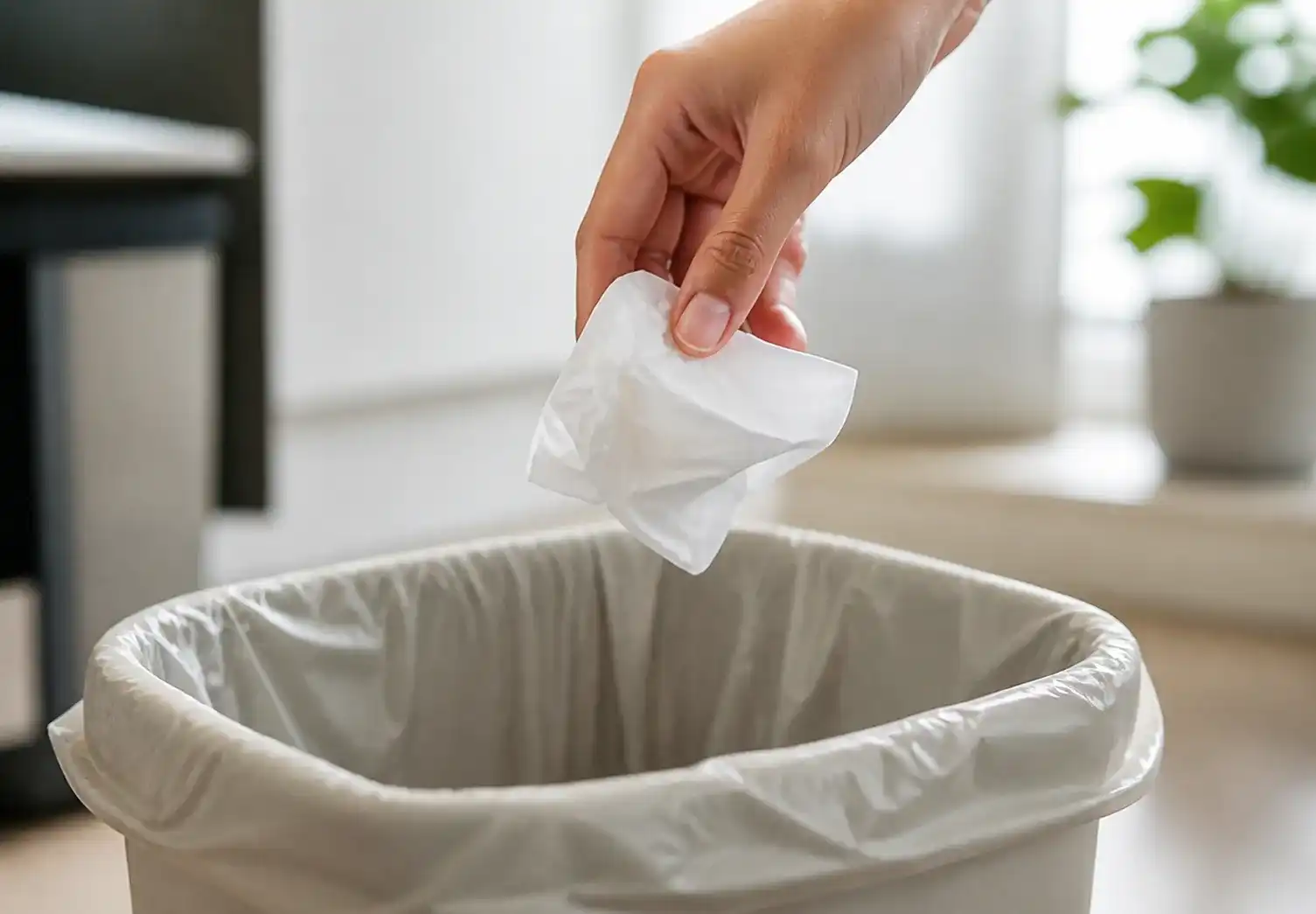
Why Some Recycling Facilities Reject Tissue Paper
A facility needs to collect, identify, bale, and sell each material it accepts. Tissue paper has less recoverable fiber than heavier grades of paper, and repeated recycling shortens the fibers further. This can reduce its market value.
Thin sheets can also cause operational problems. Loose pieces may wrap around equipment or travel with the wrong material stream. A recycler using advanced optical sorting may handle tissue paper differently from a smaller facility using mechanical screens and manual sorting.
| Tissue paper condition | Recycling suitability |
|---|---|
| Clean, plain, uncoated packaging tissue | Often recyclable |
| Lightly printed tissue with compatible ink | Sometimes recyclable |
| Tissue with tape or labels | Limited |
| Foil- or glitter-decorated tissue | Usually unsuitable |
| Plastic-coated or laminated tissue | Usually unsuitable |
| Wet, greasy, or food-contaminated tissue | Not suitable |
| Used facial or hygiene tissue | Not suitable |
Can Recycled Tissue Paper Be Recycled Again?
Yes, clean recycled tissue paper may be recycled again if your local facility accepts it. Paper fibers do not remain usable indefinitely, however. Every pulping cycle makes them shorter and weaker, so recycled fibers eventually need to be combined with longer fibers or directed into lower-grade paper products.
The amount of recycled content does not determine local acceptance on its own. Tissue paper made with virgin fiber and tissue paper made with recycled fiber may face the same sorting restrictions. Recycled content improves the material’s upstream environmental profile, while local infrastructure determines what happens at the end of its useful life.
How To Prepare Tissue Paper For Recycling
Keep the tissue paper clean and dry. Remove ribbons, bows, adhesive labels, plastic windows, stickers, and tape before placing it in the paper stream. Do not put tissue paper inside a plastic bag unless your local collection service specifically requests bagged recyclables.
Local instructions may differ on whether sheets should be folded, left loose, or grouped with other paper. Avoid shredding them into smaller pieces because small fragments are harder to recover. If your municipality does not list tissue paper among accepted materials, contact the recycler rather than relying only on a recyclable logo.
Is Tissue Paper Compostable?
Plain tissue paper made only from paper fiber is generally compostable. It can contribute carbon-rich “brown” material to a compost pile and help absorb moisture from food scraps and other nitrogen-rich materials. Before composting it, remove tape, labels, ribbons, plastic film, foil, glitter, and other non-paper components.
Material biodegradability does not guarantee acceptance by a commercial composting facility. Industrial operators set their own rules based on processing time, contamination risks, certification requirements, and the markets for their finished compost. Some facilities accept plain tissue paper, while others accept only food-soiled paper or certified compostable products.

How To Compost Tissue Paper At Home
For home composting, tear plain tissue paper into manageable pieces and mix it through the pile rather than leaving it in a dense bundle. Combining it with food scraps, grass clippings, and other moist materials helps maintain a workable balance between carbon and nitrogen.
A compressed layer of tissue paper may restrict airflow and slow decomposition. If the compost becomes too dry, add moisture; if it becomes wet or develops an unpleasant odor, mix in dry leaves, cardboard, or a modest amount of clean tissue paper.
Check The Surface Treatments First
Compost only tissue paper whose materials you understand. Metallic foil, conventional glitter, plastic lamination, and synthetic decorative particles may remain in the compost after the paper fibers break down. These residues can introduce persistent fragments into soil.
A glossy appearance can indicate a coating, but appearance alone is not a reliable test. Ask the supplier for information about coatings, colorants, printing methods, and ink systems. If the composition cannot be confirmed, recycling or general waste may be more appropriate than composting.
Can Printed Or Colored Tissue Paper Be Composted?
Lightly printed tissue paper may be compostable when the ink and finished paper are suitable for that disposal route. Water-based or soy-based ink descriptions can be useful procurement indicators, but those terms alone do not prove that every pigment, additive, or finished print is suitable for compost.
Exercise greater caution with flood-coated tissue paper, saturated colors, metallic ink, toner printing, and full-surface designs. Where composting is a stated packaging objective, request supporting documentation for the complete printed product—not just the base paper. If suitability is uncertain, follow the local composter’s guidance.
Is Tissue Paper Biodegradable?
Plain tissue paper is biodegradable because microorganisms can break down its cellulose fibers under suitable environmental conditions. The rate depends on moisture, temperature, oxygen, microbial activity, sheet thickness, coatings, and whether the tissue is exposed or compressed.
“Biodegradable” should not be treated as permission to litter. A material can biodegrade eventually while still remaining in the environment long enough to cause harm. Tissue paper should always be reused, recycled, composted, or disposed of through a managed waste system.
Biodegradable And Compostable Are Not Identical Claims
Biodegradable describes a material’s ability to break down through biological activity. The does not necessarily identify a timeframe, disposal system, or quality standard for the resulting material. Compostable usually refers to decomposition under defined composting conditions without leaving unacceptable residues.
A paper product may be naturally biodegradable but still be rejected by a commercial composting facility. It may also contain inks, adhesives, or decorative elements that complicate composting. Businesses should avoid making broad environmental claims unless they apply to the finished product and are supported in the markets where the packaging is sold.
What Is The Best Way To Dispose Of Tissue Paper?
The preferred order is usually reuse, local recycling, appropriate composting, and then general waste. This sequence is not absolute, because contamination and regional infrastructure matter. A clean sheet may be reusable or recyclable, while a foil-decorated sheet may need to be discarded even if the paper layer itself is biodegradable.
When you receive tissue paper in a gift bag or shipping box, inspect it before choosing a bin. Keep intact sheets for future wrapping or storage. For damaged but clean sheets, check the local recycling directory. Use composting only for plain tissue paper that meets your home or commercial composter’s requirements.
- Is it clean and intact? Reuse it for gift wrapping, product storage, crafts, or protective layering.
- Is it plain paper without synthetic additions? Check whether your local recycling service accepts tissue paper.
- Does recycling reject it? Ask whether your local composting service accepts plain paper tissue.
- Does it contain foil, glitter, plastic coating, tape, or unknown additives? Place it in general waste unless a specialist program says otherwise.
- Is it wet, greasy, or used for hygiene? Do not place it in paper recycling.
Finding The Most Sustainable Tissue Paper
Sustainable tissue paper should be assessed across its full specification rather than through a single claim. Consider fiber source, recycled content, manufacturing efficiency, printing, coatings, product weight, shipping distance, reuse potential, and realistic end-of-life options.
For packaging applications, a lightweight tissue paper that protects the product with minimal material can be preferable to a heavier alternative. However, reducing weight should not compromise performance to the point that additional sheets are required. Sampling and packaging tests help determine the appropriate basis weight for wrapping, interleaving, presentation, and void-filling scenarios.
1. Choose Recycled Content Carefully
Tissue paper containing recycled fiber can reduce demand for virgin raw materials and provide a market for recovered paper. When comparing options, distinguish between pre-consumer and post-consumer recycled content. Post-consumer fiber comes from products used and recovered by households or businesses, while pre-consumer fiber generally comes from manufacturing offcuts and production waste.
Ask suppliers for the percentage and type of recycled content rather than relying on a generic recycled symbol. Also review color consistency, strength, rub resistance, odor, and print performance. Recycled tissue paper may have natural shade variation, which can be acceptable or even desirable depending on your packaging design.
2. Avoid Unnecessary Additions
Foil stamping, plastic glitter, lamination, metallic films, and mixed-material decorations can create a premium appearance, but they often restrict end-of-life options. If your objective is recyclable or compostable tissue paper, use design elements that do not interfere with the paper stream.
Minimal printing can provide brand recognition without covering the entire sheet. Repeating logos, line artwork, and limited-color patterns usually use less ink than flood-coated designs. The final choice should reflect both your visual requirements and the disposal guidance you intend to provide.
3. Review Ink And Printing Methods
Ask whether the tissue paper is printed with water-based, soy-based, oil-based, UV-curable, or toner-based systems. Each category includes different formulations, so the general ink label should not replace documentation about the specific product.
Printing performance matters as well. Tissue paper is thin and absorbent, making ink control, registration, drying, and rub resistance important. A suitable supplier should help you balance coverage, color accuracy, transfer risk, and end-of-life requirements before full production.
What About Shredded And Spiral Paper Void Fill?
Paper void fill may be recyclable or compostable, but its format affects collection. Conventional shredded paper is often excluded from curbside recycling because small strips are difficult to sort and can contaminate other material streams. Some programs accept it only when contained in a paper bag, while others direct it to composting or general waste.
Spiral-cut or interconnected paper fill may be easier to handle because the pieces remain larger and produce less loose dust. Even so, local acceptance is not guaranteed. The paper’s width, coatings, inks, and collection format can all influence whether a facility recovers it.
Tissue Paper Versus Paper Void Fill
Tissue paper is useful for wrapping, surface protection, presentation, and separating lightweight products. Structured paper void fill is designed to occupy empty space and restrict movement inside a shipping carton. They serve different packaging functions and should be selected according to the product’s weight, fragility, and distribution conditions.
If you need both presentation and protection, avoid adding layers without testing them. A transit test may show that fewer sheets, a better carton size, or a structured paper insert provides the required protection with less overall material. Sustainable packaging begins with reduction, not simply replacing one material with another.
Conclusion
Tissue paper can be recyclable, compostable, and biodegradable, but those terms are not interchangeable and do not override local collection rules. For the best outcome, choose clean paper-based designs, reduce unnecessary coatings and decorations, provide accurate disposal instructions, and encourage customers to reuse each sheet before discarding it.
Liansheng Sempo manufactures tissue paper for packaging, wrapping, retail, and eCommerce applications. If you need help selecting paper specifications, recycled content, sheet sizes, printing options, or custom tissue paper for your packaging scenario, contact the Liansheng Sempo team to discuss your requirements and request samples.
Frequently Asked Questions
Can Tissue Paper Go In The Recycling Bin?
Clean packaging tissue paper can go in the recycling bin only if your local program accepts it. Remove tape, labels, ribbon, foil, glitter, and plastic components first. Used facial tissues should not be recycled.
Why Is Tissue Paper Sometimes Not Recyclable?
Tissue paper has short fibers, low material value, and a lightweight format that can be difficult for recycling equipment to sort. Some facilities accept it, while others treat it as residue.
Can Colored Tissue Paper Be Recycled?
Some colored tissue paper is recyclable if it is clean and free from coatings or synthetic decorations. Dark, saturated, metallic, laminated, or heavily printed tissue may not be accepted. Check local rules and supplier specifications.
Can Tissue Paper Go In Compost?
Plain, uncoated paper tissue can generally be composted. Do not compost tissue paper containing foil, plastic glitter, lamination, tape, or unknown decorative coatings. Commercial facility rules may differ.
Is Gift Tissue Paper Biodegradable?
Plain gift tissue paper made from cellulose fiber is biodegradable. Coatings, plastic film, glitter, metallic decoration, and adhesives may not biodegrade with the paper.
How Long Does Tissue Paper Take To Decompose?
There is no fixed timeframe. Decomposition depends on moisture, oxygen, temperature, microbial activity, sheet thickness, and coatings. Tissue paper usually breaks down faster in an active compost pile than in a dry landfill or as unmanaged litter.
Can You Recycle Tissue Paper With Tape On It?
Remove the tape before recycling. Small amounts may be separated during processing, but tape adds contamination and can reduce the quality of recovered paper.
Can Wet Tissue Paper Be Recycled?
No. Wet paper can lose fiber quality, stick to other recyclables, and create contamination. Compost plain wet tissue if appropriate, or place it in general waste.
Is Tissue Paper Made From Recycled Paper Still Recyclable?
It can be, provided it is clean and accepted by the local recycling facility. Recycled content does not automatically guarantee local recyclability.
Are Paper Towels And Facial Tissues Recyclable?
Generally, no. Their fibers are very short, and used products may contain moisture, food residue, cosmetics, or biological contamination. Follow local composting or general-waste guidance.
Is All Water-Based Ink Compostable?
No. “Water-based” describes the ink carrier system, not every pigment and additive in the formulation. Ask for evidence relating to the specific ink and finished printed tissue paper.
Should Tissue Paper Be Recycled Or Composted?
Reuse it first. If your local recycler accepts clean tissue paper, recycling usually keeps the fiber in circulation. If recycling is unavailable, compost plain, uncontaminated tissue paper where accepted.


