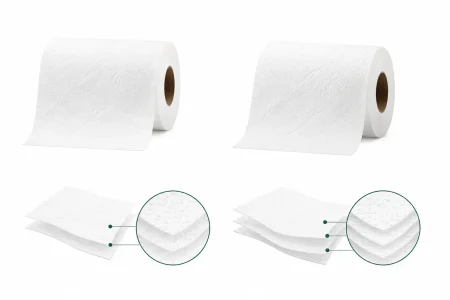
How wide is a toilet paper roll? The short answer is that most household rolls are close to 3.7 to 4.5 inches wide, or approximately 94 to 114 mm. That range is useful for orientation, but it is not a universal standard. A retail roll, hotel roll, jumbo roll, and dispenser-specific commercial roll can all use different dimensions.
The question also becomes confusing because people use the words width, height, sheet size, tube length, and diameter interchangeably. They are related, but they describe different parts of the product. If you are only replacing a roll at home, an approximate answer may be enough. If you are developing a private-label SKU, selecting a dispenser, every dimension needs to be identified before a sample is approved.
The Toilet Paper Roll Width
For household toilet paper, a practical reference is about 94-114 mm (3.7-4.5 in) from one flat cut side of the finished roll to the other. Many current products sit near 100-110 mm, while some wider formats are closer to 114 mm.
| Term | What you measure | Why buyers care |
|---|---|---|
| Roll width / roll height | The straight side-to-side distance across the finished roll | Sheet feel, holder width, wrap size, pack dimensions |
| Sheet width | The width of one perforated tear-off sheet | Usually follows roll width in household rolls |
| Outer diameter | The round face-to-face size of the wound roll | Holder clearance, roll capacity, and rotation |
| Core diameter | The inside opening of the cardboard tube | Spindle and commercial dispenser compatibility |
| Sheet length | The tear-off distance from perforation to perforation | Total linear feet and usage value |
Standard Toilet Paper Roll Widths in Inches and Millimeters
There is no single worldwide toilet paper width. Converters set the finished format around the target market, parent roll, packaging equipment, dispenser design, and the brand’s price and comfort position.
| Product format | Practical width reference | Approximate imperial range | What to verify |
|---|---|---|---|
| Narrow household roll | 94-102 mm | 3.7-4.0 in | Sheet comfort, pack dimensions, and local expectations |
| Common household roll | 100-110 mm | 3.9-4.3 in | Holder fit, sheet size, and repeat-order consistency |
| Wider household or private-label roll | 110-114 mm | 4.3-4.5 in | Paper usage, retail artwork, and carton layout |
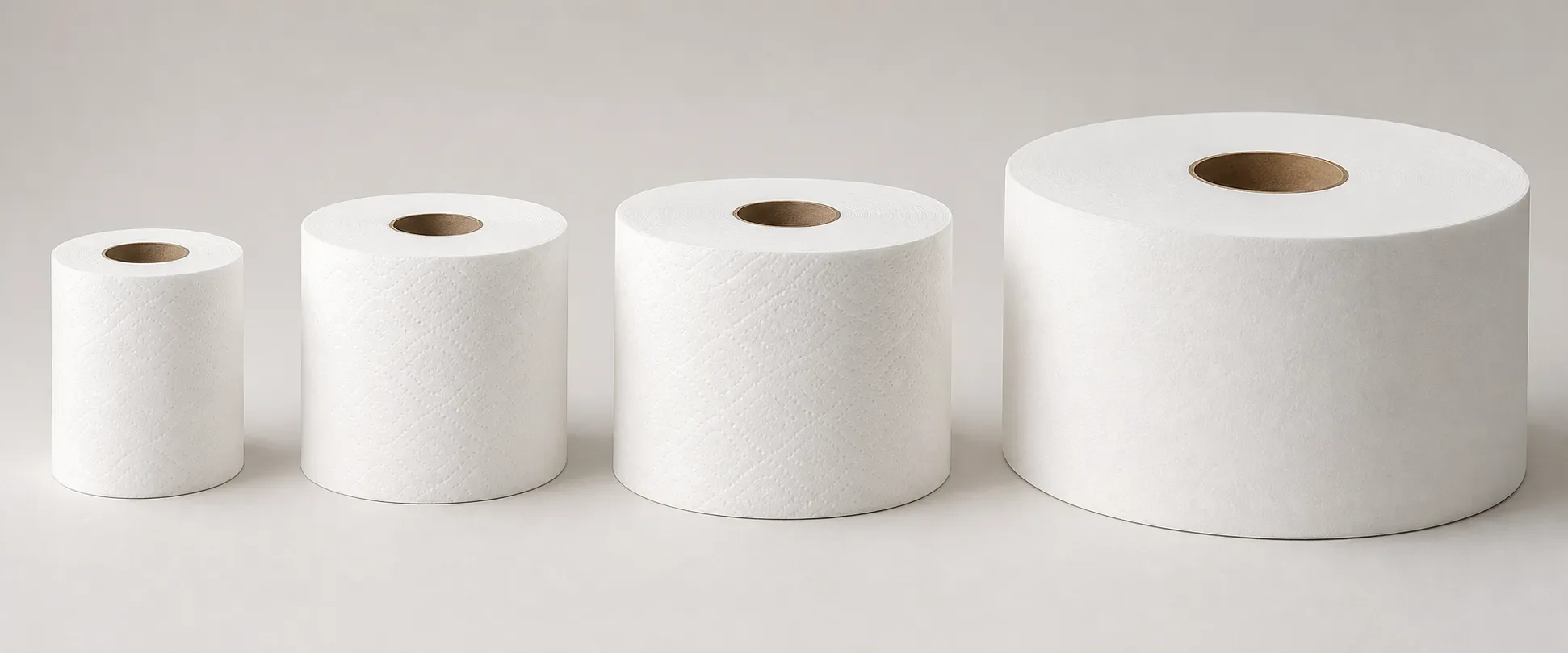
| Mega or double roll | Often similar to household width | Often around 4 in | Usually a larger diameter or higher sheet count, not a wider sheet |
| Commercial jumbo roll | Dispenser dependent, often about 89-114 mm | About 3.5-4.5 in | Width, outer diameter, core, and dispenser clearance together |
Different markets can use different proportions even when the product is sold under the same name. North American household rolls are often seen around 4.0-4.5 inches. European retail products commonly fall near 95-105 mm. Some Japanese retail formats are near 110-114 mm, although sheet length and total roll length can differ from Western products. Southeast Asian and Middle Eastern products vary widely by country and price tier. Commercial away-from-home rolls are designed around a dispenser model rather than a consumer shelf convention.
Is 4 Inches or 4.5 Inches More Common?
Both numbers appear in product discussions. Older household references often describe sheets near 4.5 by 4.5 inches, while many newer products use sheets closer to 4 inches wide or slightly narrower.
Reducing the sheet width from 114 mm to 105 mm changes the paper area used per sheet, the width of an individual wrap, the arrangement of rolls inside a pack, the carton footprint, and the way the product feels in use.
Roll Width, Sheet Width, Diameter, and Core Size
| Specification | Example value | What it controls |
|---|---|---|
| Roll width / height | 100, 105, or 110 mm | Finished side-to-side size and sheet width |
| Sheet size | 105 x 100 mm | Width and tear-off length of each sheet |
| Outer diameter | 100, 110, or 120 mm | How much room the roll needs in the holder |
| Core diameter | 38, 40, or 45 mm | Whether the spindle or dispenser accepts the roll |
| Sheets per roll | 200, 300, or another approved count | Total sheet count and retail value claim |
| Sheet length | 90-110 mm | Total paper length and consumption comparison |
In most perforated household rolls, sheet width is close to finished roll width because the parent web is slit to the target width before the sheets are perforated and rewound. Edge trim, compression, and the way a supplier records its measurements can otherwise create an avoidable disagreement.
How Toilet Paper Width Is Created During Converting
Finished roll width is not chosen after the product is packed. It is built into the converting process. A tissue mill supplies a large parent roll, and a converting line slits that web into narrower lanes, embosses and laminates the plies, adds perforations, winds the paper onto a core or forms a coreless roll, and cuts the log into finished rolls.
Each stage can affect the final measurement. Slitter settings determine the target width; embossing can increase bulk; rewinding tension influences how firmly the roll is built; cutting can leave a small edge variation; and compression in a bag or carton can make a finished roll temporarily narrower or wider. This is why a responsible supplier provides a tolerance instead of promising that every roll will measure exactly the same to the last fraction of a millimeter.
For a private-label project, ask the supplier to state the nominal width and the acceptable production tolerance, for example: 105 mm nominal, with the agreed tolerance shown on the specification sheet. The exact tolerance should be set by the factory and the buyer after the product, packaging, and dispenser have been tested.
How to Measure Toilet Paper Roll Width Correctly
Use a loose roll, not a roll still inside plastic film or a paper band. The package can add several millimeters and can hide compression from transport.
- Remove the roll from its retail packaging.
- Let a compressed sample regain its normal shape for a short time.
- Place the roll on a clean, flat surface with one cut side facing you.
- Measure straight from one flat cut side to the opposite cut side.
- Use a ruler for a quick check or a caliper for a quality-control inspection.
- Record millimeters first, then convert to inches if required by the buyer or artwork team.
- Measure several rolls from the same batch and compare the average and the spread.
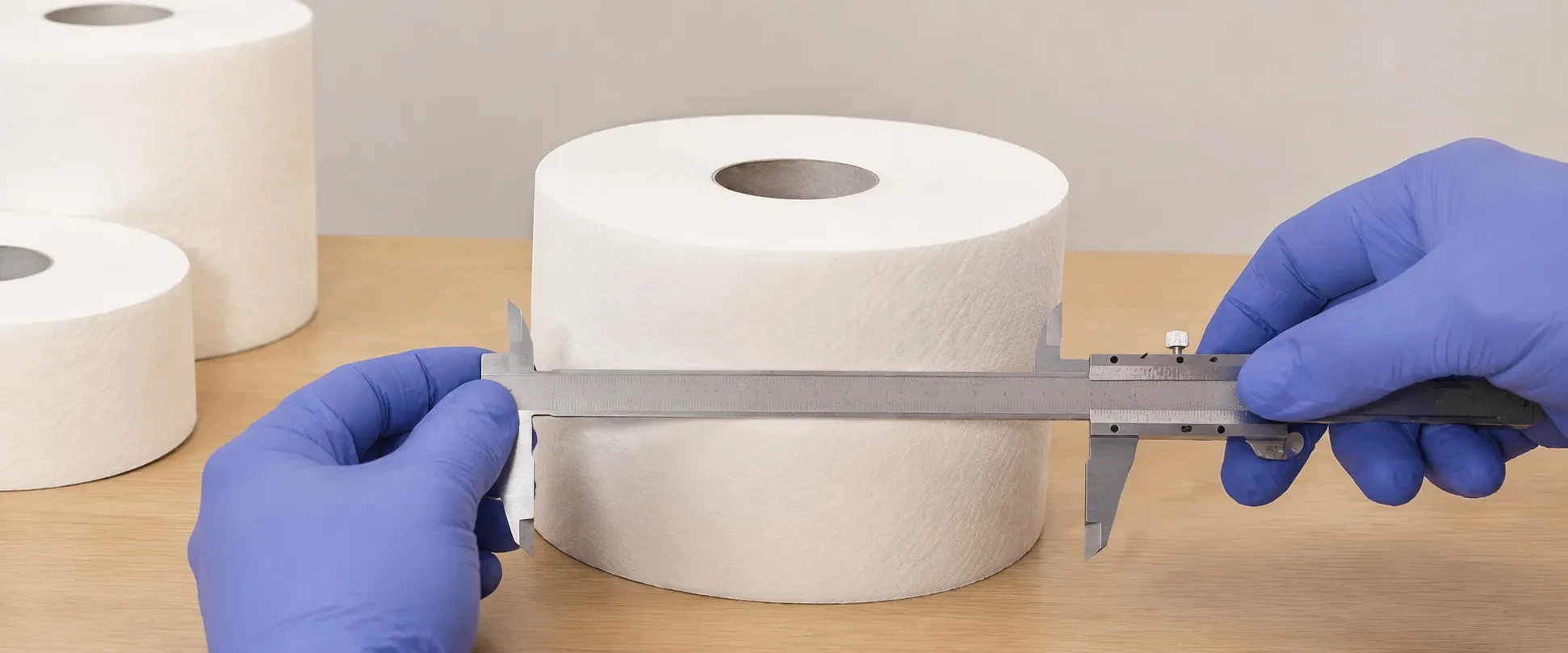
Do not measure across the circular face; that is the outer diameter. Do not measure the hole in the middle; that is the core diameter. If the roll is oval because of carton pressure, take two measurements at right angles and note the condition instead of silently choosing the larger number.
Why does a change in width have an impact?
A difference of 5-10 mm may look minor. For a buyer ordering thousands of packs, the width is connected to several other calculations:
- Paper usage: sheet area is approximately sheet width multiplied by sheet length. Ply and sheets per roll then change the total paper area.
- Packaging: individual wrap width, bag width, printed film, paper bands, and retail pack dimensions must be redrawn when the roll format changes.
- Cartons and pallets: a different roll width can change the number of rolls per row, carton dimensions, container loading, and pallet stability.
- Dispenser fit: commercial rolls must rotate freely, clear the side walls, and match the spindle or axle.
- Customer expectation: a narrower sheet can change the perceived value even when the label shows a similar sheet count.
- Repeat orders: a later width change can make approved packaging, dispenser tests, and previous quotations inaccurate.
Do not compare two offers only by price per roll. Compare the roll width, sheet size, sheet length, sheets per roll, ply, GSM, total paper length, packaging, and carton quantity as one specification.
Are Mega and Jumbo Rolls Wider?
Usually not in the way shoppers expect. A mega or double roll often keeps a familiar household width and adds more sheets, more total paper, or a larger outer diameter. The roll looks bigger on the holder because it is thicker, not because each sheet is wider.
Jumbo rolls for public washrooms are a different category. Their width may be selected to suit a particular dispenser, while the diameter and core are increased to provide longer service intervals. Before ordering a jumbo format, confirm:
- finished roll width;
- maximum outer diameter allowed by the dispenser;
- core diameter, coreless design, or adapter requirement;
- sheet length and perforation pitch;
- roll weight and carton quantity;
- clearance for free rotation and stub-roll transfer.
Tube Length, Core Diameter, and Roll Width
The cardboard tube runs across the roll, so its tube length is normally close to the finished roll width. The hole inside that tube is a different measurement called core diameter. A buyer asking for “tube width” may therefore be asking for tube length, while a dispenser engineer may actually need the core diameter.
| Wording | Meaning | Term to use |
|---|---|---|
| Toilet paper roll width | Finished side-to-side dimension | Roll width or roll height |
| Tube width | Length of the cardboard tube | Tube length or roll width |
| Tube diameter | Size of the opening | Core diameter |
| Core size | Inner opening and sometimes coreless format | Core diameter and core type |
Private-Label Approval Workflow for Roll Width
- Define the use case: retail household, hotel, office, public washroom, or jumbo dispenser.
- Set the target format: roll width, sheet size, sheet length, ply, GSM, sheets per roll, diameter, and core.
- Check the sample: measure several rolls and test the holder or dispenser.
- Approve packaging: confirm that the roll width, number of rolls, wrap, bag, carton, and pallet plan match the sample.
- Confirm production controls: record the nominal value, tolerance, inspection method, and approved reference sample.
- Recheck repeat orders: compare the first production rolls with the approved sample before shipment.
Need a Custom Toilet Paper Roll Width?
Sempo supports household and commercial toilet paper programs with configurable roll width, sheet size, ply, GSM, core options, embossing, perforation, packaging, and private-label production. Share your market, dispenser or holder requirements, target sheet size, and packing plan so the finished format can be checked before mass production.
Explore Sempo toilet paper options or contact the team for a specification review and quotation.